wayground logo

Free Printable Worksheets

NEW

Font size

S
M
L
XL
Worksheets

Energy Transfers

Total questions: 55

Worksheet time: 1hrs 17mins
Name
Class
Date
1.
Heat is the movement of ______.
a)
radiation
b)
thermal energy
c)
cold
d)
fire
2.
Heat from the sun travels to Earth by _____.
a)
conduction
b)
convection
c)
insulation
d)
radiation
3.
On a hot summer day, which shirt would you put on to make sure you stay cool while you are outside playing?
a)
A black shirt because it reflects the sun's energy.
b)
A white shirt because it reflects the sun's energy.
c)
A black shirt because it absorbs the sun's energy.
d)
A white shirt because it absorbs the sun's energy.
4.
Energy of motion is which type of energy?
a)
Potential
b)
Kinetic
c)
Sound
d)
Gravitational
5.
What type of energy is in this picture?
a)
Kinetic
b)
Potential
c)
Chemical
d)
Sound
6.
When plants convert the sun's energy into food, which type of energy is it?
a)
kinetic
b)
chemical
c)
thermal
d)
radiant
7.
A battery converts what type of energy to another?
a)
sound to kinetic
b)
light to heat
c)
mechanical to electrical
d)
chemical to electrical
8.
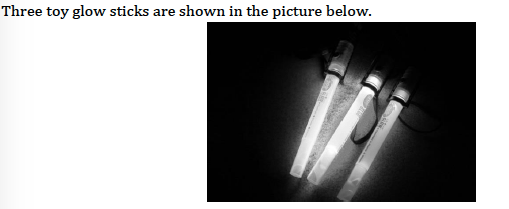
The glow sticks produce light for a short amount of time. The light from the glow stick is a conversion from what to what?
a)
thermal to light
b)
gravitational to potential
c)
radiant to electrical
d)
chemical to light
9.
Wind turbines and windmills convert what energy to another?
a)
Kinetic to electric
b)
Gravitational potential to electric
c)
Mechanical to potential
d)
Thermal to sound
10.

Heat always travels from...

a)

Warm to cool

b)

Cool to warm

c)

Warm to warm

d)

Cool to cool

11.

A hot air balloon rising is an example of ...

a)

conduction

b)

convection

c)

radiation

d)

connection

12.

Which of the following correctly identifies a method of heat transfer that will happen in this situation?

a)

Heat will be transferred from the hot plate to the thermometer through radiation.

b)

Heat will be transferred from the beaker to the thermometer through convection.

c)

Heat will be transferred from the hot plate to the beaker through convection.

d)

Heat will be transferred from the thermometer to the beaker through conduction.

13.

Conduction can only occur between two objects when–

a)

one object is less dense than the other.

b)

both objects are in physical contact with each other.

c)

one of the objects is made of a metal.

d)

both objects are exactly the same temperature.

14.

Feeling warmth on your hands when you hold them near a campfire is an example of ____________________________.

a)

radiation

b)

conduction

c)

convection

d)

conductors

15.

All sounds are made by ............. objects.

a)

warm

b)

cold

c)

vibrating

16.

.............. is measure of how high or low a sound is.

a)

Pitch

b)

Temperature

c)

Length

17.

Sound waves cannot travel through ...................

a)

solid

b)

liquid

c)

Gases

d)

Vacuum

18.

What medium does sound travel the fastest in?

a)

Solid

b)

Liquid

c)

Gas

d)

Vacuum

19.
In what direction does sound travel?
a)
Straight 
b)
ZigZag
c)
All Directions 
d)
Diagonal 
20.
Which wavelength has the higher frequency? 
a)
Top Wavelength
b)
Bottom Wavelength
c)
Both 
21.
Which wavelength has the louder sound? 
a)
Top Wavelength 
b)
Bottom Wavelength
c)
Both
22.
Which wavelength has the highest PITCH?
a)
Top Wavelength
b)
Bottom Wavelength 
c)
Both 
23.
Which wavelength do you think has the least amount of energy? 
a)
Top Wavelength
b)
Bottom Wavelength 
c)
Both 
24.
What do you call the bottom of a wave? 
a)
Truth
b)
Truck
c)
Trough 
d)
Trench
25.
The amplitude determines the ________ of sound
a)
Pitch
b)
Loudness
c)
Frequency 
d)
Lions 
26.
White light is made up of _________________ colors.
a)
10
b)
3
c)
7
d)
70
27.
Light travels at ___________________ km per second.
a)
30
b)
300,000
c)
15
d)
1,000,00
28.

Light is a form of ______________________

a)

electric energy

b)

electromagnetic energy

c)

sound energy

d)

heat energy

29.
Light that bounces back has been _______________
a)
transferred
b)
heated up
c)
absorbed
d)
reflected
30.
Which of the following items would most likely reflect light?
a)
tree
b)
mirror
c)
horse
d)
brick wall
31.
Light that bends has been ____________________
a)
teleported
b)
reflected
c)
charged
d)
refracted
32.

Light can travel through empty vacuum.

a)

True

b)

False

33.
Light travels in ___________________
a)
waves
b)
sound
c)
packs
d)
thunder
34.

A lens that is thicker in the center and thinner at the edges and bends light inwards is a ____________________

a)

concave lens

b)

convex lens

35.

Al lens that is thinner in the center and thicker at the edges and bends light outward is a _______________________

a)

concave lens

b)

convex lens

36.

A reflected light ray makes an angle of 60 degrees with a mirror's surface. What angle did the incoming light ray form with the mirror's surface?

a)

30

b)

60

c)

90

d)

180

37.

Which determines the color of an object?

a)

Absorption

b)

Diffraction

c)

Reflection

d)

Refraction

38.

Which type of wave is light?

a)

Diffusion

b)

Transverse

c)

Longitudinal

d)

Compression

39.

An object that absorbs all the colors in the visible spectrum will appear?

a)

invisible

b)

red

c)

black

d)

white

40.

When a light wave is refracted and its moving from liquid to gas, its speed will ____.

a)

increase

b)

decrease

41.

A wave is refracted when it changes speed. As the light moves from gas to liquid it bends ____ the normal line.

a)

away

b)

towards

42.
What is the popular name for an electrochemical cell? Choose one answer. 
a)
 A fuel cell.
b)
A catalytic cell. 
c)
A battery.
d)
A galvanometer
43.

A battery is

a)

Electricity generated from water

b)

Electricity created from wind

c)

one or more cells connected together

d)

Can only be used once

44.

an _____________ stops the flow of electricity

a)

conductor

b)

insulator

45.

A _______________ allows electricity to flow

a)

insulator

b)

conductor

46.

What is the Law of Conservation of Energy?

a)

law that requires you to save energy

b)

energy can be created and can be destroyed

c)

energy cannot be created or destroyed

d)

fake news

47.

What type of circuit is this?

a)

series

b)

simple

c)

open

d)

parallel

48.

What kind of circuit is this?

a)

series

b)

parallel

c)

simple

d)

open

49.

Copper wire is an example of a _________________

a)

conductor

b)

insulator

50.

What happens if a bulb goes out in a parallel circuit?

a)

all bulbs go out

b)

the battery dies

c)

other bulbs stay lit

d)

the circuit is broken

51.

What happens if a bulb goes out in a series circuit?

a)

all bulbs go out

b)

other bulbs stay lit

c)

the battery dies

d)

the circuit stays closed

52.
What happens to particles as they heat up?
a)
They slow down
b)
Nothing
c)
They don't move
d)
They speed up
53.
Adding HEAT to matter causes its particles to:
a)
move faster and farther apart
b)
Move slower and farther apart
c)
Move faster and closer together
d)
Move slower and closer together
54.
Which of the following occurs when a liquid becomes a gas?
a)
the particles slow down
b)
the particles beak away from one another
c)
the particles move closer together
55.

Drum with a tighter skin will produce a ________________ sound when struck.

a)

Louder

b)

softer

c)

higher pitch

d)

lower pitch