Wayground logo

Free Printable Worksheets

Font size

S
M
L
XL
Worksheets

Business Studies and Economics IGCSE

Total questions: 53

Worksheet time: 35mins

Name
Class
Date
1.

Pick all the benefits of setting a business objectives

a)

Giving workers and manager a clear target

b)

Owner will have more leisure time

c)

Taking decisions will be focused on: "How can I make this easier?"

d)

Business managers can compare how well their company has performed against others.

2.

The most common objectives for businesses in the private sector are to achieve

(a)  

3.

There are three objectives for social enterprise whose goal is to provide a service for a society. Pick all that apply.

a)

Social

b)

Historical

c)

Environmental

d)

Financial

4.

Why are some people called the stakeholders of a company?

a)

They owned the company

b)

They have interest in the company

c)

Their parents own the company

d)

They are an economist.

5.

There are people whose businesses are in the public sectors. They have objectives completely different than those in the private sectors. One of those objectives are social. Which one is it?

a)

Reinvesting profits to another certain business

b)

Meet quality targets set by government of a service

c)

Protect of create employments

d)

Provide health and education services.

6.

There are a few reasons why people go to work. The main reason is money. The others are security, job satisfaction, social needs and...

a)

Health Care

b)

Self-Importance

c)

Business

d)

Friends

7.

1. Motivation is ________________________

a)

A component of ability, personal traits and desire

b)

An individual’s intensity, direction and persistence

c)

An effort toward creating goals

d)

An constant intensity

8.

Which needs were considered higher-order needs?

a)

Physiological and safety

b)

Social, esteem, and self-actualization

c)

Safety, physiological, esteem and social

d)

Esteem, and self-actualization

9.

Employees will always try harder if they have the opportunity to participate in the setting of goals.

a)

TRUE

b)

FALSE

10.

Which of the following explain job simplification?

a)

This can improve task efficiency by reducing the number of tasks performed by workers.

b)

This involves moving employees from one job to another to provide them with variety and stimulation.

c)

A job design that combines a series of tasks into one new, broader job to give employees variety and challenge.

d)

incorporates high-level motivators into the work including job responsibility, recognition, and opportunities for growth, learning, and achievement.

11.

Maslow Hierarchy of Need identifies five (5) distinct levels of an individual’s needs as listed below, EXCEPT:

a)

Satisfaction

b)

Physiological

c)

Safety

d)

Social

12.
Taylor's views on worker motivation suggests that:
a)
workers will work hard when they have clean conditions
b)
workers will work hard when they enjoy work socially
c)
workers will work harder when they are paid more
d)
workers work harder when they are given extra responsibility
13.
According to Maslow's hierarchy of needs, workers' self-fulfilment will be reached when
a)
they are given challenging  work to do and are recognised
b)
they are paid a higher salary than other employees
c)
work in groups and are given the chance to make decisions  
d)
they have job security
14.
Job satisfaction can be defined as:
a)
being happy when work is finished
b)
being happy when more jobs come in
c)
being happy when an unemployed person finds a job
d)
being happy at work because of the type of job being done
15.
Which of the following did Herzberg believe is the best example of job enrichment?
a)
the worker is given more work to do and is paid more
b)
the worker is allowed to change jobs
c)
the worker is given more physical jobs to complete
d)
the worker is encouraged to take more responsibility at work
16.
An advantage of the time rate system is that:
a)
it encourages workers to produce as much as possible
b)
 it is easy to calculate from a time sheet
c)
 it encourages workers to get the job finished quickly
d)
 income tax does not have to be paid on earnings
17.
One disadvantage of the piece rate system of wages is that:
a)
workers have to fill in detailed time sheets
b)
high output is discouraged as workers will receive more pay
c)
quality may be a problem if workers work too fast
d)
little time is wasted by workers
18.
An advantage to workers of being paid a salary rather than a piece rate is
a)
there is more security of payment
b)
higher pay results from higher output
c)
workers will always receive a higher salary than piece rate 
d)
working longer hours always means higher salary 
19.
Which of the following is an example of a fringe benefit?
a)
Higher pay
b)
Free Meals at the canteen
c)
Annual bonus
d)
 Commission
20.
The best definition of a firm's  organizational structure is
a)
it shows exactly what job everyone does
b)
it shows a plan of the offices and factory
c)
it shows the management structure & responsibilities
21.
What is delegation?
a)
Giving authority to junior managers to do a particular task
b)
Passing down full responsibility to subordinates
c)
Ordering workers to do certain jobs
d)
Keeping full control with senior managers
22.
An advantage of delegation is
a)
workers have less work to do
b)
managers can concentrate on more important tasks
c)
managers lose some of their responsibilities
d)
managers can control subordinates more  closely
23.
One of the disadvantages of delegation is that
a)
workers are given more authority
b)
there is less control over the work done by staff
c)
managers have more work to do
d)
workers may gain job enrichment
24.
The chain of command in an organisation is
a)
the link that exists between different departments
b)
the method of communication used in the organisation
c)
the line of authority flowing down the organisation
25.
The span of control can be defined as
a)
the number of subordinates directly controled by one manager
b)
the number of departments in a business
c)
the number of managers who report directly to each worker
d)
the number of levels in a firm's hierarchy
26.
One of the benefits of wider spans of control is that
a)
delegation is wanted as many people are heard by the manager
b)
it will lead to a long chain of command
c)
there will be more managers in the organisation
27.
An advantage of a short chain of command is that
a)
the company will gain unlimited liability
b)
managers will have greater bonuses
c)
fringe benefits will become more common
d)
communication between managers and staff will improve
28.
In what type of leadership style do managers take all decisions?
a)
Autocratic leadership
b)
Democratic leadership
c)
Laissez-faire leadership
d)
Centralised leadership
29.

It is the function of management which consists of monitoring and checking alignment of performance of predetermined standards.

a)

Controlling

b)

Influencing

c)

Organizing

d)

Planning

30.

The best definition of a firm’s organisational structure is that:

a)

1) it shows exactly what job everyone does

b)

2) it shows a plan of the offices and factory

c)

3) it shows the levels of management and division of responsibilities

d)

4) it refers to the way in which products are made and pass through the factory

31.

These are events and circumstances that may not necessarily happen.

a)

Centralization

b)

Contingencies

c)

Scalar Chain

d)

Skills

32.

This approach is oriented toward the application of management principles for more effective and efficient functioning of the organization.

a)

Scientific Management

b)

Bureaucratic Organizations

c)

Administrative Management

d)

Total Quality Management

33.

Economic activities relate to

a)

Production of wealth

b)

social relationship

c)

Helping the society

34.

Which of the following will increase economic growth

a)

An increase in unemployment

b)

An increase in incomes

c)

An ageing population

d)

Investment in technology

35.

Which of the following will NOT increase economic growth?

a)

Updates in technology

b)

Immigration

c)

Increased taxation

d)

Increased Government spending

36.

Which of the following is NOT a consequence of economic growth

a)

Less employment

b)

Pollution

c)

Increased incomes

d)

Improved living standards

37.

Unemployment occurs when

a)

Someone wants a job but can't find work

b)

Someone is able and willing to work but can't find a job

c)

Someone is able to work but does not have employment

d)

Work provided is not sufficient to meet the needs of workers

38.

The labour force survey measure of unemployment is

a)

Usually higher than the claimant count

b)

Usually lower than the claimant count

c)

Fully representative of the labour force

d)

A measure often used to make comparisons of unemployment between countries

39.

During the recession more businesses shut down, causing unemployment. This type of unemployment is:

a)

Seasonal

b)

Frictional

c)

Structural

d)

Cyclical

40.
The law of demand states that
a)
consumers demand a larger quantity of a good when price is low.
b)
consumer demand increases when price is low.
c)
sellers supply a larger quantity of a good when price is high.
d)
sellers increase supply when price is high.
41.
Movement along the Demand curve to the right is called
a)
decrease in demand
b)
decrease in quantity demanded
c)
increase in demand
d)
increase in quantity demanded
42.
As the price of a good rises in a market, it acts as a signal:
a)
consumers that they should buy a greater quantity of the good.
b)
to producers that they should supply a greater quantity of the good.
c)
to consumer that they should increase their demand for the good.
d)
to producers that they should increase their supply of the good.
43.
What is the relationship between quantity supplied and price?
a)
a.  They are not related.
b)
a.  They are directly related.
c)
They are inversely related
d)
They are related through demand.
44.
According to the graph, what is the quantity at equilibrium?
a)
14
b)
400
c)
600
d)
1200
45.
If OPEC decided to cut oil production for the coming year, what would be the MOST LIKELY effect?
a)
a.  prices would not change
b)
a.  oil prices would probably rise
c)
a.  oil prices would probably decline
d)
a.  the price for substitute products would decline
46.
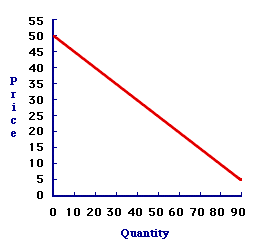
What does this curve represent?
a)
supply
b)
equilibrium
c)
demand
d)
surplus
47.
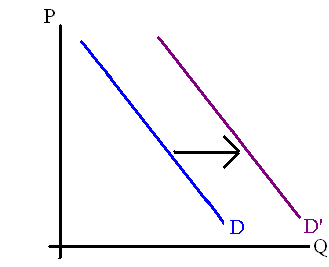
The diagram represents a
a)
increase in demand
b)
decrease in demand
c)
change in quantity demand
d)
none of the above
48.
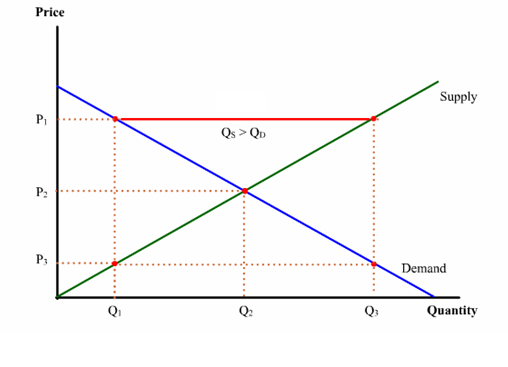
What does this graph show?
a)
Shortage
b)
Surplus
c)
Supply Table
d)
Equilibrium
49.
Which of the following would not cause as shift in demand?
a)
Decrease in income
b)
Lower supply
c)
Change in tastes
d)
Increase in price
50.
The government is giving every individual 18 and above an extra $1,000.00 this year. What determinant of demand does this likely fall under?
a)
Change in Consumer Tastes
b)
Change in Consumer Price Expectations
c)
Change in Number of Consumers in the Market
d)
Change in Consumer Income
51.

How is a shortage created?

a)

When demand increases.

b)

When demand decreases.

c)

When demand stagnates.

d)

When supply increases.

52.

What are the basic problems/questions in economy?

a)

What to produce

b)

How to produce

c)

For whom to produce

d)

None of the above

53.
How many types of economies are there?
a)
1
b)
4
c)
3
d)
5