wayground logo

Free Printable Worksheets

Font size

S
M
L
XL
Worksheets

Metals and acids

Total questions: 90

Worksheet time: 2hrs 56mins

Name
Class
Date
1.

Metal + Acid -> ___ + ___

a)

Metal Salt + Hydrogen

b)

Metal Hydroxide + Hydrogen

c)

Metal Oxide + Hydrogen

d)

Metal Carbonate + Hydrogen

2.

Sodium + Hydrochloric acid ->

a)

Sodium chlorine

b)

Sodium chlorine + hydrogen

c)

Sodium chloride + hydrogen

d)

Sodium chloride

3.

Lithium + nitric acid ->

a)

Lithium nitride + hydrogen

b)

Lithium nitric + hydrogen

c)

Lithium nitrogen + hydrogen

d)

Lithium nitrate + hydrogen

4.

Zinc + sulphuric acid ->

a)

hydrogen + Zinc sulphate

b)

Zinc sulphide + hydrogen

c)

Zinc Sulphur + hydrogen

d)

Zinc sulphate + helium

5.

What is always a product when a metal reacts with an acid?


(a)  

6.

___ + _____ -> sodium nitrate + hydrogen

a)

Sodium + nitric acid

b)

Sodium + nitrate

c)

Sodium + sulphuric acid

d)

Sodium + hydrochloric acid

7.

Lead + ____ -> Lead sulphate + hydrogen

a)

nitric acid

b)

sulphuric acid

c)

hydrochloric acid

d)

citric acid

8.

How can you test for hydrogen gas?

a)

sniff it

b)

squeaky pop test

c)

add universal indicator

d)

add lemon water

9.

Hydrochloric acid + (a)   -> Iron Chloride + hydrogen

10.

The property of metals by which they can be beaten in to thin sheets is called

a)

Sonority

b)

Malleability

c)

Ductility

d)

None of the above

11.

Metals are

a)

Hard

b)

Lustrous

c)

Sonorous

d)

Non ductile

12.

Sodium is very reactive

a)

Non-metal

b)

Liquid metal

c)

Metal

d)

Metalloid

13.

Metals react with acids to produce a gas

a)

Carbon dioxide

b)

Nitrogen

c)

Hydrogen

d)

Oxygen

14.

Metal oxides are

a)

Basic

b)

Acidic

c)

Neutral

d)

None of the above

15.

More reactive metal displaces less reactive metal from its salt solution is known as

a)

Combination reaction

b)

Displacement reaction

c)

Neutral reaction

d)

None of the above

16.

Non-metal used in water purification process

a)

Oxygen

b)

Nitrogen

c)

Chlorine

d)

Iodine

17.

Metals that react quickly/strongly with water and acids are called?

a)

Reactive

b)

Unreactive

c)

Noble

d)

Corrosive

18.
How can you tell that a metal is reacting with water?
a)
Colour change
b)
Bright light
c)
Fizzing
d)
It gets colder
19.
How can you test to show that when a metal reacts with water, hydrogen gas is produced?
a)
Relights a glowing splint
b)
A lit splint produces a squeaky pop
c)
Puts out a burning splint
d)
Is cold to the touch
20.
What gas is produced when sodium reacts with water?
a)
Hydrogen
b)
Carbon dioxide
c)
Carbon monoxide
d)
Water vapour
21.
Which salt will be produced if magnesium react with hydrochloric acid?
a)
Magnesium oxide
b)
Magnesium sulfate
c)
Magnesium sulfide
d)
Magnesium chloride
22.
When magnesium reacts with copper sulphate, there are two products. What are they?
a)
Magnesium  and Copper
b)
Magnesium Sulphate and Copper
c)
Magnesium Sulphate and Copper Sulphate
d)
Magnesium and Copper Sulphate
23.

If potassium reacts with water what are the 2 products of the reaction?

a)

potassium hydroxide + oxygen

b)

potassium hydroxide + hydrogen

c)

potassium + hydrogen oxide

d)

Potassium hydroxide + hydrogen oxide

24.

Metals that float on water and fizz around water.

a)

Transition metal

b)

Alkaline earth metal

c)

Alkali metal

d)

Group 3 metals

25.

When Copper metals are added to water ____

a)

oxide and hydrogen gas

b)

Hydroxide and hydrogen gas

c)

carbonates and hydrogen gas

d)

No reaction

26.

A chain of repeating units (called monomers)

a)

monomer

b)

dimer

c)

replicate

d)

polymer

27.
Why do you think people use plastic for their products ?
a)
Because it's strong
b)
Because its very cheap and it's easy to make
c)
Because it's expensive
d)
Because it's rare and it's good for the enviorment
28.

Define polymer

a)

circular molecule made with many repeating units

b)

short molecule made of a few repeating units

c)

long, chain-like molecule made of repeating units

d)

chain-like molecule that contains hydrogen and oxygen

29.

What is the process to make long polymer (plastic) chains?

a)

Fractional Distillation

b)

Curing

c)

Fracking

d)

Polymerization

30.

A polymer made in the laboratory (or industry) usually made from petrochemicals

a)

nature polymer

b)

natural polymer

c)

protein

d)

synthetic polymer

31.

Which of the following determine the properties of a polymer?

a)

chemical nature of the monomer

b)

length of the polymer chain

c)

how the monomers are joined together

d)

All of the above

32.
Alkali metals are found in which group of the periodic table?
a)
Group 1
b)
Group 2
c)
Group 7
d)
group 8 
33.
Which of the following is the most reactive in water?
a)
Lithium
b)
Sodium
c)
Potassium
34.
What is the symbol equation for the reaction between sodium hydroxide and water?
a)
2Na + 2H2O → 2NaOH + H2
b)
Na + H2O → NaOH + H
c)
Na + H20 → NaCl + CO2
d)
2Na + 2H2O → 2NaH2 + O2
35.
Which of the following is NOT an alkali metal
a)
Li
b)
Cl
c)
K
d)
Cs
36.
When an alkali metal reacts with water, the hydroxide produced dissolves to form and alkaline solution, True or False?
a)
True
b)
False
37.

How many electrons do the alkali metals have in their outer shell?

a)

1

b)

2

c)

8

d)

7

38.

Is hydrogen an alkali metal?

a)

no

b)

yes

c)

maybe

39.
What does 'brittle' mean?
a)
Soft
b)
Easily breakable
c)
Easily bendable
d)
Tough
40.
Which of these properties do ceramics possess?
a)
Light
b)
Very fragile
c)
Strong hardness
d)
Flexible
41.
Ceramics also have a chemical inertness. What does this mean?
a)
They do not react with chemicals.
b)
They react strongly with chemicals.
c)
They only react with reactive elements.
d)
They react sometimes with chemicals.
42.
What is a disadvantage of ceramics?
a)
Ceramics are tough. 
b)
Clay is easy to obtain.
c)
They can be painted.
d)
They can fracture easily.
43.
Because of their strong bonds, ceramics are...
a)
Electrically resistant
b)
Elastic
c)
Heat resistant
d)
Magnetic
44.
Are ceramics...
a)
Good insulators
b)
Good conductors
45.
Which of these objects is a ceramic?
a)
Brick
b)
Pylon
c)
Water bottle
d)
Tarmac
46.
What is the formula for Nitric Acid?
a)
HNO2
b)
HNO3
c)
HNO4
d)
H2NO3
47.
What is the formula for hydrochloric acid?
a)
HCl
b)
HClO
c)
H3ClO3
d)
HClO3
48.

A sour taste is a characteristic of:

a)

acids

b)

bases

c)

neutral

d)

pH scale

49.

What is the name for this acid H2SO4

a)

hydrochloric acid

b)

phosphorus acid

c)

sulfuric acid

d)

nitric acid

50.

All acids have a pH value

a)

above 7

b)

below 7

c)

around 7

d)

exactly 7

51.

Acids have a ___________ taste and also turn __________ litmus paper __________.

a)

sour, red, blue

b)

bitter, red, blue

c)

sour, blue, red

d)

bitter, green, red

52.

Acids react with __________________ to form a salt and a gas which extinguishes with a 'pop' sound.

a)

alkalis

b)

bases

c)

carbonates

d)

reactive metals

53.

Iron + copper oxide =

a)

Iron + copper oxide

b)

Iron oxide + copper oxide

c)

Iron oxide + copper

d)

Magic

54.
the starting materials in a chemical reaction
a)
Products
b)
Reactants
c)
Starters
d)
Enders
55.
a substance that is formed as the result of a chemical reaction
a)
Product 
b)
Reactant
c)
Starters
d)
Enders
56.

Which of the following is more reactive?

a)

Calcium

b)

Magnesium

c)

Zinc

d)

Gold

57.

Will the following reaction take place?


Ni + NaCl ->

a)

NO

b)

YES

58.

Which one of the following combinations result in a displacement reaction?

a)

Iron with magnesium chloride

b)

magnesium with iron chloride

c)

Iron with Zinc Sulphate

d)

gold with silver nitrate

59.
A displacement reaction will occur when...
a)
a more reactive metal displaces a less reactive metal from its compound.
b)
A less reactive metal displaces a more reactive metal from its compound
c)
Displacement only occurs when two of the same metals are reacted 
d)
Displacement reactions will only occur in metals above iron in the reactivity series
60.

What will the products of this reaction be?

calcium + zinc nitrate --------->

a)

Calcium + zinc nitrate

b)

Zinc + calcium nitrate

c)

there will be no reaction

d)

Zinc + calcium chloride

61.

What are the products when magnesium reacts with hydrochloric acid?

a)

magnesium nitrate and hydrogen gas

b)

magnesium sulfate and hydrogen gas

c)

magnesium oxide and oxygen gas

d)

magnesium chloride and hydrogen gas

62.
Which of the following will not undergo reaction?
a)
zinc metal  +  zinc oxide 
b)
iron metal  +  copper oxide
c)
zinc metal +  iron oxide
d)
magnesium  +  iron oxide
63.

Which metal is more reactive than calcium?

a)

magnesium

b)

potassium

c)

silver

d)

aluminum

64.
Does Iron displace Aluminium?
a)
Yes
b)
No
65.

True or false? Chemical reactions are easily reversible

a)

True

b)

False

66.

True or false: A change in state is a chemical reaction

a)

True - something melting would be an example of a chemical reaction

b)

False - a change in state is a physical change

67.

When energy is transferred from the substances to the surroundings during a chemical reaction, what type of reaction is this?

a)

endothermic

b)

exothermic

c)

decomposition

d)

combustion

68.
What is the term for the → sign in a reaction?
a)
makes
b)
produces
c)
yields
d)
all are correct
69.
Is the reaction below exothermic or endothermic?
CH4 + 2O2 → CO2 + H2O + heat
a)
exothermic
b)
endothermic
70.
The Law of Conservation of Mass states
a)
that matter exists in all states and reacts the same
b)
that matter can only be changed into new substances by introducing a catalyst
c)
that matter exists in the same state throughout any chemical change
d)
that matter cannot be created or destroyed and that the mass of the products must equal the mass of the reactants
71.
One of the signs of a chemical reaction taking place is:
a)
Bubbles are produced 
b)
Reactants are not combining
c)
Products are not forming
d)
Color is not changing
72.
Which is NOT an indication of a chemical change?
a)
temperature change
b)
formation of a precipitate
c)
shape change
d)
production of light
73.
You know you a chemical reaction has occurred if 
a)
there is a precipitate.
b)
there is a color change.
c)
there is a temperature change.
d)
All of these answers are evidence.
74.
Which of the following is an example that includes evidence of a chemical reaction?
a)
A sample of zinc is placed in water and it settles to the bottom
b)
A solid block of ice is heated and it completely melts into a liquid. 
c)
Sugar that is burned gives off an odor and turns brown and then black.
d)
A tomato is placed into a blender and chopped up into smaller pieces.
75.
When is it OK to eat or drink in the lab?
a)
Always
b)
Never
76.
It's fine to smell chemicals directly from their containers.
a)
True
b)
False
77.
At the end of the lab you see some leftover chemical that looks just like the stuff you were using.  You should:
a)
put the chemical back in the jar it came from.
b)
sweep it into your hand and throw it out.
c)
tell the teacher so you can dispose of it properly.
d)
tell your classmates that your lab partner is really messy.
78.

What does this symbol warn us about?

a)

Health hazard

b)

Lung disease

c)

Irritant

d)

Corrosive

79.

What does this symbol mean if found as a label on a substance?

a)

Flamable

b)

Flammable

c)

Set this on fire

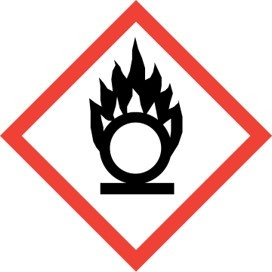
80.

What does this symbol stand for?

a)

Flammable

b)

Oxidising

c)

Non-flammable

d)

Explosive

81.

What does this symbol stand for?

a)

Flammable

b)

Oxidising

c)

Irritant

d)

Corrosive

82.

What does this symbol stand for?

a)

Flammable

b)

Toxic

c)

Deadly

d)

Corrosive

83.

What does this symbol warn us of?

a)

Danger

b)

Alert

c)

Toxic

d)

Irritant/harmful

84.

This symbol tell us the chemical it is labelling is:

a)

Harmful to the environment

b)

A pressurised container

c)

Explosive

d)

Corrosive

85.

Match the pictogram to the correlating hazard


EXPLOSIVES

a)
b)
c)
d)
86.
You should never ______ chemicals in the lab. 
a)
taste
b)
touch
c)
smell
d)
all of the above
87.
H is the chemical symbol for which element?
a)
Helium
b)
Hydrogen
c)
Mercury
88.
Na is the chemical symbol for which element? 
a)
Sodium
b)
Nitrogen
c)
Neon
89.
K is the chemical symbol for which element? 
a)
Krypton
b)
Potassium
c)
Knox
90.
Fe is the chemical symbol for which element? 
a)
Freon
b)
Iron
c)
Flourine