Wayground logo

Free Printable Worksheets

Font size

S
M
L
XL
Worksheets

Year 8 His Final Exam Term 3

Total questions: 93

Worksheet time: 2hrs 48mins

Name
Class
Date
1.

Emperor Justinian revised the Roman laws which then became known as?

a)

Justinian's Code

b)

Hammurani's Code

c)

The Da Vinci Code

d)

Chaussard's Code

2.

What is the Hagia Sophia?

a)

A church

b)

A castle

c)

A towering statue

d)

Shrine to Sophia I

3.
What was the capital city of the Byzantine Empire? 
a)
Rome 
b)
Athens 
c)
Constantinople 
d)
Italy 
4.

Which group conquered Constantinople?

a)

Persians

b)

Huns

c)

Ottoman Turks

d)

Carthage

5.
What became of the Byzantine Empire after its collapse?
a)
Ottoman Empire
b)
Seljuk Empire
c)
Persian Empire
d)
Persian Empire
6.
What was the title given to the ruler of the Ottoman Empire?
a)
Janissary
b)
Rajput
c)
Sultan
d)
Mansabdar
7.

What religion did the Ottoman Empire help spread throughout their empire?

a)

Buddhism

b)

Christianity

c)

Shintoism

d)

Islam

8.

What city did the Ottoman Empire conquer in 1453 putting an end to the Byzantium Empire?

a)

Rome

b)

Constantinople

c)

Athens

d)

Vienna

9.
True or False: The Ottomans required that all the peoples they conquered converted to the Islamic religion or they were executed.
a)
False
b)
True
10.

One of the reasons for the wealth of the Ottoman Empire was

a)

its control over the Eastern Mediteranian

b)

the usage of trans-saharan trade routes

c)

because they found the Americas first

d)

strong diplomatic ties with the Genghis Khan

11.

____ were an elite guard of Ottoman soldiers.

a)

sinans

b)

ulema

c)

pashas

d)

janissaries

12.

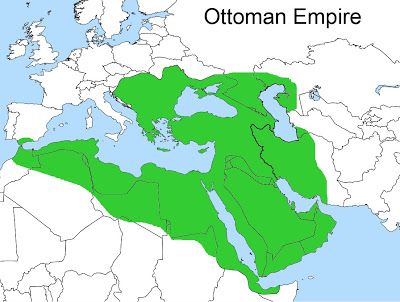
Which continents did the Ottoman Empire have some control over? Click all that apply.

a)

Europe

b)

Asia

c)

Africa

d)

North America

e)

South America

13.

Which technology, first developed by the Chinese, enabled the Ottoman Empire to expand militarily into western Asia, Europe, and northern Africa?

a)

woodblock printing

b)

wheelbarrow

c)

gunpowder

d)

magnetic compass

14.

Suleman was known to westerners as the Magnificent, but to many others he was known as the

a)

Gravedigger

b)

Enlightened

c)

Lawgiver

d)

Peace Maker

15.

Due to its diverse population, the Ottomans were known for

a)

Forcing its subjects to convert to Islam

b)

Creating harsh laws against Christians and Jews

c)

Allowing many non-muslims into the government

d)

Allowing religious practice for all, at a price

16.
Which Islamic group began to invade the Christian, Byzantine Empire?
a)
Fatimid
b)
Turk
c)
Chinese
d)
Franks
17.
Pope Urban II changed the world by
a)
Launching the Crusades
b)
Discovering America
c)
Defending Jerusalem from attacks
d)
Launching the first Catapult 
18.
lords/nobles let whom live on their land in return for food/rent?
a)
Nobles
b)
lords
c)
nobody
d)
peasants
19.
Why did every great empire seek to control the Middle East
a)
 rich in resources
b)
didn't have deserts
c)
trade center
d)
it was never valued
20.
Why were the Crusades fought?
a)
Oil
b)
Holy Land
c)
Drama
d)
Funsies
21.
What ancient empire did the Ottomans end?
a)
China
b)
Arab
c)
Byzantine
d)
none are true
22.
What did the Ottoman Empire do to the Hagia Sofia?
a)
burned it to the ground
b)
turned it into a mosque
c)
made it their capitol
d)
turned it into a hotel
23.
What area(s) did the Ottoman Empire control or have pieces of?
a)
Europe
b)
North Africa
c)
Asia
d)
All of the above
24.
Who served in the Janissary army?
a)
Christian slaves who converted to Islam made up the Janissary  army.
b)
Armed foot Soldiers.
c)
Minnesota Vikings.
d)
Mercenaries.
25.
Nicknamed 'the Magnificent' or 'the Lawgiver', he was the leader of the Ottoman Empire from 1520-1566
a)
Mehmed the Conqueror
b)
Muhammad II
c)
Mustafa IV
d)
Suleyman I
26.
He is the Conqueror because he took over Constantinople.
a)
Suleyman I
b)
Ossman the Great
c)
Ottoman III
d)
Mehmed II
27.
Under Suleyman
a)
the Ottoman Empire collapsed
b)
the Ottomans conquered all of Europe
c)
Christians and Jews were forced to convert to Islam
d)
the Ottoman Empire reached its cultural peak or golden age
28.
The Byzantine Empire was actually part of
a)
the Mongol Empire
b)
the Roman Empire
c)
the Persian Empire
d)
part of Umayyad caliphs
29.
The Ottomans were originally
a)
nomads from central Asia
b)
Mongols
c)
Chinese immigrants
d)
Christians
30.
Which event directly caused the collapse of the Ottoman Empire?
a)
World War I
b)
World War II
c)
Revolutionary War
d)
Iraq War
31.
Who divided the Ottoman Empire into new countries at the end of WWI?
a)
European Powers
b)
Middle East Governments
c)
Ottoman Empire
d)
United States
32.
Who were the Ottomans named after? (He is the founder of Ottoman Empire)
a)
Osman I
b)
Mehmet II
c)
Suleiman the Magnificent
d)
Selim
33.
Which word best describes the type of government in the Ottoman Empire?
a)
Monarchy
b)
Presidential Democracy
c)
Fascism
d)
Parliamentary Democracy
34.

Who were the Mongols?

a)

Herdsmen who lived in South America

b)

Nomadic tribes from Mongolia who lived in yurts

c)

People who built the Great Wall of China

d)

People who created the world's largest empire

35.

What term describes someone who moves from place to place, usually following food supply or animals?

a)

Cattle herder

b)

Rancher

c)

Nomad

d)

City-goer

36.

What was the name given to the top ruler of Mongol clans, tribes, or groups?

a)

Genghis

b)

King

c)

Daimyo

d)

Khan

37.

The Mongols created the world's largest empire

a)

True

b)

False

38.
Where was Mongolia in relation to China?
a)
north of China
b)
south of China
c)
near Tibet
d)
on the islands 
39.
What advantage did the Mongols have over surrounding peoples?
a)
They were mostly literate, unlike China who mostly was illiterate
b)
They had more equality than surrounding peoples
c)
Their calvary, fighting from horseback, unlike the Chinese who were not as well trained
d)
They didn't care about religion, where as the Chinese made Confucianism the official religion 
40.
Who was the fiercest Mongol leader?
a)
Empress Wu
b)
Genghis Khan 
c)
Confucius
d)
Marco Polo
41.
What was one reason why Genghis Khan was so fierce? 
a)
He was really mean
b)
He was well trained in combat
c)
He led the capture of China, Central Asia, & Persia
d)
He killed many of his followers who did not listen
42.
How was Kublai Khan related to Genghis? 
a)
his son
b)
his grandson
c)
his brother
d)
his wife
43.
Besides China, Southeast Asia, Tibet, & Europe, what other place did the Mongols take over for the next 200 years?
a)
northern coast of Africa
b)
Japan
c)
England
d)
Russia
44.
Kublai Kahn united with the Chinese to create the ________ Dynasty. 
a)
Ming 
b)
Song
c)
Qin
d)
Yuan 
45.
After Genghis' death in 1227 Mongolia was divided into 4 sections called _________. 
a)
states
b)
counties
c)
Khans
d)
Khanates
46.

Where did the Mayans live?

a)

Desert of South America

b)

Arctic Circle

c)

Southern Mexico and Central America

d)

Woodlands of North America

47.

What two contributions did the Mayans make to the modern world?

a)

Hieroglyphics

b)

Pueblo villages

c)

Floating gardens

d)

Math and the number zero

e)

Cities of gold

48.

What was the Mayan religion like?

a)

They believed in one god

b)

They believed in many gods (polytheistic)

c)

They didn't believe in any gods

d)

They didn't believe in animal or human sacrifices

49.

How did the Mayan civilization end?

a)

A neighboring tribe conquered them

b)

They were captured by Portuguese sailors

c)

Cortes conquered them

d)

They abandoned their cities and disappeared

50.

How did the Mayans farm?

a)

The cut terraces into the hillside

b)

They grew gardens on top of mesas

c)

They planted crops on floating gardens

d)

They used special fertilizers and watering systems

51.

What was the social structure of the Mayans?

a)

Farmers on top; warriors and nobles on bottom

b)

President on top; farmers and priests on bottom

c)

Powerful kings and nobles on top; poor peasants and slaves on bottom

d)

Elected officials on top; priests and traders on bottom

52.

Which Mayan crops are part of Mexican food today?

a)

wheat, rice, and barley

b)

lettuce, tomatoes, and sour cream

c)

corn, beans, and squash

d)

tortilla chips, beef, and rice

53.
The Mayans lived in which area of the world:
a)
South America: Peru and Ecuador
b)
Central America: Guatemala and Mexico
c)
North America: Southern United States and Mexico
d)
Africa: Zimbabwe and Lesotho 
54.
The Mayans were able to create a detailed calendar because of their advancements in:
a)
astronomy and physics
b)
astronomy and agriculture
c)
astronomy and mathematics
d)
mathematics and art
55.

The Mayan Civilization started later than Mesopotamia. It started around the year 200 CE which is about _________.

a)

1800 years ago.

b)

800 years ago.

c)

8000 years ago.

d)

200 years ago.

56.

Mayan created _____________ which were buildings to help them view the stars.

a)

Binoculars

b)

Weapons made of obsidian

c)

Calendars

d)

Observatories

57.

The Mayans suffered through a bad ____________, which means there was very little rain, so crops won't grow. This could have led to their civilization's decline.

a)

temper

b)

flood

c)

drought

d)

head cold

58.

What is the main purpose of this map?

a)

To show me where Mexico is.

b)

To show me where the Mayan city-states were located.

c)

It is a map of Central America.

d)

It is a map of America.

59.

The Mayan economy was based mostly on ______________.

a)

Mining obsidian.

b)

Fishing.

c)

Drilling for oil.

d)

Farming

60.

Mayan city-states were ruled by ______________.

a)

presidents.

b)

priests.

c)

kings.

d)

a democracy.

61.
Mayans carved flat surfaces into the sides of hills to farm the land.  What are these known as?
a)
hillocks
b)
flat tops
c)
terraces
d)
plateaus
62.

Yucatan Peninsula is _______________________

a)

A large Mountain

b)

A land form surrounded on three sides by water

c)

An ocean

d)

A Mayan City

63.

The Mayans created a n__________________ system

a)

number

b)

no war

c)

naughty

d)

notorious

64.
An independent government where a large city rules the surrounding area is called _____________.
a)
empire
b)
country
c)
city-state
d)
poytheistic
65.
The Mayans belived in more than one god. This is called _____________.
a)
nomadic
b)
polytheism 
c)
temple
d)
sacrifice
66.
The Maya were the first recorded civilization to feature the concept of ________ in their number system.
a)
1
b)
- 1
c)
0
d)
Infinity
67.

How did humans get to the Americas?

a)

Airplane

b)

Land Bridge

c)

Cars

d)

Riding horses

68.

Where did the Sun god (Tonatiuh) tell the Aztec people to settle?

a)

Where they found a lot of water to survive.

b)

Where they found an eagle on a cactus eating a snake.

69.

How did Aztecs keep their gods satisfied?

a)

By offering human sacrifices so the gods would feed themselves with the victims’ hearts and blood.

b)

By offering them gold, cacao, jewels and arts.

70.

Aztecs had 2 calendars.

a)

The Solar Calendar worked with 2 wheels and had 13 months and 20 days, The Sacred Calendar had 365 days and it was used to figure out when to plant and harvest crops.

b)

The Sacred Calendar worked with 2 wheels and had 13 months and 20 days, The Solar Calendar had 365 days and it was used to figure out when to plant and harvest crops.

71.

Important celebrations for the Aztec were:

a)

the opening of a new temple, welcoming warriors back from a victory, the death of a ruler or the rise of a new one, religious rituals, the birth and naming of a baby, entering and leaving school, marriage, and death.

b)

only for nobles, kings and warriors and they only celebrate when they got a new ruler or when they won a fight.

72.

It was built on top of what was once Tenochtitlan.

a)

Mexico City.

b)

Guatemala

73.
Where did the Aztecs come from?
a)
South America
b)
Deserts of Northern Mexico
c)
Yucatan Peninsula
74.
The Aztecs were a nomadic tribe until they settled on Lake Texcoco. What does nomadic mean?
a)
They ate humans
b)
they traveled around
c)
they were lazy
75.
The Aztecs settled on a lake called:
a)
Lake Texcoco
b)
Lake of the Aztec
c)
Land o Lakes
76.
The Aztecs built Chinampas. What were they?
a)
Mexica food
b)
floating gardens
c)
pyramids
77.
Who was the Spanish explorer that arrived in 1519?
a)
Cortez
b)
Pizzaro
c)
Marc Anthony
78.
A form of writing that the Aztecs used which included pictures:
a)
alphabet
b)
hieroglyphs
c)
sketches
79.
The advantage of having their city built on a lake was: 
a)
protection from enemies
b)
a source of water for crops
c)
bathing and washing
d)
all of the above
80.
What was the capitol of the Aztec empire?
a)
Tenochan
b)
tenochtitlan
c)
Miamoi
d)
Mexico city
81.
The disease that killed 1/3 and weakened the Aztecs was called  ______.
a)
the flu
b)
stomach bug
c)
tonsilitis
d)
small pox
82.

Which color represents where the Aztec civilization was?

a)

blue

b)

red

c)

gray

d)

green

83.

The people in the surrounding city-states that were conquered by the Aztecs had to

a)

Adopt Aztec gods as their own

b)

Become slaves

c)

Pay tribute to the Aztec Emperor

d)

Sacrifice their government officials

84.

Tribute is most like which of the following?

a)

Paying taxes

b)

Playing soccer

c)

Donating to a local charity

d)

Being baptized

85.

The Aztecs repaid and honored their gods usually with some form of

a)

donation

b)

sacrifice

c)

pilgimage

d)

gold

86.

True or False: The Aztecs were monotheistic

a)

True

b)

False

87.

True or False: Aztec gods usually represented some aspect of Aztec life (nature, death, fertility, etc.)

a)

True

b)

False

88.

True or False: Aztec slaves had some rights. Their masters could not mistreat them, they could buy back their freedom, and they could not be sold without their permission.

a)

True

b)

False

89.

What caused the end of the Aztec Empire?

a)

Disease killed most of the population

b)

Spanish soldiers(under Cortez) captured their capital city

c)

Loss of crops led to starvation

d)

The Incas invaded their land

90.

The Aztec were best known as

a)

farmers

b)

warriors

c)

nomads

d)

magicians

91.

Name the facts about Ottoman Empire in terms of religion, region, leaders, and duration.

4 lines
92.

What are the similarities between Aztec and Mayan civilizations?

4 lines
93.

Who was Kulai Khan?

4 lines