Wayground logo

Free Printable Worksheets

Font size

S
M
L
XL
Worksheets

EOY REVISION QUIZ Y7

Total questions: 70

Worksheet time: 35mins

Name
Class
Date
1.

What is a cell?

a)

A part of the human body

b)

The smallest and most basic unit of life

c)

A type of element

d)

A non living organism

2.

What is the job of a cell membrane?

a)

To give them a strong shape

b)

To make food

c)

To control the entry and exit of substances

d)

To release energy

3.

Why do very active cells have lots of mitochondria?

a)

Mitochondria release energy to power cells

b)

Mitochondria help cells to divide in two

c)

Mitochondria help give the cell their shape

d)

Mitochondria make hormones

4.

What is the name for the connector that attaches bone to bone?

a)

ligament

b)

tendon

c)

joint

d)

cartilage

5.

What is the name for the connector that attaches muscle to bone?

a)

ligament

b)

tendon

c)

joint

d)

bones

6.

What is the place where two bones meet?

a)

bones

b)

tendons

c)

ligament

d)

joint

7.

What is a flexible connective tissue that is found in your nose and ears?

a)

cartilage

b)

joints

c)

ligaments

d)

cranium

8.

Which type of joint gives you the largest range of motion?

a)

Pivot joint

b)

Ball-and-socket joint

c)

Hinge joint

d)

Gliding joint

9.
Mechanical movement to inhale and exhale air
a)
Gas Exchange
b)
Respiration
c)
Breathing
d)
Transport
10.

What is the main function of the respiratory system?

a)

to provide oxygen and remove carbon dioxide from the body

b)

to bring oxygen to the body

c)

to break down food and absorb nutrients

d)

to remove oxygen from the body and deliver carbon dioxide

11.

The following is NOT one of the 3 Joint Classifications..

a)

Cartilaginous

b)

Cartilage

c)

Fibrous

d)

Synovial

12.

The joints that allow the most movement are called

a)

Fixed

b)

Fibrous

c)

Cartilaginous

d)

Synovial

13.

Examples of a Ball & Socket Joint are found in the

a)

Shoulder

b)

Knee

c)

Hip

d)

Ankle

14.

A hinge joint allows

a)

A wide range of movements

b)

Circumduction

c)

Rotation

d)

Movement in only one direction (ie. backwards & forwards)

15.

An example of a Saddle joint is in the

a)

Knee

b)

Hip

c)

Thumb

d)

Vertebral column

16.

Which of the following is part of a Synovial joint

a)

Synovial membrane

b)

Joint cavity

c)

Ligament

d)

Cartilage

17.
Identify the joint action being performed.
a)
Extension
b)
Flexion
c)
Abduction
d)
Adduction
18.
Identify the joint action being performed.
a)
Extension
b)
Flexion
c)
Abduction
d)
Adduction
19.
Identify the joint action being performed.
a)
Extension
b)
Flexion
c)
Abduction
d)
Adduction
20.
Identify the joint action being performed.
a)
Extension
b)
Flexion
c)
Abduction
d)
Adduction
21.
Are microorganisms helpful or harmful?
a)
Helpful
b)
Harmful
c)
Both
d)
Neither
22.
Yogurt contains harmful bacteria.
a)
True
b)
False
23.
Which two examples below are helpful bacteria?
a)
Medicine and Cherry Coke
b)
Yogurt and bread
c)
Salmonella and E. Coli
d)
Water and germs
24.
Algae and plankton are helpful microorganisms.
a)
True
b)
False
25.
Harmful bacteria produces cheese.
a)
True
b)
False
26.
Yeast makes bread, rolls and cakes rise.
a)
True
b)
False
27.
Mold helps dead things (plants, animals)...
a)
Grow
b)
Decay
c)
Sleep
d)
Reproduce
28.
Some fungus can provide food.
a)
True
b)
False
29.
Salmonella and E. Coli can be found on ________________ and ________________ so it is important to cook all meat to kill bacteria.
a)
Waffles and scrambled eggs
b)
Broccoli and steamed corn
c)
Eggs and raw chicken
d)
Sushi and Toaster Strudel 
30.
Harmful viruses can cause:
a)
Colds
b)
Influenza
c)
Both of the above
d)
Neither of the above
31.
Fungi can cause skin diseases and kill crops.
a)
True
b)
False
32.
A piece of bread has a tiny spot of mold growing on it. Is it safe to eat?
a)
Yes
b)
No
33.
Microorganisms can be found:
a)
The the ocean, inside and outside your body
b)
On plants and animals
c)
In medicine and your food
d)
All of the above
34.
Anti-bacterial means:
a)
active against bacteria.
b)
feeds bacteria and helps it grow.
c)
has no effect on bacteria.
d)
sometimes works against bacteria, but not always.
35.
Which of the following statements are true?
a)
All microorganisms are bad
b)
All microorganisms are good
c)
Some microorganisms are harmful, while some can be helpful
d)
Microorganisms are too small to do anything to anyone
36.
Four students in Mrs. Sterling's class make the following observations.  Choose which student is correct
a)
Shelby says that all microorganisms are found in the ocean.  Some are helpful, but some are harmful.  It's best to shower after swimming at the beach.
b)
Garry says that all microorganisms are harmful.  This is why we must get vaccinations and antibiotics from the doctor.
c)
Ireland says that some microorganims are helpful and some are harmful.  The best way to protect ourselves from harmful microbes is to wash our hands with soap and water.
d)
Jonathan says it's impossible to become sick from bacteria.  Only viruses and fungi can make a person sick.  Make sure to sneeze in your elbow to prevent the spread of germs.
37.
Four of Mrs. Sterling's students go to Six Flags.  Two become sick.  Choose which answer gives the best evidence as to why the students became sick.
a)
Isabela and Sauzaas become sick because they do not like the dressed up characters at Six Flags.  
b)
James and and Salwa become sick because they did not have enough money to buy a souvenir. 
c)
Sauzaas and James become sick because they ingested some chicken at the food stand that had bacteria on it.  
d)
Isabella and Salwa become sick because they washed their hands too many times while at the park.
38.
Harmful bacteria produces cheese.
a)
True
b)
False
39.

Producers are:

a)

animals

b)

rocks

c)

plants

40.

Plants are called producers because they can produce their own:

a)

music

b)

food

c)

air

41.

Animals that eat only plants are called:

a)

herbivores

b)

omnivores

c)

carnivores

42.

Animals that eat only meat are called:

a)

herbivores

b)

carnivores

c)

omnivores

43.

Animals that eat both plants and animals are called:

a)

herbivores

b)

carnivores

c)

omnivores

44.

A living thing that breaks down dead plants and animals - such as, fungi, worms, bacteria, is:

a)

decomposer

b)

food web

c)

omnivore

45.

A system of many food chains that interact with each other:

a)

predator

b)

consumer

c)

food web

46.

Which action would most likely reduce concerns about how strip mining can harm the environment?

a)

Restrict mining operations to rural areas

b)

Reclaim the ecosystem after mining

c)

Increase the usage of the products being mined

d)

Decrease the amount of labor needed in the mines

47.

Which of the following is not a renewable resource?

a)

Solar

b)

Natural Gas

c)

Wind

d)

Hydroelectric

48.

Coal was formed from

a)

the remains of decomposing dinosaurs

b)

the remains of decomposing marine organisms

c)

the remains of ancient swamp plants

d)

cooling magma

49.

What is a disadvantage associated with many renewable or alternative energy sources?

a)

cost

b)

pollution

c)

waste

d)

radiation

50.

Which of the following would be considered a renewable resource?

a)

trees

b)

`oil

c)

coal

d)

natural gas

51.
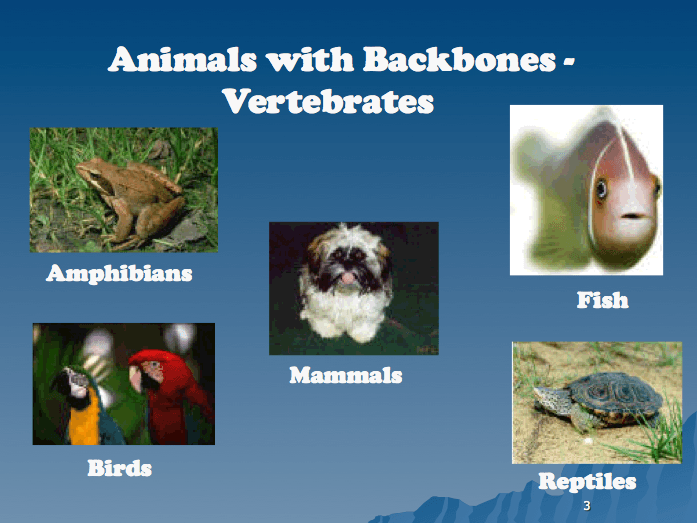
What are vertebrates?
a)
Animals with a backbone
b)
Animals without a backbone
52.
There are five categories of vertebrates.  Which one is not a vertebrate?
a)
Mammals
b)
Birds
c)
Arthropods
d)
Reptiles
53.
This group feeds milk to its young.
a)
birds
b)
mammals
c)
fish
d)
reptile
54.
All invertebrates _________
a)
Have a backbone
b)
Do not have a backbone
c)
Are really just Vertebrates
d)
Have a nerve cord
55.
I am covered in dry scales and I lay eggs.  What am I?
a)
Mammal
b)
Fish
c)
Amphibian
d)
Reptile
56.
Which of the following is a difference between mammals and birds?
a)
4 chambered heart
b)
Endothermic
c)
Hair
d)
Coelomates
57.
True/False: Amphibians have scales and claws.
a)
True
b)
False
c)
True, but only for newts
58.
How are fish different from amphibians?
a)
Spinal column
b)
Gills during part of their life
c)
Scales
d)
Are in water at least during part of their life.
59.
Which three parts of the body has an insect?
a)
Tencacles, head, legs
b)
head, abdomen, legs
c)
Head, thorax, abdomen 
d)
Hair, bones, foot 
60.
There are arthropods with 
a)
1,2,3,4 and 5 legs 
b)
0,1,5,6,8,10 and more than 10 legs
c)
3,6,9 and 10 legs 
d)
0,1,5,8 and 10 legs
61.

What does invertebrate mean?

a)

Animals without a backbone

b)

Animals that change their form

c)

Animals with a backbone

d)

Animals that lay eggs

62.

Which of the following is an invertebrate?

a)

Cat

b)

Snail

c)

Goldfish

d)

Humans

63.
Dragonflies, stink bugs, and lady bugs are __________.
a)
insects
b)
arthropods
c)
animals
d)
all of these
64.
I have a soft-body, a hard shell, and live on land and water.  What am I?
a)
Mollusk
b)
Arthropod
c)
Echinoderm
d)
Cnidarian
65.
Between 90-95% of all animals on earth can be classified as _____.
a)
invertebrates
b)
vertebrates
c)
reptiles
d)
mammals
66.
Why are sponges classified as animals
a)
they digest food
b)
they breathe through gills
c)
they use legs to move
d)
they have skeleton
67.
Which statement applies to ALL invertebrates?
a)
They are made of only one cell.
b)
They have no backbone.
c)
They reproduce asexually.
68.
Which three parts of the body has an insect?
a)
Tencacles, head, legs
b)
head, abdomen, legs
c)
Head, thorax, abdomen 
d)
Hair, bones, foot 
69.

Sponges use pores to absorb nutrients and oxygen.

a)

true

b)

false

70.
Do the invertebrates have backbone?
a)
yes
b)
no