
Font size
 Worksheets
AQA Business Studies Unit 6
Total questions: 53
Worksheet time: 29mins

Which one is NOT a stage in the PLC?
maturity
decline
growth
development

Which stage has rapid sales?
introduction
maturity
decline
growth

Which stage has lots of competitors?
growth
maturity
introduction
decline

What is a product extension?
longer production time
products with extension features
strategies to keep the product from declining
products that keep going through the different stages
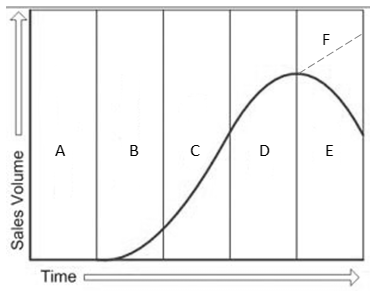
In this stage:
•Low sales
•High cost per customer acquired
•Negative profits
•Innovators are targeted
•Little competition
Product development
Introduction
Growth
Maturity
Decline
A flexible workforce suits a business whose sales are :
stable
predictable
reliable
unpredictable
Internal recruitment :
chooses from a wide field of candidates
is more expensive than external
involves promotion
brings in new ideas

Training on day one =
on-the-job
off-the-job
induction
redundancy

A narrow span of control create a t (a) structure
Which of the following would cut costs and improve communication ?
increasing the levels of hierarchy
choosing a narrower span of control and increased supervision
lengthening the chain of command
delayering

Which structure offers more promotion opportunities ?
left
right
Which motivation theorist focused on pay as the only motivator?
F. W. Taylor
E. Mayo
F. Herzberg
A. Maslow

Herzberg's motivators include :
working conditions
pay
supervision
responsibility

Herzberg's hygiene (maintenance) factors include :
recognition
achievement
interesting work
pay

Maslow's hierarchy of needs has .................................at the top
esteems needs
physiological needs
social needs
self actualisation
Group norms and effect of the team were found to be important by ..................
Herzberg
Mayo
Taylor

Esteem needs in Maslow's hierarchy of needs is
top
second from top
third from top
fourth from top
Giving the worker more complex and challenging tasks =
job enlargement
job rotation
job enrichment
job production
Division of labour to create specialisation of simple repetitive tasks was created by
E Mayo
F Taylor
A Maslow
F Herzberg
Paying the worker for each item they make =
bonus
commission
piecework pay
salary

Why is profit-sharing good ?
Managers can pick and choose who gets it
It is guaranteed each year
It is unaffected by costs rising
Everyone benefits fairly
Performance-related pay is most suitable for :
production-line workers
staff making physical products
office, professional staff
office cleaners

Motivation is more important when production is :
capital intensive (machinery)
labour intensive
outsourced
automated
Which of the following is a feature of a weak economic climate?
High levels of consumer spending
Low levels of consumer spending
High levels of employment
Low levels of unemployment
Which of the following is a drawback to a business of behaving in an environmentally responsible way?
Sales increase due to positive public image
Brand reputation is improved
Publicity may not persuade customers to buy
Easier to motivate and recruit employees
Which of the following is a possible impact facing a hotel chain if facilities and accommodation are falsely described?
Sales may increase
Customer numbers may increase
Profits may increase
Reputation may decrease
A business that uses renewable energy, such as solar and wind power, aims to reduce:
Recycling
Global warming
Traffic congestion
Waste disposal
Changes in which of the following external influences is most likely to have led to the development of online businesses such as travel agents?
Technology
Interest rates
Legislation
Exchange rates
A business that operates in a competitive environment is likely to reduce prices when the economic climate is:
HIDE ANSWER
Weak and consumer spending is high
Weak and consumer spending is low
Strong and consumer spending is high
Strong and consumer spending is low
Which one of the following is a common benefit of Employment laws?
Businesses have to employ more workers to reduce unemployment
Workers must be trained by businesses to improve their chances of promotion
Workers must be given a written employment contract containing key conditions
Businesses have to increase workers' pay regularly
Which one is the drawback of monopolies?
lower prices in large scale production
increased expenditure on new product
various choice of products
less investment in new products
One of the common features of an economic 'boom' is:
a reduction in the rate of inflation
a reduction in the rate of employment in the economy
an increase in demand for income elastic products
a reduction in land and property prices
What is an economic recession?
two successive quarters of declining real GDP
the recovery phase of the business cycle
two successive quarters in which inflation is falling
any time period in which GDP declines
What is the 'hygiene' in Herzberg's 2 factor theory
Demotivates the employee if the workplace is clean and tidy
Demotivates the employee if the workplace is unsafe or unattractive to work in.
Motivates the employee if the workplace is clean
Demotivates the employee if they have to work long hours
What is the top level on Maslow's Hierarchy?
Physical needs
Safety needs
Self actualisation
Self-esteem
Which theorist believed that people are inherently lazy and are only motivated by money?
Mayo human relations theory
Taylor's scientific management
Herzberg's two factor theory
Maslow's hierarchy of needs
Which financial method of payment was derived from Taylor's theory?
Salary
Bonus
Fringe benefits
Piece rate

If safety needs are not met one cannot move to ___________________
basic physiological needs
Social (love and belonging)
esteem
self actualization
According to Taylor workers are mainly motivated by
Job satisfaction
Money
Is the following phrase related to Taylor or Mayo? "The concept of money as the principle motivator for employees is still referred to as a '?' approach.'
Tayloristic
Mayoristic

