
 Worksheets
FINAL EXAMINATION MODERN PHYSICS
Total questions: 70
Worksheet time: 2hrs 30mins
What is a beta particle made of?
One proton
A helium particle
One electron
One proton and one neutron
Which of these processes describes a nuclear fusion reaction?
A nucleus absorbs energy to produce lighter nuclei.
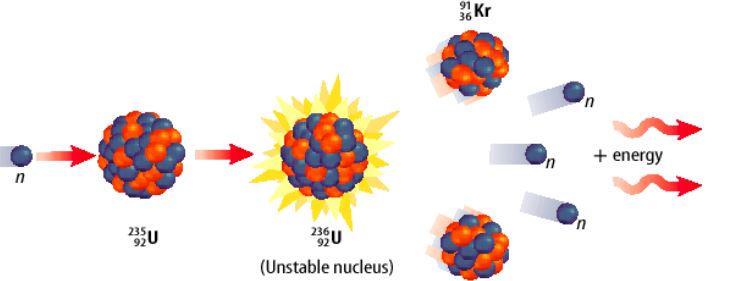
A nucleus splits to produce energy and lighter nuclei
Two nuclei bind together to produce energy and heavier nuclei.
Two nuclei bind together to produce energy and a lighter nuclei.
Of the main types of radiation emitted from naturally radioactive isotopes, which is the hardest to block?
Alpha deca
Gamma Decay
Beta decay
They are all blocked using the same method

Neutrons ......
has positive electric charge with equal magnitude to that of an electron.
has no net electric charge.
has negative electric charge.
orbiting the nucleus.
What kind of force holds the nucleus together?
Strong Nuclear Force
Weak Nuclear Force
Gravitational Force
Electromagnetic Force

What is the number of neutrons in Cesium?
55 neutrons
76 neutrons
84 neutrons
106 neutrons
139 neutrons
The atomic number of a given element is equivalent to which of the following?
Proton number in the nucleus
Neutron number in the nucleus
Sum of the protons and neutrons in the
nucleus
Sum of the protons, neutrons and electrons
If there are 146 neutrons in 238U, how many neutrons are found in the nucleus of 235U?
141
143
145
147

The energy emitted by the Sun is produced as a result
coal burning
the reaction cycle in which we get the helium nuclei from hydrogen nuclei
uranium nucleus fission reaction
pass electrons from higher shells to lower ones

It is able to penetrate radiation through human skin
alpha and beta
alpha and gamma
beta and gamma
alpha, beta and gamma
Which of these are FALSE about nucleons?
Nucleons are subatomic particles.
Nucleons are located in the nucleus of an atom.
Protons or neutrons are nucleons.
Nucleons are has negative electric charge.
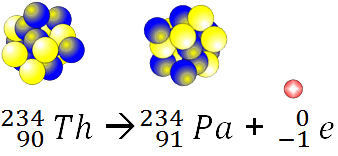
If the unstable nucleus has excess neutrons than a neutron converts itself into a proton. This process is called -
α decay
β− decay
γ decay
β+ decay
In a γ decay process the mass number and atomic number of the nucleus remain unchanged.
True
False
The atomic number of a given nuclide is equal to
Number of protons in nucleus
Number of neutrons in nucleus
Sum of number of protons and neutrons in nucleus
What is radioactivity?
The phenomena of spontaneous disintegration of an atomic nucleus resulting in a release of only matter.
The phenomena of spontaneous disintegration of an atomic nucleus resulting in a release of only energy.
The phenomena of spontaneous disintegration of an atomic nucleus resulting in a release of energy and matter.
If there are 92 protons in U238 . Find the number of neutrons?
145
146
147
144
Isotopes of the same elements have different
Number of neutrons in nucleus
Number of protons in nucleus
What is a.m.u. expressed in MeV?
930.4
931.6
932.5
931.5
Which of the following substances can be used as a moderator in a nuclear reactor?
Boron
Concrete
Uranium-238
Water
A pure sample of nuclide X containing N nuclei has an activity A. The half-life of X is 6000 years. A pure sample of nuclide Y containing 3N nuclei has an activity 6A. What is the half-life of nuclide Y?
1000 years
3000 years
12 000 years
18 000 years
β particles are emitted from a radioactive source in a school laboratory. What is correct for these particles?
A strong magnetic field will not deflect them.
They are absorbed by aluminium.
They do not damage human tissue.
Their range in air is shorter than that of α particles.
After 64 days the activity of a radioactive nuclide has fallen to one sixteenth of its original value. The half-life of the radioactive nuclide is
2 days.
4 days.
8 days.
16 days.
All of the following are quarks except
strange
bottom
charmed
spark
These are the category of hadrons that contain three quarks. This distinguishes them from mesons, which contain two (1 quark and 1 antiquark).
Gluons
Electrons
Leptons
Baryons
All baryons are assigned a baryon number of ___, all anti-baryons are assigned ___, and all non-baryons are ___
-1, +1, 0
-1, 0, +1
+1, -1, 0
0, -1, +1
All leptons are assigned a lepton number of ___, all anti-leptons are assigned ___, and all non-leptons are ___
-1, +1, 0
-1, 0, +1
+1, -1, 0
0, -1, +1
There are three families of leptons;
electron, muon, and pi.
electron, muon, and tau.
electron, pi and tau.
electron, pi and neutrino.
The main three conservation laws used in particle physics are:
Conservation of charge/strangeness, baryon and lepton numbers.
Conservation of gravity, charge and lepton numbers.
Conservation of momentum, hadron and lepton numbers.
Conservation of charge/strangeness, hadron and lepton numbers.
Which quarks form a neutron?
up, up, down
down, down, down
up, up, up
up, down, down
Tracks in particle detectors are created by...
collision between heavy particles
ionizations caused by charged particles
particles with no charge
particles moving close to the speed of light
a hadron with one quark and one antiquark
neutron
baryon
hadron
meson
an electron with a positive charge
neutrino
gauge boson
positron
gluon
a particle of the same mass and opposite charge
antiparticle
positron
Which statement concerning the forces between particles is incorrect?
Leptons experience the weak interaction.
Leptons experience the strong interaction.
Hadrons experience the weak interaction.
Hadrons experience the strong interaction.
Which of the following statements about muons is incorrect?
A muon is a lepton.
A muon has a greater mass than an electron.
A muon is made up of a quark and an anti-quark
A muon decays via the weak interaction
Which answer shows the correct interactions experienced by a hadron or a lepton?
Hadron: Strong = Yes. Weak = Yes
Lepton: Strong = Yes. Weak = Yes
Hadron: Strong = Yes. Weak = No
Lepton: Strong = Yes. Weak = No
The nucleus of a deuterium atom, called the deuteron, consists of a proton and a neutron. What is the binding energy of the deuterium in MeV, given that its atomic mass, the mass of a deuterium nucleus plus an electron, is 2.014102 u.
(a)
After two half-lives have elapsed, a radioactive atom will always decay.
True
False
An isotope is a version of an element with the same number of protons but different number of (a) .
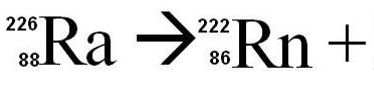
Describe the structure of an alpha particle.
a fast-moving electron
2 protons and 2 neutrons
a slow-moving neutron
a hydrogen nucleus
What is the relative charge of an alpha particle?
-1
0
1
2
In alpha decay, the atomic number...
increases by 2
decreases by 2
increases by 4
decreases by 4
In alpha decay, the mass number...
increases by 2
decreases by 2
increases by 4
decreases by 4

The mass number of Neptunium (Np) is (a) .

The atomic number of Neptunium (Np) is (a) .
In the equation, 146C --> 147N + 0-1B, the _______ decay of radioactive carbon-14 results in the creation of a new nitrogen-14 atom.
Gamma
Beta
Alpha
23892U-->23490Th + 42He + 200
What is the relative charge of a positron?
-1
0
1
2
In beta-minus decay, a proton changes to a neutron and an electron.
True
False

The atomic number of Actinium (Ac) is (a) .

The atomic number of Carbon (C) is (a) .
Armour-piercing shells with depleted uranium cores are
fired by aircraft at tanks. (The high density of the uranium makes them effective.) The uranium is called depleted because it has had its 235 U removed for reactor use and is nearly pure 238 U . Depleted uranium has been erroneously called nonradioactive. To demonstrate that this is wrong. Calculate the activity of 60.0 g of pure 238 U.
(a)

