
Font size
 Worksheets
Chromatography
Total questions: 100
Worksheet time: 58mins
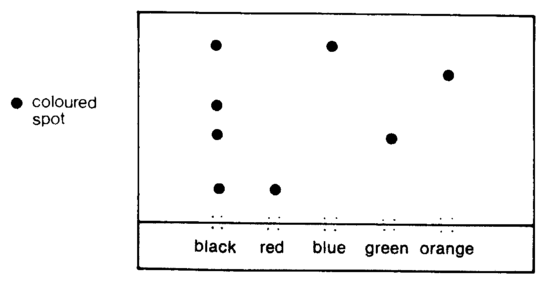
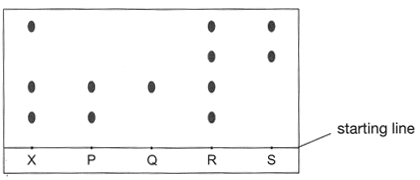
A substance is soluble if it can be dissolved.
In paper chromatography, the most soluble solute _____________________ .
does not move from the start point
stays closest to the start point
travels furthest away from the start point
can be found in the middle of the chromatogram
Which of the following mixture/s is/are separated by chromatography?
Pigments from natural colours
Colours in a dye
Colours of flowers extracts
All the above
Which of the following is correct about chromatography?
It separates those solutes that dissolve in the same solvent.
It separates those solutes that dissolve in different solvents.
It separates a solute that dissolves in a solid solvent.
It separates gaseous solutes from liquid solvents.
If a substance is not soluble in the solvent, what happens to the spot placed on the start line?
a) Dot moves to the top of the paper
b) Dot does not move at all
c) Dot moves to the left or right
d) Dot moves down to the bottom of the paper
In size exclusion chromatography, the higher the degree of cross-linking of the gel polymer, ………..
the lower the mechanical strength and the larger the molecular sieving range.
the higher the mechanical strength and the larger the molecular sieving range.
the lower the mechanical strength and the smaller the molecular sieving range.
the higher the mechanical strength and the smaller the molecular sieving range.
In gel permeation chromatography, a type of size exclusion C, which of the following is correct?
Compressible gels are commonly used.
Spherical bead shape is preferred.
Mechanical strength increases with large particle size.
Gels with large bead size are preferred.
Q. Chromatography is generally used for the separation of mixtures based on the differences in their
shape
size
structure
all of the above
Ion-exchange chromatography is used for the separation of
polar molecules
nonpolar molecules
none of the above
all of the above
Which chromatographic technique depends on the highly specific interactions between pairs of biological materials such as enzyme-substrate?
ion exchange chromatography
affinity chromatography
adsorption chromatography
igel permeation chromatography
In gel filtration (size exclusions) chromatography, separation of proteins are based on their
size and net charge
size and shape
size and specific affinity
shape and net charge
Which polymer is often used for matrix materials in Affinity chromatography
Agarose
cellulose
dextrose
all of the above
In anion exchange chromatography,
the column contains positively charged beads where negatively charged proteins bind
the column contains negatively charged beads where positively charged proteins bind
the column contains negatively & positively charged beads where proteins bind depending on their net charge
all of the above
Chromatography is used to separate the components of a mixture and can be carried out in a range of different ways.
a) A suitable example of a ‘carrier gas’ in gas chromatography is
Chlorine
Nitrogen
Steam
Not possible to state, as there should be a vacuum
(b) Separation is achieved in gas chromatography due to the components in the mixture having different
Interactions with the stationary phase.
Interactions with the mobile phase.
Colours
Solubility in the moving solvent.
Which gas is the least suitable as a carrier gas in Gas-Liquid Chromatography?
Argon
Carbon Dioxide
Oxygen
Nitrogen
Chromatography may be used to separate mixtures of amino acids. This is best explained by the fact that different amino acids have different interactions with
the mobile phase only
the stationary phase only
the mobile phase and the stationary phase
ninhydrin
In one type of HPLC, the stationary phase is non-polar and a polar solvent is used as the eluent. Which of the following would travel through the chromatography column most quickly?
Tetrachloromethane
Chloromethane
Iodomethane
Hexane
In HPLC (High Performance Liquid Chromatography) which of these factors does not affect the time taken for a component to pass through the column?
Type of detector
Material of stationary phase
Particle size of stationary phase
Temperature of column
In gas chromatography, the time taken for a substance to travel through the column is called
Reference time
Retention time
Separation time
Travelling time
Why is GC-MS an important analytical technique in science?
Allows unknown substances to be identified
Quantifies the amount of known chemicals
Characterizes the boiling point of a compound
Determines the volatility of a compound
Fill in the blank : The more soluble the colour in water __________ the colour is carried
The further up the paper
the more water will soak up the paper
more spots of mixture are placed on pencil line
The lower down the paper
Which of the following columns are not used in HPLC
Analytical column
Separation column
Guard column
Capillary column
Which of the following will improve the efficiency of separation process in liquid chromatography?
Increase in sample size, increase in column diameter
Reduction in sample size, increase in column diameter
Increase in sample size, reduction in column diameter
Reduction in sample size, reduction in column diameter
The retention factor is used
to zero the chromatography scale
to identify unknown compounds in a sample
to retain solvent
as a starting tool for chromatography
Thin layer chromatography is
partition chromatography
electrical mobility of ionic species
adsorption chromatography
none of the above
Ion-Exchange chromatography:
separate and analyze compounds that can be vaporized without decomposition
Also known as Liquid-Solid Chromatography
Separation based on partition coefficient between 2 immiscible liquids
Materials used are either cation or anion resins
The presence of more than one spot on the TLC plate shows that____
the Rf value is higher than it should be
the solvent used was too dilute
impurities are present
too much solvent was used

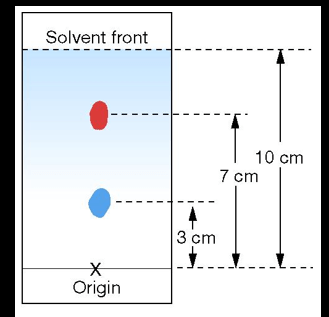
The Rf value for the red component is
0.3
0.7
10
7
In size exclusion chromatography, the higher the degree of cross-linking of the gel polymer, ………..
the lower the mechanical strength and the larger the molecular sieving range.
the higher the mechanical strength and the larger the molecular sieving range.
the lower the mechanical strength and the smaller the molecular sieving range.
the higher the mechanical strength and the smaller the molecular sieving range.
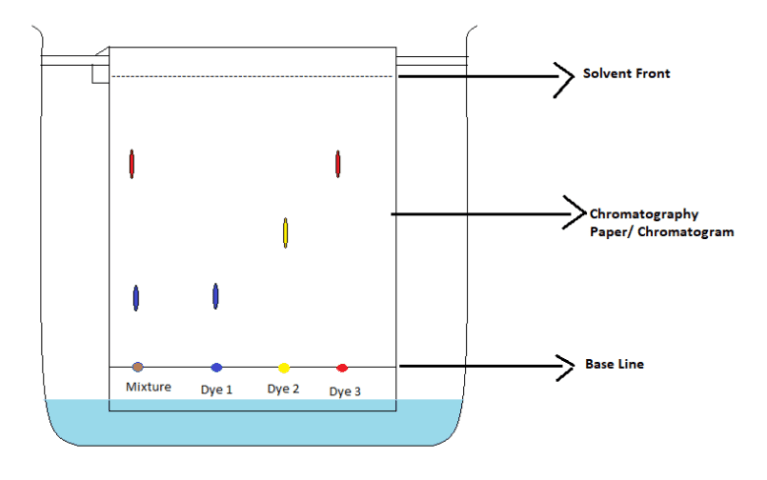
The stationary phase in this experiment is...
chromatography paper
water
beaker
dye
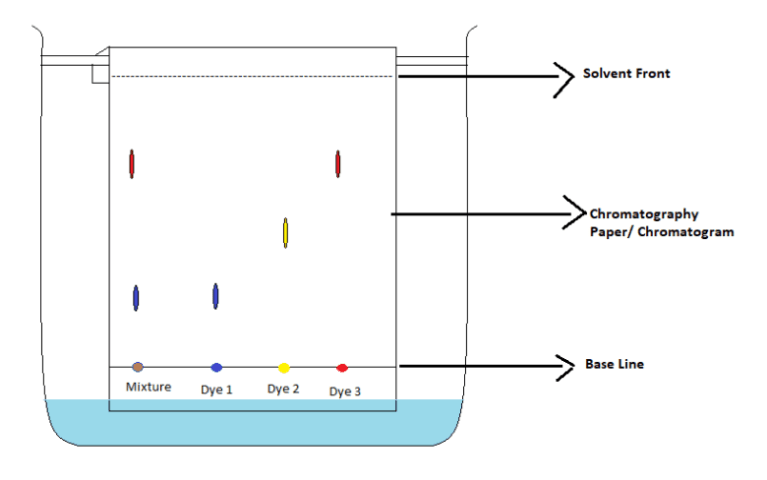
The mixture on the left contains...
All three dyes
None of the dyes
Dye 1 and Dye 2
Dye 1 and Dye 3
Dye 2 and Dye 3
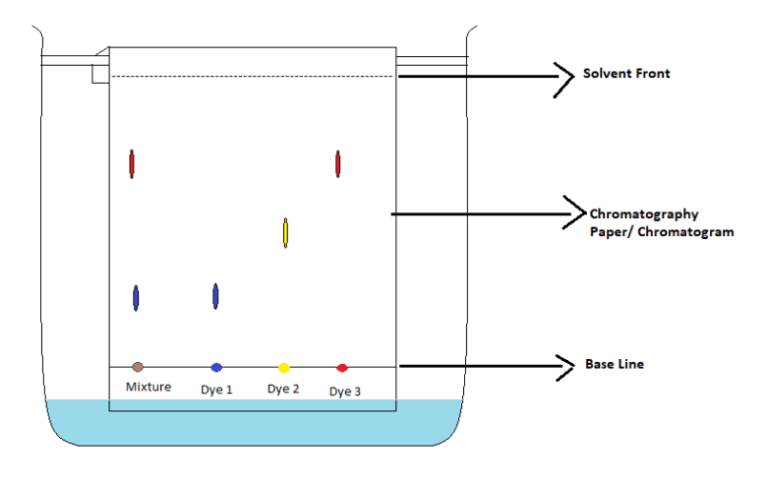
The dye with the HIGHEST Rf value will be...
Dye 1
Dye 2
Dye 3
All have the same Rf value
Chromatography separates a mixture of dyes on the basis of their
density or weight
gravity
boiling point
I paper chromatoraphy
II TLC
III HPLC
IV GC
I paper chromatoraphy
II TLC
III HPLC
IV GC
I Size/weight
II Polarity
III melting point
In case of chromatography the solvent rises up due to ……………………..
Solute
Filter paper
Capillary action
None of the above
Which of the following cannot be separated by chromatography?
Components of blood
Salt from water
Components of ink
Both a and b
Black dye separates into:
Yellow, red and green colour
Blue, red and yellow colour
Yellow and green colour
Red and yellow colour
Which of the following statements is correct?
The most soluble component remains near the bottom.
The most soluble component rises to the top.
The least soluble component remains near the bottom.
Both b and c
What molecules move up the paper to carry the different colors of ink?
color
fat
water


What type of chromatography is depicted by the illustration?
Gel Filtration Chromatography
Column Chromatography
HPLC
Thin Layer Chromatography
Which of the following methods could be used to check the molecular weight of your purified protein?
SDS-PAGE
Mass Spectrometry
Analytical SEC
All of above
To elute target proteins from an affinity chromatography matrix, which of the following conditions would be the most appropriate?
Low salt concentrations
High salt concentrations
Adding a soluble ligand which competes with the affinity tagged protein for binding to the column
Just keep washing buffer through the column, isocratic elution
What is the starting point for selection of a suitable IEX matrix for purification of a recombinant protein?
Prediction of isoelectric point (pI) from the amino acid sequence
Test protein binding to an IEX matrix at a range of pHs and salt concentrations
Test protein binding to a selection of anion and cation exchange matrices
Pass your sample through a preparative column and elute with a salt gradient
Which of these techniques is often considered a suitable "polishing" step in a protein purification strategy?
Affinity chromatography (AC)
Ion-exchange chromatography (IEX)
Hydrophobic interaction chromatography (HIC)
Size-exclusion chromatography (SEC)
You find that your protein sample loses activity during storage. What can you do about this?
Add an additional purification step
Use a protease inhibitor during purification steps
Perform each step as quickly as possible, in a cold-room
All of the above
Investigators use ________ chromatography when identifying unknown plant pigments and other compounds.
thin-layer
gas
paper
liquid
____________ Chromatography uses thin plastic or glass trays to identify the composition of pigments, chemicals, and other unknown substances.
Gas
Thin-layer
Liquid
Paper
____________ Chromatography is used to determine the chemical composition of unknown substances, such as the different compounds in gasoline.
Paper
Liquid
Gas
Thin-Layer
____________ Chromatography can be used to separate the components of inks, dyes, plant compounds, make-up and other substances.
Paper
Liquid
Gas
Thin-Layer
__________ is a substance that does dissolve in water.
Solvent
Insoluble
Soluble
Solution

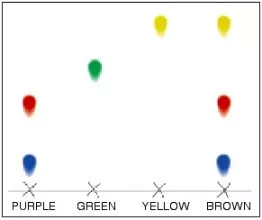
Which colour is the most soluble?
Blue
Green
Yellow
How many spots will show on a chromatogram of a pure substance?
0
1
2
3
What information can you obtain from a chromatogram about the composition of a coloured substance?
whether it contains salt
whether it is pure or a mixture
whether it contains water
whether it has a low boiling point
What information can you obtain from a chromatogram about the composition of a coloured substance?
whether it contains salt
whether it is pure or a mixture
whether it contains water
whether it has a low boiling point
Which separation technique is used to obtain pure water from seawater?
Simple distillation
Filtration
Chromatography
Evaporation
What is the physical property on which fractional distillation depends?
different boiling points
different melting points
different solubilities
different densities
Name the separation method that causes wet clothes on a laundry line to dry
Chromatography
Filtration
Distillation
Evaporation
Hydrophobic molecules can be separated by ion exchange chromatography
True
False
Cationic exchanger is used when molecules of interest is
Positively charged
Negatively charged
Neutral
Zwitterion
Anionic exchanger is used to separate molecules having
Positively charged
Negatively charged
Neutral
Elution can be done by how many types?
1
2
3
4
Elution of anionic exchanger resin can be done by treatment with
Acid
Buffer
NaOH
Ammonia
HPLC stands for
High Performance Layer Chromatography
High Performance Liquid Chromatography
Highly Placed Liquid Chromatography
Hard Performance Liquid Chromatography
HPLC methods include
liquid/liquid (partition) chromatography
liquid/solid (adsorption) chromatography
ion exchange nd size exclusion chromatography
all of the option correct
Based on a normal chromatography, the stationary phase is polar.
TRUE
FALSE
Depends on the substance
A wave with a long wavelength will have a ______ frequency and _____ energy
high, low
high, high
low, high
low, low
A hydrophobic compound will preferentially partition into an aqueous solvent. True or false?
True
False
Chromatography is a physical method that is used to separate and analyse _____________.
Pure compounds
Complex mixtures
Viscous mixtures
Metals
In which type of chromatography, the stationary phase held in a narrow glass tube and the mobile phase is forced through it under pressure?
Column chromatography
Planar chromatography
Liquid chromatography
Gas chromatography
In chromatography, which of the following can the mobile phase be made of?
Solid or liquid
Liquid or gas
Gas only
Liquid only

