wayground logo

Free Printable Worksheets

Font size

S
M
L
XL
Worksheets

chemistry chapter 1

Total questions: 100

Worksheet time: 1hrs 15mins

Name
Class
Date
1.

Chemistry is a branch of science to study

(I) Interactions between matter

(II) Structure of matter

(III) Composition of matter

(IV) Properties of matter

a)

I, II, and III

b)

I, II, and IV

c)

II, III, and IV

d)

I, II, III, and IV

2.

Which of the Following is a Benefit of Chemistry

a)

Increased Pollution

b)

Explosives

c)

Depletion of Natural Resources

d)

Agriculture

3.

The branch of chemistry which deals with the study of carbon compounds is ?

a)

Biochemistry

b)

Organic Chemistry

c)

Inorganic Chemistry

d)

Polymer Chemistry

e)

Physical Chemistry

4.

In the ________ world, objects are large enough to see with the unaided eyes and in the _______ world, magnification is required to see objects.

a)

microscopic; macroscopic

b)

macroscopic; microscopic

c)

macroscopic; large

d)

small; microscopic

5.

A well-tested explanation for a broad set of observations

a)

scientific law

b)

theory

c)

observation

d)

hypothesis

6.

Lavoisier helped transform chemistry from the science of _______ to the science of ________.

a)

measurement; observation

b)

technology; periods

c)

observation; measurement

d)

experiment; alchemy

7.
The study of chemicals that, in general, do not contain carbon. 
a)
applied chemistry
b)
inorganic chemistry
c)
organic chemistry
d)
biochemistry
8.

Which of these is not a purpose of chemistry?

a)

improve quality of life

b)

explain reactions

c)

solve problems

d)

explain life processes

9.
Which part of an atom is POSITIVELY charged?
a)
protons
b)
neutrons
c)
electrons
d)
atoms
10.
What part of an atom is NEGATIVELY charged?
a)
protons
b)
neutrons
c)
electrons
d)
atoms
11.
What is the picture displayed?
a)
Atom
b)
Element
c)
Molecule
d)
Compound
12.

What is the picture displayed?

a)

atom

b)

element

c)

compound

13.
Which two particles make up the nucleus of an atom?
a)
protons and electrons
b)
protons and neutrons
c)
molecules and compounds
d)
neutrons and electrons
14.

Which of the following cannot be broken down into something simpler?

a)

A compound

b)

An element

c)

A mixture

15.
What determines the type of element an atom makes?
a)
The size of the nucleus
b)
The number of protons
c)
How much an atom weighs
d)
The number of neutrons
16.
What do we call a chemical substance made up of 2 or more different types atoms bonded together?
a)
formula
b)
atom
c)
subscript
d)
compound
17.

How many Hydrogen atoms are present in H20?

a)

2

b)

4

c)

1

d)

0

18.

Humans absorb oxygen from the air they breathe in and exhale carbon dioxide gas, CO2. Carbon dioxide gas is

a)

an element made of carbon and oxygen atoms.

b)

a solution made of carbon and oxygen atoms.

c)

a compound of carbon and oxygen atoms.

d)

a mixture of carbon and oxygen atoms.

19.
Carbon (C) and hydrogen (H) are pure substances. Each is made of only one type of atom, but carbon atoms are different from hydrogen atoms. Carbon and hydrogen chemically combine to form methane (CH4).
a)
methane is an element and carbon and hydrogen are compounds.
b)
carbon, hydrogen, and methane are all elements.
c)
carbon, hydrogen, and methane are all compounds.
d)
carbon and hydrogen are elements and methane is a compound.
20.
A compound is...
a)
a substance made up of one type of atom in its molecular form.
b)
a substance formed by the reaction of two or more elements.
c)
a mixture formed by the mixing of two or more elements.
d)
a substance made up of one type of atom in its atomic form.
21.
What part of the atom is responsible for determining an atom's chemical properties? 
a)
all electrons
b)
protons
c)
neutrons
d)
valence electrons
22.

What is a small particle that is known as the basic building block of matter?

a)

molecule

b)

compound

c)

element

d)

atom

23.

What is a substance with unique physical and chemical properties that can't be reduced by chemical means.

a)

an element

b)

an atom

c)

a molecule

d)

a compound

24.

A(n) ____________ between atoms determine whether they will bond to form a molecule.

a)

attraction

b)

compound

c)

repulsion

d)

bridge

25.

which of the following terms best describes and extended structure with repeating patterns.

a)

A crystal

b)

An atom

c)

A molecule

d)

An element

26.

What type of model is pictured here?

a)

space filling model

b)

ball and stick model

27.

Which of these is only a molecule and not a compound?

a)

a

b)

b

c)

c

d)

d

28.

Which of the images represents a mixture.

a)

pepper

b)

salt

29.
What is a mixture?
a)
elements chemically combined
b)
a combination of different things
c)
it is found on the Periodic Table 
d)
it is made of chemical
30.
What type of mixture is this?
a)
heterogeneous 
b)
homogeneous
31.

In a solution the substance that dissolves in the solvent.

a)

Solute

b)

Suspension

c)

Colloid

d)

Solvent

32.
The scattering of light by colloids is called ____. 
a)
homogeneous
b)
suspension
c)
air pollution
d)
The Tyndall effect
33.

Which statement is true about compounds?

a)

a pure substance where two or more elements are chemically combined

b)

a homogenous mixture of 2 or more elements

c)

a pure substance containing only one type of atom

d)

a heterogeneous mixture of 2 or more elements chemically combined

34.
What is a precipitate?
a)
an insoluble reactant formed during a chemical reaction
b)
an insoluble product formed during a chemical reaction
c)
a soluble solvent in a saturated solution
d)
a soluble solute in a saturated solution
35.
Sand floating in water, but most of the sand is settled at the bottom this an example of which type of mixture?
a)
A solution
b)
A colloid
c)
A suspension
d)
A compound
36.

What is a physical property?

a)

A property that describes how something changes over time

b)

An observable property that describes the state of a system

c)

A property that describes how reactive something is

37.

Is an ice cream cone melting a physical or chemical change?

a)

Physical

b)

Chemical

38.

Is toasting bread a physical or chemical change?

a)

Physical

b)

Chemical

39.

Is grass growing a physical or chemical change?

a)

Physical

b)

Chemical

40.

Is crumpling a piece of paper a physical or chemical change?

a)

Physical

b)

Chemical

41.
Which state of matter has molecules that move fastest and spread to fill the space they are in?  They do not form any pattern.
a)
solid 
b)
liquid 
c)
gas
42.
Which of the following is not a chemical property? 
a)
rusting 
b)
boiling 
c)
rotting 
d)
burning 
43.
Ability to rust is this type of property:
a)
Physical property
b)
Chemical property
44.
What kind of properties can only be observed when a substance changes into a different substance?
a)
physical properties
b)
chemical properties
c)
liquid properties
d)
real properties
45.
The tool used to measure the mass of a substance or object is a ______________.
a)
balance
b)
graduated cylinder
c)
ruler
d)
thermometer
46.
Jack has a rock. The rock has a mass of 14g and a volume of 2cm3. What is the density of the rock?
a)
7 mL
b)
7 g/cm3
c)
28 g/cm3
d)
1/7 g/cm3
47.
What is the volume of Object X?
a)
10.0 cm3
b)
15.0 cm3
c)
20.0 cm3
d)
25.0 cm3
48.
Which state of matter has molecules that move fastest and spread to fill the space they are in?  They do not form any pattern.
a)
solid 
b)
liquid 
c)
gas
49.
Is burning wood a chemical or physical change?
a)
chemical
b)
physical
50.
Is glass breaking a chemical or phyiscal change?
a)
chemical
b)
physical
51.
Is a a rusting bicycle a chemical or physical change?
a)
chemcial
b)
physical
52.
Is spoiling food a physical or chemical change?
a)
phyiscal
b)
chemical
53.
Is frying an egg a physical or chemical change?
a)
chemical
b)
physical
54.
Salt dissolves in water
a)
physical Change
b)
chemical change
55.
Which is a chemical change?
a)
freezing fruit juice
b)
slicing a potato
c)
boiling water
d)
copper metal turning green
56.

What is chemical change?

a)

How two chemicals react with one another when combined

b)

A property that we can measure or observe with our 5 senses or other tools

c)

When two chemicals react with one another to form a new substance

d)

When a change occurs but it does not result in the formation of a new substance

57.

What do we call the molecules that are present at the end of a chemical reaction?

a)

Reactants

b)

Products

c)

Ingredients

d)

Atoms

58.

Thermal energy (heat) is released or absorbed during the reaction explains the _________________

a)

Change in color

b)

Change in temperature

c)

Change in gas

59.

When you increase the energy by heating a liquid what happens to the motion of the molecules

a)

They slow down

b)

They speed up

c)

Heat doesnt change the motion of the molecules

60.
Convert 17 m to cm:
a)
0.17 cm
b)
0.017 cm
c)
1,700 cm
d)
170 cm
61.

1 L = ______ milliliters

a)

A. 0.01

b)

B. 0.001

c)

C. 100

d)

D. 1000

62.

Which of the following is a unit that measures TEMPERATURE?

a)

grams

b)

meters

c)

seconds

d)

Ampere (Amp)

e)

Kelvin

63.

What is the mass of the object on this triple beam balance?

a)

310.30g

b)

313.0g

c)

13g

d)

310.03g

e)

none of these

64.

What is the abbreviation for picosecond?

(a)  

65.

What is the abbreviation for nanometer?

(a)  

66.

The metric prefix that means one trillionth?

a)

micro-

b)

pico-

c)

nano-

d)

milli-

67.

The metric prefix that means one thousandth?

a)

tera-

b)

deci-

c)

centi-

d)

milli-

68.
It is a measure of how close measurements come to each other when they are made in the same way
a)
Accuracy
b)
Precision
c)
Error
d)
Extrapolation
69.
a)
Student A
b)
Student B
c)
Student C
d)
Cannot be determined
70.
This bullseye demonstrates...
a)
High Accuracy & High Precision
b)
High Accuracy & Low Precision
c)
Low Accuracy & High Precision
d)
Low Accuracy & Low Precision
71.

How close a measurement is to the accepted value is called..

a)

Accuracy

b)

Precision

c)

Significant

d)

Estimate

72.
A set of data are all close to each other, and they are close to the actual value.  This set of data can be described as...
a)
accurate
b)
precise
c)
both precise and accurate
73.

Which Student is the most Precise?

a)

Alex

b)

Shandra

c)

Luis

74.
How many sig figs are in 0.0045670?
a)
8
b)
4
c)
5
d)
7
75.
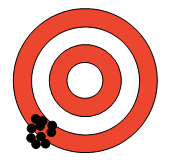
Describe the accuracy and precision of the image
a)
Accurate and Precise
b)
Accurate and not precise
c)
Not Accurate and Precise
d)
not accurate and not precise
76.
How many significant figures does the following number have: 1740200
a)
2
b)
1
c)
3
d)
5
77.
How many sig figs are in 927.0020?
a)
4
b)
3
c)
6
d)
7
78.
Describe the accuracy and precision of the image
a)
Accurate and Precise
b)
Accurate and not precise
c)
Not Accurate and Precise
d)
not accurate and not precise
79.
How many significant figures does the following number have: 100.3
a)
4
b)
3
c)
5
d)
2
80.

Which set of properties, intensive or extensive, are based on the size of a sample?

a)

intensive

b)

extensive

81.

What kind of physical property is this? Color

a)

intensive

b)

extensive

82.

What kind of physical property is this? Energy

a)

intensive

b)

extensive

83.

What kind of physical property is this? Odor

a)

intensive

b)

extensive

84.

What kind of physical property is this? Boiling Point

a)

intensive

b)

extensive

85.

What kind of physical property is this? Mass

a)

intensive

b)

extensive

86.

What kind of physical property is this? Length

a)

intensive

b)

extensive

87.

A __________________ is a substance that has definite physical and chemical properties such as appearance, melting point, and reactivity.

a)

mixture

b)

pure substance

c)

compound

d)

element

88.

Which of these is a compound?

a)

Aluminium (Al)

b)

Carbon Dioxide (CO2)

c)

Nitrogen (N)

d)

Sand

89.

All of the following are compounds EXCEPT:

a)

hydrogen

b)

sodium chloride

c)

water

d)

carbon dioxide

90.

The particle diagram shown is a:

a)

pure substance

b)

mixture

91.

The particle diagram shown is a:

a)

pure substance

b)

mixture

92.

Which picture(s) represents a mixture between an element and a compound?

a)

A

b)

B

c)

D

d)

B and D

93.

All of the following are elements EXCEPT:

a)

carbon

b)

nitrogen

c)

oxygen

d)

water

94.

An observation made with your senses

a)

Qualitative observation

b)

Quantitative observation

c)

temperature

d)

conclusion

95.

What is an hypothesis?

a)

a guess

b)

a testable, tentative explanation

c)

a theory

d)

data

96.

What is a manipulated variable (independent variable)?

a)

the variable that changes as a result of the experiment

b)

the variable that the scientist changes

c)

the evidence

d)

the quantitative observation

97.

Based on the graph, what happens to the solubility of CO2 as the temperature increases?

a)

it increases

b)

it stays the same

c)

it decreases

d)

what is a graph?

98.

Which of the following is an example of quantitative data?

a)

grey

b)

oily

c)

44.2oC

d)

Copper

99.

What is a control?

a)

a variable that is unchanged to compare results to

b)

a changed variable

c)

a hypothesis

d)

a conclusion

100.

What is the correct representation of 702.2g in scientific notation?

a)

7.02 x 10³g

b)

70.22 x 101 g

c)

7.022 x 10² g

d)

70.22 x 10² g