
NEW
Font size
 Worksheets
TOPIC 1-MOLECULES OF LIFE
Total questions: 25
Worksheet time: 24mins
At what temperature is water at the highest density?
0oC
4oC
32oC
100oC
Water is a universal solvent due to its
low viscosity.
polar molecules.
high specific heat.
high boiling point.
What gives rise to the cohesiveness of water molecules?
Hydrophobic interactions
Nonpolar covalent bonds
Ionic bonds
Hydrogen bonds

A water strider can skate on the surface of a pond because:
covalent bonds result in water cohesion
hydrogen bonds result in water cohesion (surface tension)
water striders have adapted to take advantage of water cohesion
low surface tension of water
Which property of water is responsible for cooling off the human body when sweat evaporates into water vapor?
Surface Tension
High latent heat of vaporization
Ice floats on water (solid water -ice- is less dense than liquid water
Adhesion
beta glucose condensed to form polymer, which of the following molecule is produced?
Glycogen
Starch
Cellulose
Insulin

Name the structure shown in the diagram.
β-glucose
α - glucose
amino acid
fatty acid

Diagram shows the structure of polysaccharide. Name the polysaccharide.
Amylose
Amylopectin
Glycogen
Cellusose
Which type of bond stabilize the alpha and the beta pleated sheet structures of proteins?
peptide bonds
disulphide bonds
hydrogen bonds
ionic bonds
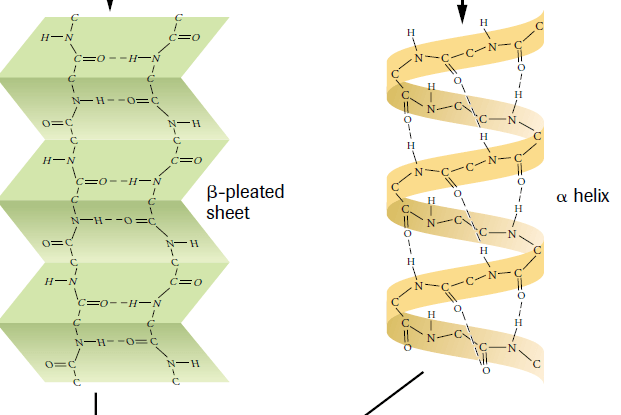
What level of protein structure is this?
Primary
Secondary
Tertiary
Quaternary

Triglycerides are formed by
Hydrogen bonding
Covalent bonding
Ester bond
Glycosidic bonds

What molecule is this?
Triglyceride
Saturated Fatty Acid
Glycerol
Unsaturated Fatty Acid

How many water molecules would be required to hydrolyse a triglyceride?
One
Two
Three
None
What are the building blocks of nucleic acids?
Amino acids.
Nucleotides.
Pentose sugars.
Phosphate groups.

Diagram shows a monomer of a.............................
Monosaccharide
Amino Acid
Nucleotide
Polysaccharide
The phoshodiester linkage in DNA or RNA is formed between
two bases
two sugars
a sugar and a base
a sugar and a phosphate
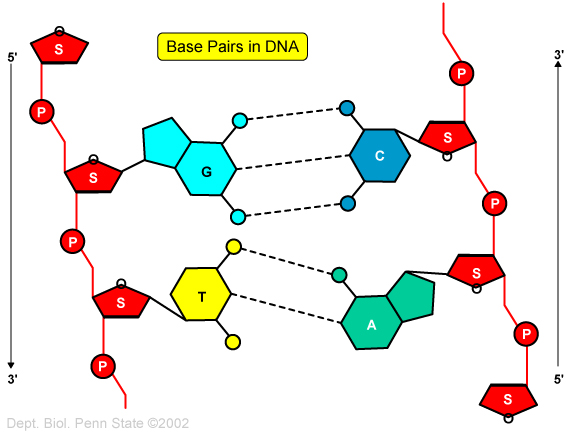
Nitrogenous bases of DNA are joined by which type of bond?
polar bonds
ionic bonds
covalent bonds
hydrogen bonds
dehydration
Polymers of polysaccharides, proteins and nucleic acid are all synthesised from monomers by
hydration.
condensation.
carboxylation.
hydrolysis

