
 Worksheets
Semester II: Module 3: Chapter 4: Electromagnetism
Total questions: 75
Worksheet time: 1hrs 16mins

Charged particles that flow continuously through material is called
Insulator
Electric Current
Flashlight
closed circuit

Electrical current will pass easily through metals such as copper, aluminum and gold. These metals are good
things
insulators
charged particles
conductors


Which of the following can move from one atom to another?
protons
neutrons
electrons
the nucleus
An object with a negative charge will be most strongly attracted to which of the following?
an object with a weak positive charge
an object with a strong positive charge
an object with a weak negative charge
an object with a strong negative charge
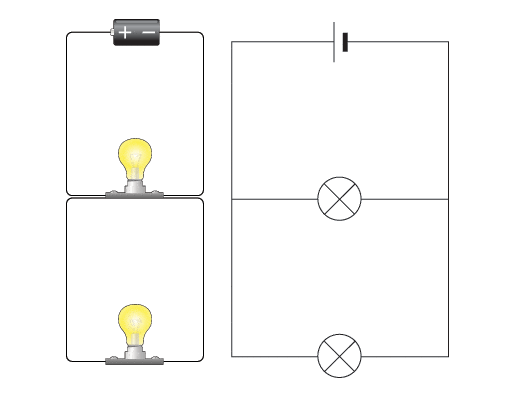
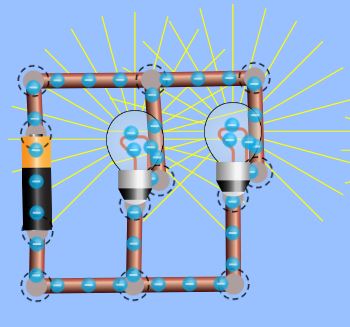
What unit is used to measure current?
Ohms
Omega
Volts
Amps
What unit is used to measure resistance?
Ohms
Omega
Volts
Amps
What is the current in a circuit with 6 ohms of resistance and a battery containing 24 Volts?
1/4 A
144 A
4 A
0.4 A
What is the resistance of a lightbulb that experiences 9 Volts and 3 amps of current?
1/3 ohms
3 ohms
27 ohms
9 ohms
What is the voltage of a circuit with 4 ohms of resistance and 3 amps of current?
12 V
21 V
4/3 V
3/4 V
What is the formula for ohms law?
1+2=3
R X E = I
V =I x R
E= MC squared

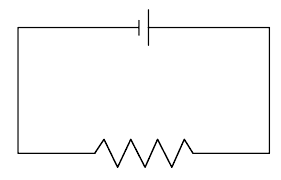
Which factor does not affect resistivity?
Length
Mass
Cross-sectional area
Temperature
The unit of resistivity is
Ω/m
Ω/m2
Ω.m
Ω.m2
The nichrome wire has a cross-sectional area of 1.3 × 10⁻⁷ m2 . Resistivity of nichrome = 1.1 × 10⁻⁶Ωm and a resistance of 53Ω. The length of the wire is
0.63m
63m
0.0063m
6.3m
A copper wire of length 2.5 m and cross-sectional area 2.4 × 10⁻⁷ m2 has a resistivity of 1.7x10⁻⁸Ωm. What is the resistance of the wire?
1.6x10⁻¹⁵Ω
1.0x10⁻¹⁴Ω
0.18Ω
5.6Ω
Resistance of a material would be equal to resistivity when
l = T
A = l
A = T
l = R
A cylindrical conductor of length l, diameter D, and resistivity ρ has a resistance R. What is the resistance of another cylindrical conductor of length l, diameter D/2 , and resistivity ρ?
8R
4R
2R
R
A wire of uniform diameter 0.28mm and a length of 1.50m has a resistance of 45Ω. It's resistivity is
2.2 x 10⁻⁸Ωm
36 Ωm
1.8 x 10⁻⁶Ωm
3.4 x 10⁻⁷Ωm
Resistivity
changes with conditions
relies on dimensions of the material
inversely proportional to resistance
a property of the material
Resistance is proportional to
l
ρ1
A
l1
A wire has a resistance R.
What is the resistance when both the length and radius of the wire are doubled?
R/4
R/2
2R
4R

What is the effective resistance of this circuit?
100Ω
200Ω
300Ω
400Ω

What is the effective resistance of this combination?
2 kΩ
1 kΩ
5 kΩ
500 Ω

What is the effective resistance of this combination?
5 kΩ
1.2 kΩ
1 kΩ
833 Ω

What is the total effective resistance of these three resistors?
3 kΩ
5 kΩ
7 kΩ
18 kΩ

What is the current flowing in this circuit?
20 μA
20 mA
20 nA
20 A

What is the current in the 1kΩ resistor?
12 mA
6 mA
1.2 mA
0.6 mA

What is the voltage across the 2 kΩ resistor?
12 V
8 V
4 V
6 V
An electrical junction has three wires A, B and C connected to it. Wire A carries 4.2 A going in, wire B carries 2.6 A going out. What does wire C carry?
1.6 A going in
1.6 A going out
6.8 A going in
6.8 A going out
Current is shared between two resistors of 3 Ω and 6 Ω, if the current in the 6 Ω is 12 A what is the total incoming current?
24 A
36 A
18 A
72 A
Select the correct statement:
The current in parallel resistors is always equal.
The sum of the sources of EMF and volt-drops in a closed loop is zero.
The sum of the currents in a closed loop is zero.
The sum of the voltages at a node is zero.
Which statement is correct?
The current in parallel resistors is always equal.
The sum of the electric potential differences (or voltages) around a loop add to zero.
The sum of the currents in a closed loop is zero.
The sum of the voltages at a node is zero.
"The sum of all voltage drops in a series circuit equals the total applied voltage." This is know as what?
Ohm's Law
Kirchhoff's Voltage Law
Kirchhoff's Current Law
Bolen's Law
"The total current in a parallel circuit equals the sum of the individual branch currents."
Ohm's Law
Kirchhoff's Voltage Law
Kirchhoff's Current Law
Bolen's Law
Power is measured in what units?
Ohms
Volts
Amperes
Watts
What does Kirchhoff's second law show?
conservation of charge
conservation of energy
In any closed loop, the sum of the e.m.f. is equal to the sum of the products of the current and the resistance (potential difference).
The sum of the current entering a junction is the sum of the current leaving the junction.
In a Wheatstone bridge if the battery and galvanometer are interchanged then the deflection in galvanometer will
(a) change in previous direction
(b) not change
(c) change in opposite direction
(d) none of these.
The magnetic field lines near a long straight wire carrying current are:
Straight lines
Concentric rings
Spiral lines
Radial lines
According to right hand thumb rule the direction of magnetic field in a current carrying straight conductor is denoted by:
Thumb
Curl fingers
Middle finger
First finger
According to right hand thumb rule the direction of magnetic field in a current carrying circular coil is denoted by
Thumb
Middle finger
Curl finger
First finger
Magnetic field arises due to
flow of steady current through a current element
flow of charges
flow of steady current through an infinite wire
flow of steady current through a closed loop
What is the unit of magnetic field?
ampere
watt
kilowatt hour
tesla
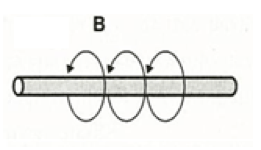
1) A wire carries a current, creating a magnetic field around itself as shown. The current in the wire is:
A. Directed to the right
A. Directed to the left
A. Equal to the magnetic field
In the same direction as the magnetic field
In moving coil galvanometer, the pole faces of U-shaped magnet are made concave
to make the field radial
to increase the field
to weaken the field
both (a) and (b)
In a moving coil galvanometer, the deflection of the coil Φ is related to the electric current i by the relation
I ∝ tanΦ
I ∝ Φ
I ∝ Φ2
I ∝ tan2Φ
The sensitivity of a moving coil galvanometer can be increased by decreasing
the number of turns in the coil
the area of the coil
the magnetic field
the restoring torque per unit twist of the suspension
A moving coil galvanometer has N number of turns in a coil of effective area A, it carries a current I. The magnetic field B is radial. The torque acting on the coil is
NA2B2I
NABI2
N2ABI
NABI
What is the principle of Moving Coil Galvanometer.
Current carrying coil in an electric field experiences a force
Current carrying coil in magnetic field experiences no force
Current carrying conductor in magnetic field experiences a force
Current carrying conductor in an electric field produces no force
The direction of the force on a current-carrying wire placed in a magnetic field depends on
the direction of the current
the direction of the field
the direction of current as well as field
neither the direction of current nor the direction of field
How does an ammeter is added in the circuit?
Series
Parallel
How does a voltmeter meter is added in the circuit?
Series
Parallel
An ammeter must have
Low resistance so that it does affect the current through the main circuit
High resistance so that it does affect the current through the main circuit
Low resistance so that it does affect the voltage across the resistor
A voltmeter must have
Low resistance so that it does affect the current through the main circuit
High resistance so that it does affect the current through the resistor
Low resistance so that it does affect the voltage across the resistor

