wayground logo

Free Printable Worksheets

Font size

S
M
L
XL
Worksheets

Properties of Matter - Unit 1

Total questions: 78

Worksheet time: 1hrs 9mins
Name
Class
Date
1.
What subatomic particles would you find in the nucleus of an atom?
a)
Protons only
b)
Protons and Neutrons
c)
Neutrons and Electrons
d)
Protons and Electrons 
2.
What subatomic particle is electrically neutral (no charge)?
a)
Proton
b)
Ion
c)
Neutron
d)
Electron
3.
What is the mass of an atom if it has 11 protons, 12 neutrons, and 11 electrons?
a)
22
b)
11
c)
34
d)
23
4.
If an atom has 10 protons, 10 neutrons, and 10 electrons, what is the mass of the atom?
a)
10
b)
20
c)
30
5.
What subatomic particle(s) would be found orbiting the nucleus?
a)
Neutrons only
b)
Electrons only
c)
Protons and Neutrons
d)
Protons and Electrons
6.
Which subatomic particles contribute the most to the mass of an atom?
a)
Protons, Neutrons, Electrons
b)
Protons only
c)
Protons and Electrons
d)
Protons and Neutrons
7.
Which one of these is NOT located in the element square on the Periodic Table?
a)
Atomic Number
b)
Atomic Mass
c)
Room Temperature
d)
Chemical Symbol
8.
Where are electrons of an atom found?
a)
Nucleus
b)
Electron Cloud
c)
Some are in the nucleus and some in the electron cloud.
d)
They are moving everywhere.
9.
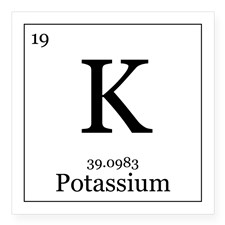
How many neutron are in the atom "K"?
a)
7
b)
2
c)
39
d)
20
10.
What is the number of protons that the element in this image contain?
a)
14
b)
7
c)
15
d)
18
11.
Ions are: 
a)
atoms with a positive or negative charge
b)
atoms with no charge
c)
atoms with ONLY a positive charge
d)
atoms with ONLY a negative charge
12.
When an atom loses a valence electron, it becomes a(n) _____________ ion.
a)
positive
b)
negative
c)
neutral
d)
polyatomic
13.
Negative ions form when atoms _________ valence electrons.
a)
lose
b)
gain
c)
share
14.
an atom with atomic number 6 would have how many protons 
a)
6
b)
12
c)
3
d)
cannot be determined 
15.

What is a cation's charge?

a)

positive

b)

negative

c)

neutral

d)

depends on the element

16.

What is an anion's charge?

a)

positive

b)

negative

c)

neutral

d)

depends on the element's charge

17.
Isotopes are atoms of the same element that have the same number of __________ but different number of __________ . Therefore, isotopes of the same element have different masses. 
a)
protons, neutrons
b)
protons, electrons
c)
neutrons, protons
d)
electrons, protons
18.
What is an isotope? 
a)
A charged atom
b)
An atom with different amounts of neutrons
c)
An atom with different amounts of protons
d)
A neutral atom
19.

What are valence electrons?

a)

The total number of electrons in an atom

b)

The number of electrons in the outermost shell

c)

The number of electrons in the second shell

d)

The number of protons in the outermost shell

20.
When a liquid reaches the temperatures of its ___, it can become a gas.
a)
melting point
b)
freezing point
c)
boiling point
d)
density
21.
The temperature when a solid changes to a liquid - 
a)
melting point
b)
freezing point
c)
boiling point
22.

What causes an object to sink in a water?

a)

if the object's density is less than the water's density.

b)

if the object's density is the same as water's density.

c)

if the object's density is greater than water's density.

d)

if the object's density is zero

23.
Helium balloons rise on earth because
a)
helium is less dense than air
b)
helium is more dense than air
c)
helium is cooler than air
d)
helium is warmer than air
24.

Why do all bonds form?

a)

so the number of protons equals the number of electrons

b)

so an atom can become unstable

c)

to fill the outermost energy level

25.

Valence electrons are found

a)

in the innermost energy level of an atom

b)

in the middle energy levels of an atom

c)

in the outermost energy levels of an atom
26.
Covalent bonds are between...
a)
Metal and Non-metal
b)
Non-metal and Non-metal
c)
Metal and Metal
27.
Ionic bonds are between...
a)
Metal and Non-metal
b)
Non-metal and Non-metal
c)
Metal and Metal
28.
Atoms are most stable when their outer shell is complete.
a)
true
b)
false
29.
How are covalent bonds formed?
a)
Sharing of electrons
b)
Transfer of electrons
30.
How are ionic bonds formed?
a)
Transfer of electrons
b)
Sharing of electrons
31.
Why do elements bond?
a)
To be friends
b)
To create a new element
c)
To become stable
32.
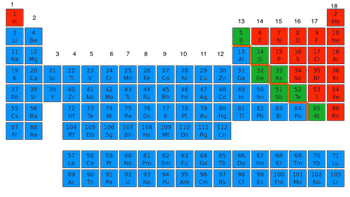
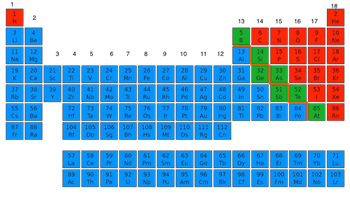
Where are the nonmetals located on the periodic table? 
a)
Blue
b)
Red
c)
Green
33.
Where are metals located on the periodic table?
a)
Blue
b)
Green
c)
Red
34.
Brittle and good conductors
a)
Ionic Bonds
b)
Covalent Bonds
c)
Both bonds
d)
Neither bond
35.
Dense and poor conductors
a)
Ionic Bonds
b)
Covalent Bonds
c)
Both bonds
d)
Neither bond
36.
Organic and less soluble
a)
Ionic Bonds
b)
Covalent Bonds
c)
Both bonds
d)
Neither bond
37.
Inorganic and very soluble
a)
Ionic Bonds
b)
Covalent Bonds
c)
Both bonds
d)
Neither bond
38.
High melting point
a)
Ionic Bonds
b)
Covalent Bonds
c)
Both bonds
d)
Neither bond
39.
Low melting point
a)
Ionic Bonds
b)
Covalent Bonds
c)
Both bonds
d)
Neither bond
40.
This picture shows a...
a)
Ionic Bond
b)
Covalent Bond
c)
Both bonds
d)
Neither bond
41.
This picture shows a...
a)
Ionic Bond
b)
Covalent Bond
c)
Both bonds
d)
Neither bond
42.
Why do covalent bonds form?
a)
Opposite charges attract
b)
Outer energy level shells become full
c)
Both
d)
Neither
43.
Why do ionic bonds form?
a)
Opposite charges attract
b)
Outer energy level shells become full
c)
Both
d)
Neither
44.

_____is the tendency of matter to be easily broken to pieces.

a)

Hardness

b)

Malleability

c)

Brittleness

d)

Elasticity

45.

____ is the ability to be pressed, hammered or rolled into various shapes and sizes without breaking.

a)

Elasticity

b)

Strength

c)

Hardness

d)

Malleability

46.
Which of these is a property of metals?
a)
It's malleable
b)
It can't conduct electricity
c)
They are used in food
d)
It's very brittle
47.
Which of the following is NOT a characteristic of most metals?
a)
Brittle
b)
Good conductor
c)
Ductile
d)
Malleable
48.
How do metals differ from nonmetals?
a)
metals are shiny, nonmetals are dull
b)
metals are good insulators, nonmetals are good conductors
c)
metals are powdery
d)
nonmetals are shiny
49.
At room temperature metals are ____________.
a)
plasma
b)
gases
c)
liquid
d)
solid
50.
Metals that can be used as wire are ____________.
a)
metallic
b)
shiny
c)
malleable
d)
ductile
51.
Which of the following is a good conductor of heat?
a)
Metal
b)
Nonmetal
c)
Metalloid
52.
Which of these grouping of elements could have the characteristic of luster (shiny)?
a)
Metal
b)
Nonmetal
c)
metalloids
d)
Both metals and metalloids
53.
If a substance is magnetic it is most likely a 
a)
metal 
b)
non-metal
54.
A substance that has luster, is brittle, and can't conduct electricity would be known as?
a)
A metal
b)
A non metal
c)
A metalloid
55.
Pure sodium has luster, bends easily, and conducts electricity.  Based off these properties, it would be classified as?
a)
A Metal
b)
A non metal
c)
A metalloid
56.
Fluorine is used in many tooth pastes because it helps maintain healthy teeth.  At room temperature it is gaseous, and does not conduct electricity. Based off these properties, it would be classified as?
a)
A metal
b)
A non metal
c)
A metalloid
57.
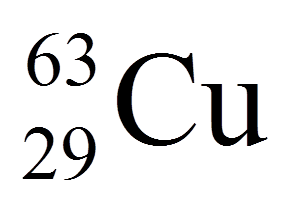
The top number in this isotope notation is
a)
the mass number
b)
the atomic number
c)
the atomic mass
d)
the neutron number
58.
How many protons does He have?
a)
4
b)
2
c)
6
d)
0
59.
The bottom number in this isotope notation is
a)
the mass number
b)
the atomic number
c)
the atomic mass
d)
the neutron number
60.
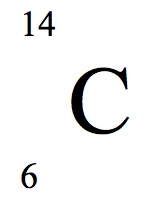
The photo above shows the isotopic notation for which isotope?
a)
Carbon 12
b)
Carbon 13
c)
Carbon 14
d)
Carbon 15
61.
Different isotopes have...
a)
different masses
b)
different atomic numbers
c)
different electrons
d)
different protons
62.

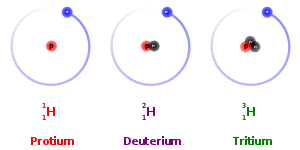
What is the atomic mass of the pictured isotope?

a)

2

b)

4

c)

6

d)

The correct answer isn't one of the choices.

63.

Lead Chloride is an ionic compound, made up from Pb2+ ions and Cl- ions. Which is the correct formula for this compound?

a)

PbCl3

b)

PbCl

c)

PbCl4

d)

PbCl2

64.

Magnesium Hydroxide is an ionic compound made up from Mg2+ and OH- ions. Which is its correct formula?

a)

MgOH

b)

MgOH2

c)

Mg(OH)2

d)

MgO

65.

Beryllium, Be, will ____ valence electrons when forming an ionic bond.

a)

lose 4

b)

gain 4

c)

lose 2

d)

gain 2

66.
In the compound aluminum oxide, which is the cation?
a)
Al+3
b)
Al
c)
O-2
d)
O
67.

Boron, B, will ____ valence electrons when forming an ionic bond.

a)

lose three

b)

gain three

c)

lose 5

d)

gain 5

68.

Sulfur, S, will ____ valence electrons when forming an ionic bond.

a)

gain 1

b)

lose 1

c)

gain 2

d)

lose 2

69.

Sulfur, S, will ____ valence electrons when forming an ionic bond.

a)

gain 1

b)

lose 1

c)

gain 2

d)

lose 2

70.
In the chemical formula for an ionic compound, which item is written first?
a)
positive ion
b)
negative ion
c)
subscript
d)
the female
71.
Write the correct chemical formula for Ag  and  Br -
a)
AgBr
b)
silver bromide
c)
Ag2Br2
d)
gold bromide
72.
Write the formula for barium + nitrogen
a)
Ba2N3
b)
Ba3N2
c)
BaN
d)
BaN3
73.
Write the correct formula for an ionic compound formed from S2- and Rb1+.
a)
SRb2
b)
SRb
c)
Rb2S
d)
RbS2
74.
What can be generalized about covalent bonds?
a)
Electrons will be exchanged.
b)
Electrons will be transferred.
c)
Electrons will be given and taken.
d)
Electrons will be shared.
75.

What is the formula for diphosphorus pentoxide?

a)

P2O5

b)

PO5

c)

P5O2

d)

P2O6

76.
What is the correct name for NO?
a)
Mononitrogen Monoxide
b)
Nitrogen Monoxide
c)
Mononitrogen Dioxide
d)
Nitrogen Oxide
77.
The chemical formula of sulfur hexabromide is
a)
SBr₆
b)
S₆Br
c)
S(VI)Br
d)
S6Br
78.

Silicon dioxide is the compound in sand. What is its formula?

a)

SO2

b)

NaO2

c)

SiO2

d)

SiO