wayground logo

Free Printable Worksheets

Font size

S
M
L
XL
Worksheets

Algebra 1 Function Characteristics Quiz Review

Total questions: 42

Worksheet time: 2hrs 40mins

Name
Class
Date
1.
For the function {(0,1), (1,-3), (2,-4), (-4,1)}, write the domain and range.
a)
D: {1, -3, -4,}
R: {0, 1, 2, -4}
b)
D: {-4, 0, 1, 2}
R:{-4, -3, 1}
c)
D: {0, 1, 2, 3, 4}
R:{1, -3, -4}
d)
D: {0, 1, 2, -4}
R: {1, -3, -4, 1}
2.
a)
{1, 2, 3, 4, 5}
b)
{-1, 1, 2, 3}
c)
{1, 2, 3, 5}
d)
[1, 5]
3.
What is the range of the following relation:
(9, -2) (4, 3)  ( 8, 10) ( -4, 8)
a)
{-4, 4, 8, 9}
b)
{-2, 3, 8, 10}
c)
{(9, -2) ( 4, 3)}
d)
{(8, 10) (-4, 8)}
4.
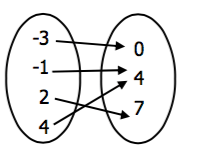
What is the range?
a)
{-3, -1, 2, 4}
b)
{0, 4, 7} 
c)
{0, 4, 4, 7}
d)
{7, 4, 0}
5.
What is the Domain of this linear function?
a)
-3 < x ≤ 5
b)
x = -1
c)
5 < x ≤ -3
d)
-2 < x ≤ 6
6.
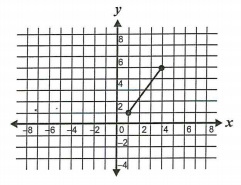
What is the range of the graph?
a)
1 ≤ x ≤ 5
b)
1 < x < 5
c)
1 ≤ y ≤ 5
d)
1 < y < 5
7.
What is the RANGE?
a)
{-3, 3]
b)
all real numbers
c)
[-4, 5]
d)
[-4, ∞)
8.
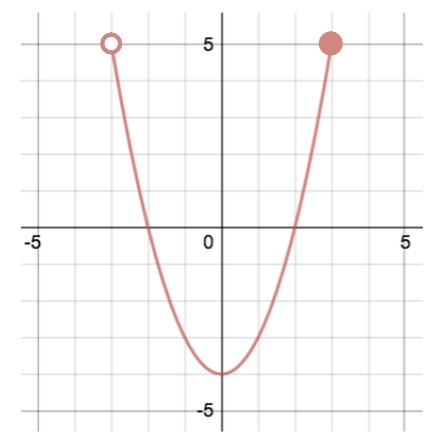
What is the DOMAIN?
a)
(4, ∞)
b)
(-4, ∞)
c)
[-3, 3)
d)
(-3, 3]
9.
What is the RANGE?
a)
(-∞, 0)
b)
(0, ∞)
c)
All real numbers
d)
{0, 1, 2, 3, 4,...}
10.
What is the DOMAIN?
a)
[0, ∞)
b)
(-∞, 0)
c)
All real numbers
d)
{0, 1, 2, 3, 4,...}
11.
What is the RANGE?
a)
all real numbers
b)
[1, ∞)
c)
(-∞, 1]
d)
none of these
12.
What is the range of the function?
a)
[-1, +∞)
b)
(-1,1)
c)
[1.5, +∞)
d)
(-2, 2)
13.
What is the range? 
a)
[-∞, +∞]
b)
[-2, 2]
c)
(-∞, ∞)
d)
[0, 2]
14.
What is the range of the graph?
a)
-15 < y < ∞
b)
(-∞, ∞)
c)
(-15, ∞)
d)
[-15, ∞)
15.
What is the domain of the graph?
a)
{x| -∞ ≤ x ≤ ∞}
b)
(-∞,∞)
c)
-3 ≤ x ≤ 3
d)
-15 ≤ y ≤ 9
16.

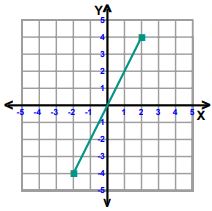
What is the domain in Interval notation?

a)

[ -2 , 2 ]

b)

[ 4 , -4 ]

c)

-2 ≤ x ≤ 2

d)

4 ≥ y ≥ -4

17.
Over what interval is this function constant?
a)
-5 < x < ∞
b)
-3 < x < 4
c)
4 < x < ∞
d)
-5
18.
When is this function increasing?
a)
-2.5 < x < 2.5
b)
0 < x < 5
c)
0 < x < 55
d)
-5 < x < 0
19.
Which statement is true about this graph?
a)
This function is always constant
b)
This function is always increasing
c)
This function is never increasing
d)
This function is both increasing and decreasing
20.

Check all the intervals where this graph is decreasing.

a)

(-∞, -1)

b)

(-1, 0)

c)

(0, 1)

d)

(1, ∞)

21.

Check all the intervals where this graph is increasing.

a)

(-∞, -1)

b)

(-1, 0)

c)

(0, 1)

d)

(1, ∞)

22.

Find the interval(s) of increase of the graph shown.

a)

(-6, -4)

b)

(-4, -2)

c)

(-2, 2)

d)

(2, 5)

e)

(5, 6)

23.

Find the interval(s) of decrease of the graph shown.

a)

(-6, -4)

b)

(-4, -2)

c)

(-2, 2)

d)

(2, 5)

e)

(5, 6)

24.

Find the interval(s) where the graph remains constant.

a)

(-6, -4)

b)

(-4, -2)

c)

(-2, 2)

d)

(2, 5)

e)

(5, 6)

25.
Where is the function increasing?
a)
(-∞,5]
b)
(-∞,0]
c)
(-∞,2]
d)
[0,2]
26.

What is the interval of increase?

a)

From 0 to 3

b)

From 3 to 7

c)

From 25 to 40

d)

From 50 to 25

27.

What is the decreasing interval(s) on the function shown?

a)

(7, 6) and (2, 4)\left(-7,\ -6\right)\ and\ \left(-2,\ 4\right)

b)

(7, 0) and (2, 4)\left(-7,\ 0\right)\ and\ \left(-2,\ 4\right)

c)

(7, 6) and (2, 0)\left(-7,\ -6\right)\ and\ \left(-2,\ 0\right)

d)

(7, 0) and (4, 5)\left(-7,\ 0\right)\ and\ \left(4,\ 5\right)

28.
What is the domain of the graph?
a)
[1,∞)
b)
(-∞,1]
c)
(-∞,∞)
d)
[-∞,∞]
29.

How would you describe the point at (0,6)?

a)

Relative Minimum

b)

Absolute Minimum

c)

Relative Maximum

d)

Absolute Maximum

30.

The blue dot on this graph represents a(n)...

a)

Absolute Maximum

b)

Absolute Minimum

c)

Relative Maximum

d)

Relative Minimum

31.

What is the x-intercept(s)?

a)

(0, 6)

b)

(6, 0)

c)

(2, 1)

d)

There is no x-intercept.

32.

What is the y-intercept?

a)

(0, 5)

b)

(5, 0)

c)

(0, -5)

d)

(-5,0)

33.
What is the x-intercept for the given graph?
a)
1
b)
-2
c)
2
d)
1/2
34.
What is the x-intercept shown on the graph?
a)
(2, 0)
b)
(-2, 0)
c)
(0, 3)
d)
(3, 0)
35.
True or false:
The y-intercept of a function ALWAYS occurs where y is equal to zero.
a)
True
b)
False
36.
True or false:
The x-intercept of a function ALWAYS occurs where y is equal to zero.
a)
True
b)
False
37.

Which ordered pair identifies the *absolute minimum* point on this function?

a)

(-1, 0)

b)

(0, -3)

c)

(1, -4)

d)

(4, 0)

38.

How would you describe the behavior of this function on the domain interval (-1, 1)?

a)

increasing

b)

decreasing

c)

constant

39.

Which coordinate point describes the location of the absolute minimum point of this function?

a)

(-2, -1)

b)

(0, -1)

c)

(-1, -2)

d)

(-5, 3)

40.

What is the minimum value (y-values only)?

a)

0

b)

-5

c)

-3

d)

-1

41.

What is the maximum value (y-value only)?

a)

2

b)

5

c)

-1

d)

0

42.

What is the minimum value (y-value only)?

a)

-3

b)

-5

c)

-1

d)

0