
 Worksheets
transport system in human and animals
Total questions: 50
Worksheet time: 32mins
Which type of cell is found in the greatest numbers in blood?
Red blood cell
White blood cell
Platelets
Why is the left wall of the heart have a thicker layer of muscle than the right side?
To stop the blood flowing backwards
To push the blood with more force at high pressure so it goes to all body cells.
To push the blood at high pressure to the lungs.
Why is there a limit to cell size in multicellular organisms?
As size of cells increase, their surface area to volume ratio also increases meaning substances would diffuse too slowly into the cell.
As size of cells increase, their volume decreases meaning substances would diffuse too slowly into the cell.
As size of cells increase, their surface area to volume ratio decreases meaning substances would diffuse too slowly into the cell.
List the structures in the circulatory system the blood travels through from vena cava to aorta.
Vena cava, lungs, pulmonary vein, left atrium, left ventricle, aorta, right atrium, right ventricle, pulmonary artery,
Vena cava, left atrium, right ventricle, pulmonary vein lungs, pulmonary artery, right atrium, left ventricle, aorta
Vena cava, right atrium, right ventricle, pulmonary artery, lungs, pulmonary vein, left atrium, left ventricle, aorta
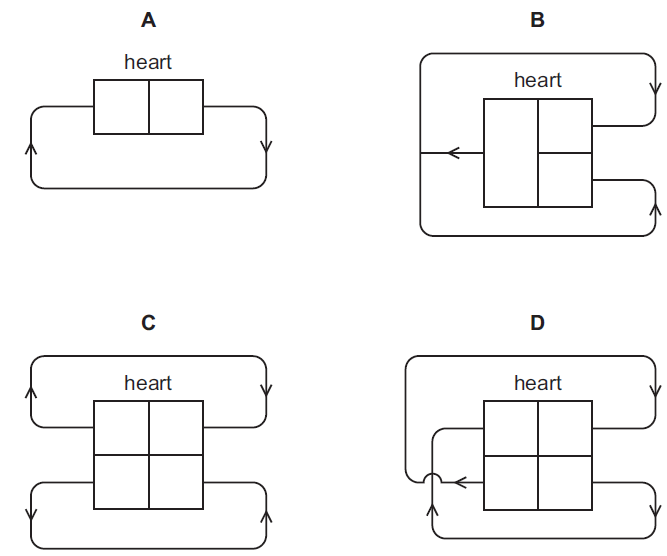
Which diagram shows the human double circulatory system?
A
B
C
D
How often must a blood cell in the renal artery pass through the heart before it again reaches the renal artery?
once
twice
three times
four times

The diagram shows some parts from the blood of a mammal.
Which part would contain the breakdown products of bacterial cells?
A
B
C
D

The photograph shows two blood cells, X and Y.
What are the functions of cells X and Y?
cell X: carries out phagocytosis
cell Y: carries oxygen
cell X: carries oxygen
cell Y: produces antibodies
cell X: carries oxygen
cell Y: carries carbon dioxide
cell X: produces antibodies
cell Y: carries oxygen

The diagram shows human blood as seen through a light microscope.
A person’s blood is unable to clot.
Which component of the blood is not functioning properly?
A
B
C
D
A deficiency in which of the following may result in a person’s blood failing to clot properly?
antibodies
fibrinogen
haemoglobin
protease
What happens when the left ventricle contracts?
atrioventricular valves: closed
semilunar valves: closed
atrioventricular valves: closed
semilunar valves: open
atrioventricular valves: open
semilunar valves: closed
atrioventricular valves: open
semilunar valves: open

The table list some characteristic features of a blood vessel. Which of the following will have all these characteristics features?
Only pulmonary vein
Only pulmonary artery
All veins except the pulmonary vein
All arteries except the pulmonary artery

The diagram shows part of the human circulatory system. Which part carries oxygenated blood at low pressure?
A
B
C
D
What is the advantage of a double circulatory system in mammals?
Blood can flow down the body on the left and up the body on the right
Blood can flow more slowly along the circulatory system
Blood pressure stays the same throughout the circulatory system
Oxygenated blood and deoxygenated blood are kept separate

Diagram shows human blood vessel. What will happen if structure X is not functioning?
Blood flow increases
Blood pressure increases
Blood flows in one direction
Blood flows backwards

Diagram shows an open circulatory system for an insect. What is the colorless fluid inside X?
Blood plasma
Haemolymph
Lymph
Tissue fluid
What is the normal blood pressure for human?
80/120 mmHg
120/80 mmHg
120/100 mmHg
80/100 mmHg
A doctor listened to Ahmad's heartbeat by using a stethoscope. He heard the 'lub-hiss, lub-hiss' sound instead of the normal 'lub-dup' sound. Which of the following is most likely to cause the 'hiss' sound?
Clogged coronary artery
A defective semilunar valve
High blood pressure
A damaged pacemaker
In the elderly persons, the pulse rate tends to fall with age. This means that:
They would have enough oxygen circulating around their body.
They can feel fatigued due to less oxygen circulating around their body.
They are more prone to diseases.
A blood sample showed that the white blood cell count was very high. Explain this result.
The body needed to build more energy
The body needed to carry nutrients around the body
The body was healthy, and no signs of infections were visible.
The body was fighting off pathogens.
If a doctor needs to take a sample of blood from a patient, the blood vessel he would use is the:
artery
vein
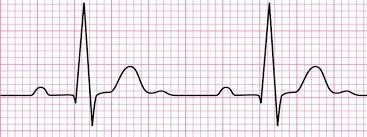
Type of device that measures the electrical currents created by the SA and AV nodes?
AED
MRI
ECG
CAT Scan
The 'lub' sound produced after
semilunar valves close
atria are fully contracted
ventricles start to relax
bicuspid valve and tricuspid valve suddenly close
Bella is a girl with blood group AB. She can donate blood to______
Jasmine with blood group A
Danial with blood group O
Rita with blood group B
James with blood group AB
Heart is made up of
cardiac muscle
smooth muscle
skeletal muscle
Which of the following statement is not true about the function of lymphatic system?
Transport fatty acid and glycerol molecules
Produce antibodies
Returns the interstitial fluid back into circulatory system
Transports glucose and amino acid molecules
The thromboplastins in the presence of __________and __________, convert prothrombin to thrombin.
I. sodium ion
II. vitamin K
III. potassium
IV. calcium ion
I and II
II and IV
I and IV
II and III
How many chambers does a frog's heart have?
1
2
3
4
What is the antigen on blood group O?
Antigen A
Antigen B
Antigen A and Antigen B
None
________is a threadlike protein fibre that forms a network on the wound surface to close the wound to prevent excessive blood loss.
Fibrin
Thrombin
Prothrombin
Fibrinogen
Filtration is involved in the formation of tissue fluid because
the wall of blood capillary is selectively permeable and acts as a filter.
The hydrostatic pressure of the blood is lower than the tissue fluid.
blood cells and plasma proteins block the pores on the wall of blood capillary.
oxygen and nutrients can diffuse across the wall of blood capillary.

The graph below shows the changes in blood oxygen content and blood pressure along blood vessels (1), (2) and (3).
Which of the following best represents the identities of blood vessels (1), (2) and (3)?
blood vessel 1: aorta
blood vessel 2: capillary
blood vessel 3: pulmonary vein
blood vessel 1: pulmonary artery
blood vessel 2: capillary
blood vessel 3: pulmonary vein
blood vessel 1: pulmonary vein
blood vessel 2: pulmonary artery
blood vessel 3: capillary
blood vessel 1: pulmonary vein
blood vessel 2: aorta
blood vessel 3: capillary
Coronary heart disease can be caused by all of the following factors except
fatty deposits on the inner surface of the heart
formation of blood clot in an artery
a diet rich in saturated fats
a stressful lifestyle
Lymph nodes are widely distributed throughout the body. Along the lymphatic veins they filter the _________ before it is returned to the _______.
lymph, blood
lymph, heart
blood, lymph
blood, heart
During ventricular systole:
the ventricles relax
blood flows from the ventricles into the atria
the AV valves are open
blood flows from the ventricles to the pulmonary arteries
How many chambers in the amphibians' heart?
one
two
three
four
Oxygenated blood and deoxygenated blood of amphibians are mixed together in the heart.
True
False
Last to receive electrical impulses resulting in the contraction of ventricles:
AV node
Purkinje fibers
SA node
AV bundle/bundle of His
Structure that creates the electrical signals for the conduction process:
SA node
AV node
Purkinje fibers
bundle of His/AV bundle
Place the following in the correct order:
1.atria contract
2.AV node
3.bundle of His/AV bundle
4.Purkinje fibers
5.SA node
6.ventricles contract
5, 1, 2, 3, 4, 6
2, 1, 5, 3, 4, 6
5, 6, 2, 3, 4, 1
2, 6, 5, 3, 4, 1
What substance is needed to convert fibrinogen to fibrin?
Thrombokinase
Thrombin
Prothrombin
Thrombus
Blood clot can be formed within the artery and prevents blood from flowing normally through the circulatory system.
What is this disease.
Heamophilia
Talasemia
Embolism
Thrombosis

Name this mesh that formed to trap erythrocytes as shown in diagram.
Thrombin mesh.
Fibrin mesh.
Scab
Andmesh Kamaleng
Which one is correct about blood group AB?
Individuals with blood group AB and have only B antigen
Individuals with blood group AB have both A and B antigens
Individuals with blood group AB do not have both A and B antigens
A person can receive blood or not depends on the presence of ____________ in his blood plasma
antibody
antigen
Which could be in danger of a blood disorder if a mother and fetus had differing Rh factors?
the mother
the fetus during the first pregnancy
the fetus during the second pregnancy
the father
How is lymph moved through lymphatic vessels?
Contractions of skeletal muscle around the vessels
Blood cells carry lymph through the vessels
Contractions of the heart
If the valves in the lymphatic vessels stopped working, how would this affect the body?
Tissue fluid would flow backwards, potentially causing edema, or tissue fluid build-up
It would have no effect, because muscle action would still keep fluid flowing
There are no valves in the lymphatic vessels
Tissue fluid would flow too quickly, causing a heart attack due to the increased fluid flow to the heart

