
 Worksheets
Current Electricity
Total questions: 100
Worksheet time: 1hrs 3mins
Electricity is a form of energy produced by charges.
TRUE
FALSE
Current electricity is a form of energy when the charges are the rest.
TRUE
FALSE
Static electricity is a form of energy when the charges are the rest.
TRUE
FALSE


What is the component labelled A?
Battery
Bell
Light bulb
Switch
What is the component labelled B?
Battery
Bell
Light bulb
Switch


A closed path in which current flows is known as an Electric circuit.
TRUE
FALSE

Is this picture shows the circuit diagram with actual instruments?
YES
NO

Is this picture shows the circuit diagram with actual instruments?
YES
NO
What is the best description for this picture?


What is the description for this picture?
Circuit is broken
Electric current does not flow
An electric current flows only when there is a:
Source of electricity
Open circuit
Closed-circuit
Broken filament


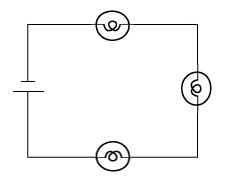
When more light bulbs are added they all remain bright.
Which one of this that are NOT basic component of simple circuit?
Light bulb
Wire
Battery
Appliances
In series circuit, the lights are connected ________ to each other.
Side by side
Parallel
Close by
Effectively
If one of the light bulb in series circuit is taken off, what will happen to the other light bulb?
The other light bulb will be on
The other light bulb will be off
The other light bulb will stay on
Both light bulb will be on
In parallel circuit, there are _________ pathways for charge to flow.
One
Two or more
None
Zero

Which one is the circuit diagram of this picture?


This is an example of a series circuit
yes
no
In this circuit, the electrons have ____ path(s) to follow.
1
more than 1
In this circuit, the light bulbs share electrical pressure
yes
no


What will happen to the bulb on the left if the bulb on the right blows up?
It will still light up.
No changes.
It will not light up.
It will blink.

The circuit shown is known as a (a) circuit.
A bulb in Sara's kitchen has blown up. Immediately all bulbs in Sara's house stopped working. The circuit in Sara's house is most probably ................ .
a series circuit.
over used.
a parallel circuit.
very old.

Th diagram is showing a ................. circuit .
series
parallel

Choose the wrong statement regarding the circuit shown.
All the bulbs have the same brightness.
All the bulbs have different brightness.
When one bulb spoils the others will not light up.
The switch breaks and completes the circuit.

Normally, when one of these bulbs spoil, the others also do not work. They are most probably fixed in .......................
series
parallel

Is this picture describe the logic of series circuits?
YES
NO
Is this picture describe the logic of parallel circuits?
YES
NO

Is this picture describe the logic of parallel circuits?
YES
NO
What is TRUE about the parallel circuits?
A closed circuit where there is more than one path for electrons to flow through.
There are three possible paths, electrons can flow to bulb 1, 2 or 3.
If one bulb goes out, the other ones will not be affected.
The part of a circuit where it braches off is called a junction point
Think about a waterslide park with one slide closed. The kids can still get to the bottom by taking another slide.
What is true about the series circuits?
When electrons have only one path to follow (like a single slide at a water park)
If a person stops the current stops, if they close the slide (open a switch) the current will no longer flow.
A circuit with only one path to follow.
A circuit with several paths to follow.

Solve for the total resistance of the circuit shown
50 V
1970 ohms
705 K ohms
20 Amps
What unit is used to measure current?
Ohms
Omega
Volts
Amps
What unit is used to measure resistance?
Ohms
Omega
Volts
Amps
This states that the current flowing in a circuit is directly proportional to the applied potential difference and inversely proportional to the resistance in the circuit.
Kepler's Law
Law of gravity
Ohm's Law
Thermodynamics Law

An alarm clock draws 0.5 A of current when connected to a 120 volt circuit. Calculate its resistance.
60Ω
120Ω
180Ω
240Ω

Speakers need a household voltage of 110 V to push a current of 5.5 A through them. What is the
resistance of the speakers?
10Ω
20Ω
30Ω
40Ω

An IPod uses a standard 1.5 V battery. How much resistance is in the circuit if it uses a current of 0.01A?
50Ω
100Ω
150Ω
200Ω

A circuit contains a 1.5 volt battery and a bulb with a resistance of 3 ohms. Calculate the current.
0.5A
1A
1.5A
2A

What current flows through a hair dryer plugged into a 120 Volt circuit if it has a resistance of 25 ohms?
2.4A
3.6A
4.8A
6A

If a toaster produces 12 ohms of resistance in a 120-volt circuit, what is the amount of current in the
circuit?
5A
10A
15A
20A

A 12 Volt car battery pushes charge through the headlight circuit resistance of 10 ohms. How much current
is passing through the circuit?
1A
1.2A
1.4A
1.6A

How much voltage would be necessary to generate 10 amps of current in a circuit that has 5 ohms of
resistance?
10V
50V
100V
150V

An electric heater works by passing a current of 100 A though a coiled metal wire, making it red hot. If the
resistance of the wire is 1.1 ohms, what voltage must be applied to it?
70V
90V
110V
130V

A light bulb has a resistance of 5 ohms and a maximum current of 10 A. How much voltage can be applied
before the bulb will break?
5V
10V
25V
50V
What is the potential difference across an electrical load that has a resistance of 4 Ω and a current of 3 A flowing through it?
4V
8V
12V
16V
Calculate the current an electric clothes dryer draws when it is connected to a 230 V source and has a resistance
of 9.2 Ω.
5A
15A
25A
35A
A portable radio connected to a 9.0 V battery draws a current of 25 A. What is the resistance of the radio?
0.036Ω
0.36Ω
3.6Ω
36Ω
What type of energy is the electrical energy from the battery being converted into in this radio?
Heat and light
Sound and light
Sound and heat
Potential energy
How much resistance does a heavy duty flashlight have if it has a current of 25 mA flowing through it and is being
powered by four 1.5 V cells?
0.15Ω
1.5Ω
15Ω
150Ω
The mathematical relationship among Voltage, Current, and Resistance
Faraday's Law
Tesla's Law
Edison's Law
Ohm's Law
According to Ohm's Law, if you were to triple the voltage of a circuit without changing the resistance, what would happen to the flow of current?
It would stay the same
It would increase by 2x
It would increase by 3x
It would decrease by 3x
According to Ohm's Law, if you were to double the voltage and double the resistance, what would happen to the flow of current?
It would stay the same
It would increase 2x
It would increase 4x
It would decrease 2x

Using Ohm's Law Triangle, What is the formula to calculate the Voltage (V)?
V = RI
V = IR
V = I ×R
Using Ohm's Law Triangle, What is the formula to calculate the Current (I)?
I = RV
I = V × R
I = VR
Using Ohm's Law Triangle, What is the formula to calculate the Resistance (R)?
R = VI
R = IV
R = V × I

Calculate the voltage for the circuit shown.
V = 0.8 v
V = 1.25 v
V = 9 v
V = 20 v

Calculate the current for the circuit shown.
I = 0.05 A
I = 20 A
I = 105 A
I = 500 A

Calculate the resistance for the circuit shown.
R = 0.17 Ω
R = 6 Ω
R = 35 Ω
R = 150 Ω
Ammeters should always be connected in (a) .

What is the missing value on the ammeter?
(a)
Potential difference is another word for (a) .
Voltmeters should always be connected in (a) around a component.
What does a voltmeter measure?
Current
Voltage
Resistance
What does an ammeter measure?
Current
Voltage
Resistance
How does an ammeter is added in the circuit?
Series
Parallel
How does a voltmeter meter is added in the circuit?
Series
Parallel
An ammeter must have
Low resistance so that it does affect the current through the main circuit
High resistance so that it does affect the current through the main circuit
Low resistance so that it does affect the voltage across the resistor
Conventionally, current is described as flowing from the ................ terminal of a battery to the ................ terminal.
Negative.....negative
Negative....positive
Positive......negative
Positive....positive
SI unit of current is
ampere
metre
ohm
volt
SI unit of voltage is
ampere
metre
ohm
volt

The table describes four different resistance wires.
They are all made from the same metal.
Which wire has the smallest resistance?
A
B
C
D

The circuit shown contains a battery, a 6.0 Ω resistor and two meters X and Y.
One meter records current and one meter records potential difference.
meter X : 2.0 A
meter Y : 12.0 V
meter X : 2.0 V
meter Y : 1.0 A
meter X : 12.0 A
meter Y : 2.0 V
meter X : 12.0 V
meter Y : 2.0 A
Conventionally, current is described as flowing from the ................ terminal of a battery to the ................ terminal.
Negative.....negative
Negative....positive
Positive......negative
Positive....positive
In the circuit, the bulb lights up because there is ............... flowing in the closed circuit.
battery
current
resistance
voltage

