wayground logo

Free Printable Worksheets

Font size

S
M
L
XL
Worksheets

Evolution Introduction

Total questions: 50

Worksheet time: 8hrs 20mins

Name
Class
Date
1.
The gradual change in species over time is...
a)
Evolution
b)
Nucleotide 
c)
Adaptation
d)
Natural Selection
2.
In natural selection, the selective agent is the
a)
humans
b)
mutations
c)
breeders
d)
environment
3.
The differences among a species, like different bird beaks, are called
a)
genes.
b)
variations.
c)
traits.
d)
theories.
4.
What process is being shown in this image?
a)
Variation
b)
Natural Selection
c)
Selective Breeding
d)
Homeostasis
5.
Where do adaptations come from?
a)
The individual organism decides to adapt
b)
Mutations that give an organism an advantage in its environment
6.
The change in allele frequencies over time.
a)
genotype
b)
crossing over
c)
evolution
d)
adaptation
7.
A group of organisms of the same species which live in a shared space and reproduce with each other.
a)
population
b)
species
c)
alleles
8.
An example of a population would be 
a)
all the owls in North America.
b)
different kinds of butterflies living in the same patch of rain forest.
c)
sparrows.
d)
a group of wood ducks living in the same pond in a forest.
9.
Sometimes referred to as "survival of the fittest," this process allows those traits which are most favorable to be passed on to the next generation and those which are not to be eliminated.
a)
genetic drift
b)
gene flow
c)
natural selection
d)
mutation
10.

A change in the genetic material of a cell is called a

a)

mutation.

b)

meiosis.

c)

gene flow.

d)

bottleneck effect.

11.

The diagram shows fossils in different rock layers. Which of these statements about the age of these fossils is most likely correct?

a)

Fossil A and C are the same age

b)

Fossil A is older than Fossil B

c)

Fossil B is older than Fossil C

d)

Fossil D is older than Fossil C

12.

Which of the following is required for a population to diverge into two separate species?

a)

The two populations must have evolved different physical appearances.

b)

The two populations must have mutated at least 10 times.

c)

The two populations must have become reproductively isolated.

d)

The two populations must have evolved analogous structures.

13.
A scientific name consists of 
a)
Genus and Order
b)
Genus and Domain
c)
Genus and species
d)
Kingdon and Phylum
14.
The most specific of the classifications is?
a)
class 
b)
order 
c)
genus 
d)
species
15.
Which term means "True Nucleus" or cell(s) with a nucleus?
a)
Eukaryotes
b)
Prokaryotes
c)
Multi-cellular
16.
The 2 kingdoms that make up Prokaryotes are?
a)
Animals and Plants 
b)
Protists and Fungi
c)
Archea and Bacteria
17.
What kingdom's organisms often live in super harsh environments?
a)
archea
b)
animalia
c)
plantae
d)
protista
18.
Mushrooms are an example of this Kingdom?
a)
Animalia
b)
Protista 
c)
Archea 
d)
Fungi
19.
Kingdom, Phylum, Class, _______
a)
Family 
b)
Order
c)
Genus 
d)
Species
20.

Which of the following organisms are most likely LEAST closely related?

a)

organisms that share a domain

b)

organisms that share a family

c)

organisms that share a genus

d)

organisms that share a species

21.
An illustration and a dichotomous key are given. What is the correct classification for this organism?
a)
Class Insecta
b)
Order Amblygygi
c)
Order Araneae
d)
Order Scorpiones
22.

The science of describing, classifying, and naming living things is called:

a)

Geology

b)

Biology

c)

Taxonomy

d)

Chemistry

23.

This organism is multicellular, heterotroph, that has a cell wall made of chitin. What kingdom does it belong in?

a)

fungi

b)

plantae

c)

animalia

d)

eubacteria

24.

I am prokaryotic and am found everywhere. What kingdom do I belong to?

a)

Eubacteria

b)

Archaebacteria

c)

Fungi

d)

Protista

25.

What kingdom do unicellular, prokaryotic organisms that live in extreme environments?

a)

Animal

b)

Archaebacteria

c)

Eubacteria

d)

Plant

26.

What is the correct order of taxonomy?

a)

Domain, kingdom, phylum, class, species, genus, family, class

b)

Species, genus, family, order, class, phylum, kingdom, domain

c)

Domain, kingdom, phylum, class, order, family, genus, species

d)

species, phylum, order, class, domain, kingdom, family, genus

27.

Which one of the following is the most general category of living things?

a)

Kingdom

b)

Domain

c)

Phylum

d)

Species

28.

What are the three domains we find in biology?

a)

Archaea, Bacteria, Eukarya

b)

Protista, Eubacteria, Animalia

c)

Archaea, Eubacteria, Eukarya

d)

Prokarya, Bacteria, Archaea

29.

Which domains are prokaryotic?

a)

Archaea

b)

Bacteria

c)

Eukarya

30.
These cause variations.
a)
mutations
b)
adaptations
c)
a desire to change
d)
injuries
31.
A slight difference in an inherited trait between individual members of the same species.
a)
variations
b)
adapatations
c)
homologous structures
d)
analogous structures
32.
An inherited trait that increases an organism's chance of surviving and reproducing.
a)
variation
b)
adaptation
c)
vestigial structure
d)
mutation
33.
The discovery of DNA and genes proved that
a)
Darwin was wrong
b)
mutations create variations and come from genes
c)
we are all the same species
d)
bats and butterflies have a very close common ancestor
34.
When an organism of a species is born with a variation in a trait that gives it an advantage in its environment, we call that trait an adaptation.
a)
true
b)
false
35.
When an organism of a species has an adaptation, it will compete for resources better, survive longer and pass that adaptation on to it's offspring. This process is called
a)
evolution by natural selection
b)
artificial selection
c)
inbreeding
d)
outbreeding
36.
What is it called when humans decide which traits of an organism are the most desirable and only allow those organisms with the specific, desired traits to breed.
a)
biological evolution
b)
evolution by natural selection
c)
artificial selection
d)
inbreeding
37.
When an organism has a trait that allows it to blend in with its environment, we call that ____.
a)
mimicry
b)
camouflage
c)
lucky
d)
sonic hedgehog gene
38.

The English naturalist that developed the theory of how evolution works.

a)

Charles Darwin

b)

Charles M. Schulz

c)

Charles Dickens

d)

Charles Norris

39.
Evolution typically happens...
a)
in a few weeks
b)
over millions of years
c)
never
d)
in 100 years
40.
Bird's beaks evolve mainly due to the type of ___________________ available.
a)
food
b)
water
c)
shrubs
d)
mates
41.
If an organism can't adapt fast enough, this might happen.
a)
hibernate
b)
stay the same
c)
live longer
d)
become extinct
42.
Darwin said that the number of offspring an organism has ___________________
a)
stays the same
b)
is more than can survive
c)
is less than needed
43.
Darwin said that within a species there will be _________________________
a)
nothing different
b)
variation/differences
44.

Based on the figure, which organism is most closely related to the polar bear?

a)

black bear

b)

european brown bear

c)

western north american brown bear

d)

asian brown bear

45.

Based on the figure, how long ago was the common ancestor of the European Brown Bear and the Asian Brown Bear?

a)

4.5 hundreds of thousands of years ago

b)

3.5 hundreds of thousands of years ago

c)

2.2 hundreds of thousands of years ago

d)

1.4 hundreds of thousands of years ago

46.

Phylogenetic trees show...

a)

Evolutionary relationships between different species

b)

How one species has evolved through time

c)

Which species has evolved the most

d)

Which species have evolved from other species

47.

The groups in a phylogenetic tree are called...

a)

Taxa

b)

Nodes

c)

Roots

d)

Branches

48.
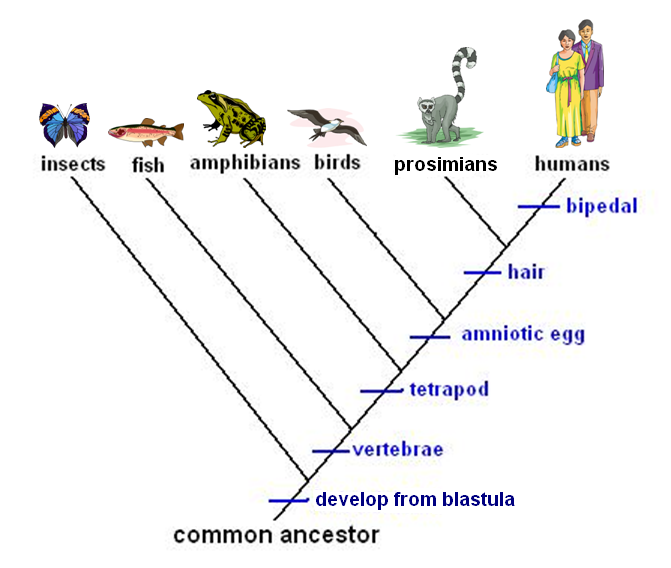
Which organisms pictured on the cladogram have hair?
a)
prosimians only
b)
prosimians and humans
c)
humans only
d)
prosimians and birds
49.

I am prokaryotic and am found everywhere that's not extreme. What kingdom do I belong to?

a)

Eubacteria

b)

Archaebacteria

c)

Fungi

d)

Protista

50.
What kingdom do unicellular, prokaryotic organisms that live in extreme environments?
a)
Animal
b)
Archaebacteria
c)
Eubacteria
d)
Plant