wayground logo

Free Printable Worksheets

NEW

Font size

S
M
L
XL
Worksheets

Honors Chapter 1 - Review of Physical Science

Total questions: 60

Worksheet time: 57mins

Name
Class
Date
1.
An iron fence rusts.  This is an example of _______ .
a)
chemical change 
b)
physical property 
c)
physical change 
d)
chemical property
2.

Fully dissolved sugar water is an example of a ______________.

a)

heterogeneous mixture

b)

homogeneous mixture

3.
Oil and water is an example of a ___________.
a)
heterogeneous mixture
b)
homogeneous mixture 
4.
What is a example of a pure substance?
a)
NaCl (sodium chloride) - compound
b)
Kool-Aide
c)
Salt water
d)
sea water
5.

Which is a chemical change?

a)

boiling water

b)

water freezing

c)

reacts with water to form hydrogen gas

d)

water condensing

6.

2 of more elements bonded together is known as what?

a)

An atom

b)

An element

c)

A mixture

d)

A compound

7.

Which state of matter is classified as particles being very structured and packed closely together?

a)

Solid

b)

Liquid

c)

Gas

d)

Plasma

8.

The melting of iron is classified as a physical change because it:

a)

Produced no new substances

b)

Absorbs heat

c)

Transfers energy

d)

Changes the chemical properties of iron

9.

Which of the following chemicals is NOT a compound?

a)

Sugar (C6H12O6)

b)

Water (H2O)

c)

Carbon (C)

d)

Table Salt (NaCl)

10.
In which state of matter are the molecules the most compressed
a)
liquid
b)
gas
c)
solid
d)
plasma
11.
Which of the following can be classified as homogeneous?
a)
vinegar
b)
fruit cake
c)
chocolate chip cookie
d)
tossed salad
12.
A ____ is a material made up of two or more substances that are physically mixed but not chemically combined.
a)
atom
b)
element
c)
mixture
d)
compound
13.
Matter is anything that has _____ and takes up space.
a)
temperature
b)
mass
c)
density
d)
weight
14.

Which of the following is an intensive property of Silver, Ag?

a)

heat content

b)

melting point

c)

volume

d)

weight

15.

Which of the following is NOT an intensive property of Lead, Pb?

a)

melting point

b)

color

c)

density

d)

mass

16.
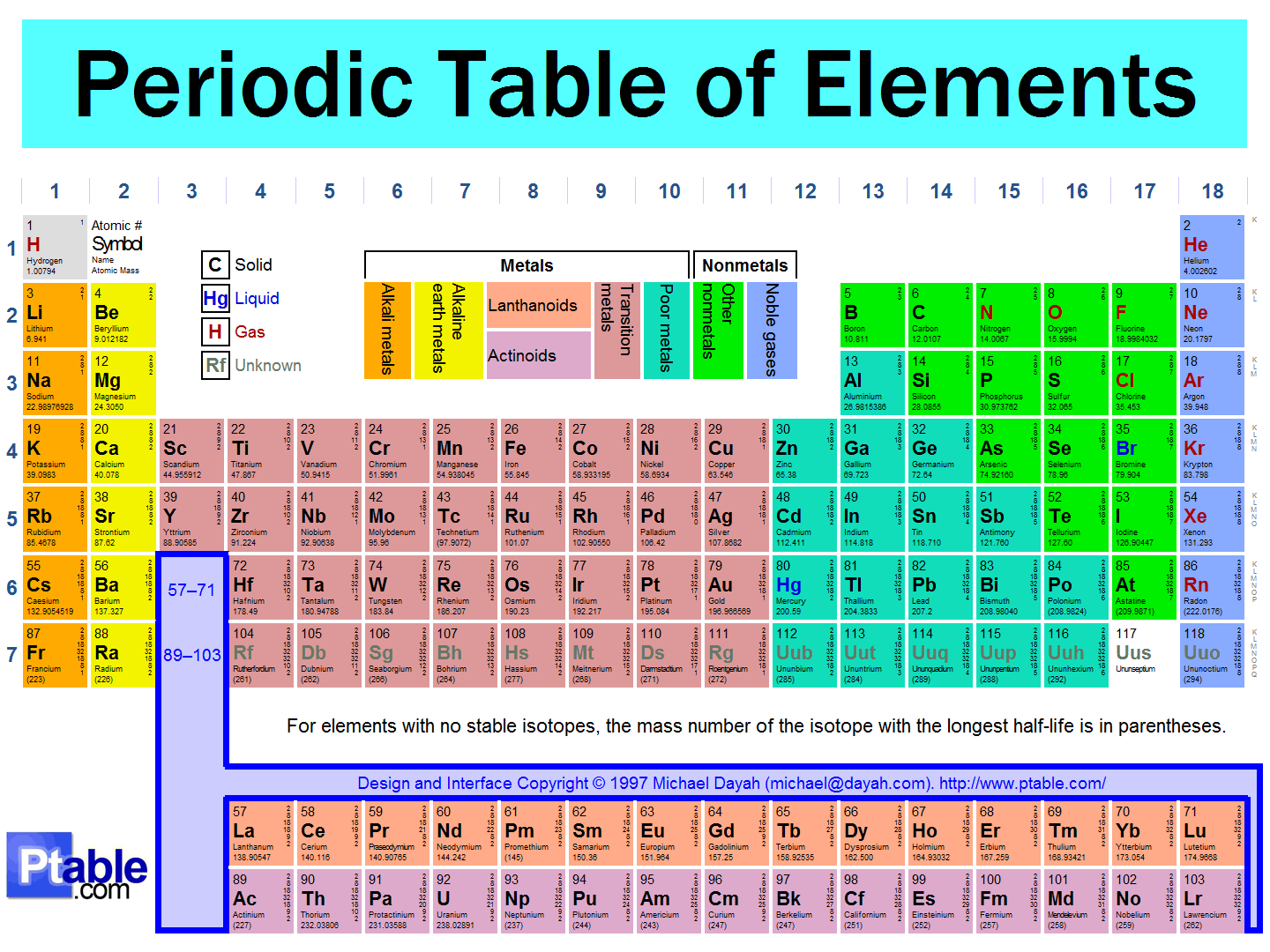
The horizontal row on the periodic table is called a
a)
group
b)
family
c)
period
d)
atomic number
17.
A vertical column is called...
a)
group
b)
tower
c)
period
d)
crew
18.
Which group of the periodic table is composed of inert (not reactive)  gases?
a)
alkali metals
b)
alkaline earth metals
c)
halogens
d)
noble gases
19.
Elements which are shiny, conduct electricity and heat are called
a)
metal
b)
nonmetal
c)
metalloid
d)
nonexistent
20.
The atoms along the staircase are called 
a)
metals
b)
nonmetals
c)
metalloids
d)
noble gases
21.
Which is an alkali metal?
a)
Magnesium
b)
Iron
c)
Sodium
d)
Europium
22.

a collection of atoms of one type that cannot be broken down into simpler substances by ordinary chemical or physical means

a)

element

b)

subatomic particle

c)

electron

d)

matter

23.
Which is a halogen?
a)
Helium
b)
Chlorine
c)
Oxygen
d)
Neptune
24.
What is the element symbol for boron? 
a)
B
b)
Bo
c)
Bn
d)
W
25.
Group Name and Number for Neon
a)
Alkaline Earth Metals 2 or 2A
b)
Noble Gases 18 or 8A
c)
Halogens 17 or 7A
d)
Alkali Metals 1 or 1A
26.
Group Name and Number for Magnesium
a)
Alkaline Earth Metals 2 or 2A
b)
Noble Gases 18 or 8A
c)
Halogens 17 or 7A
d)
Alkali Metals 1 or 1A
27.

Group Name and Number for Fluorine

a)

Transition Metals 3-12

b)

Noble Gases 18 or 8A

c)

Halogens 17 or 7A

d)

Alkali Metals 1 or 1A

28.
GOLD
a)
Al
b)
Ag
c)
Ar
d)
Au
29.
CHLORINE
a)
C
b)
Ca
c)
Cl
d)
Cu
30.
CALCIUM
a)
C
b)
Ca
c)
Cu
d)
Cl
31.
CARBON
a)
C
b)
Ca
c)
Cl
d)
Cu
32.
COPPER
a)
C
b)
Ca
c)
Cu
d)
Cl
33.
SULFUR
a)
Su
b)
S
c)
Sf
d)
Si
34.
SILICON
a)
S
b)
Si
c)
Su
d)
Sc
35.
SODIUM
a)
S
b)
So
c)
N
d)
Na
36.
POTASSIUM
a)
P
b)
Ka
c)
K
d)
Pt
37.
What is the chemical symbol for mercury?
a)
Hg
b)
Mc
c)
My
d)
C
38.
Which one of the following would you use to separate sand from iron filings?
a)
a bar magnet
b)
filter paper
c)
chromatography paper
d)
alum
39.

This diagram represents...

a)

An element

b)

A molecule

c)

A compound

d)

A mixture of elements and compounds

40.
a)
element
b)
compound
c)
mixture of elements
d)
mixture of compounds
41.
a)
element
b)
compound
c)
mixture of elements
d)
mixture of compounds
42.
a)
element
b)
compound
c)
mixture of elements
d)
mixture of compounds and elements
43.
a)
element
b)
compound
c)
mixture of elements and compounds
d)
mixture of compounds
44.
a)
element
b)
compound
c)
mixture of elements
d)
mixture of compounds
45.

Which one of the following techniques would best be used to separate soil and water?

a)

crystallization

b)

distillation

c)

Filtration

d)

Chromatography

46.
Can you separate salt from water using filtration?
a)
yes
b)
no
47.
Type of mixture that has the SAME COMPOSITION in every part.
a)
Homogenous
b)
Heterogeneous
48.

Mixtures can be separated using ________________________.

a)

Physical change

b)

Chemical change

c)

Chemical reaction

d)

Phase change

49.

An alloy is a ...

a)

A chemical compound with combination between metal and non-metal

b)

A salt contain of two or more elements where the main element is non-metal

c)

Mixture of two or more elements where the main element is metal

50.

Which metal is NOT an Alkaline Earth Metal?

a)

Calcium

b)

Radon

c)

Strontium

d)

Radium

51.
Which of the following describes a precipitate?
a)
a liquid forms when a block of metal is heated
b)
a solid forms when one liquid is poured into another
c)
a gas forms when a solid is placed in a liquid
d)
bubbles form when an acid is poured on a rock
52.
One of the signs of a chemical reaction taking place is:
a)
Bubbles are produced 
b)
Reactants are not combining
c)
Products are not forming
d)
Color is not changing
53.

You know that a chemical reaction has occurred if

a)

there is a precipitate.

b)

there is a color change.

c)

there is a temperature change.

d)

All of these answers are evidence.

54.
Which is NOT an indication of a chemical change?
a)
temperature change
b)
formation of a precipitate
c)
shape change
d)
production of light
55.
A clear liquid from a flask is poured into another clear liquid in a beaker. Which of the following results of this procedure would indicate a new substance was formed?
a)
The level of the substance in the beaker is higher after the other liquid is added.
b)
A yellow solid forms and then settles to the bottom of the beaker.
c)
Small white crystals are left behind in the flask that held the first liquid.
d)
The mass of the combined liquids is greater than either original liquid.
56.

What are the seven diatomic elements?

a)

H2, Cl2, Br2, O2, N2, I2, F2

b)

H2, Cl2, I2, F2, Hg2, Br2, Fe2

c)

H2, Cu2, Ni2, B2, O2, I2, Fe2

57.

What number do the diatomic elements form on the periodic table?

a)

7

b)

1

c)

2

58.

Is O2 a diatomic homonuclear element?

a)

Yes

b)

No

59.

All solutions are homogenous

a)

True

b)

False

60.

All pure substances are homogenous

a)

True

b)

False