
 Worksheets
Test 1
Total questions: 50
Worksheet time: 37mins
In perspective projection, what is the picture plane used for?
On the picture plane, we draw the perspective projection of the object
On the picture plane, we place the object to draw perspective
The picture plane is used for the observer to stand up
What are the characteristics of vertical picture plane?
The picture plane is inclined at an angle greater than or less than 90 degrees to the ground plane
The picture plane is parallel to the ground plane
The picture plane is perpendicular to the ground plane
System of perspective projection is constructed from which projection
below ?
Parallel projection
Perpendicular projection
Perspective projection
All of them
According to the cone of vision, the best observation amplitude of the viewer is:
15 to 30 degrees
30 to 60 degrees
45 to 60 degrees
0 to 180 degrees
In which situation the perspective of vertical picture plane is used:
When the observer looks straight, the axis of the cone of vision is parallel to the ground
When the observer looks up, the axis of the cone of vision looks upwards
When the observer looks down, the axis of the cone of vision looks downwards
How many kind of perspective projection systems ?
2- (Inclined picture plane and vertical picture plane)
1- (Only Inclined picture plane)
1- (Only vertical picture plane)
What is the horizon line ?
Is the perspective of the endless line of the ground plane
Is the perspective of the line parallel to the picture plane
Is the intersection of the ground plane with the picture plane
Is the intersection of the ground plane with the picture plane
Where is the vanishing point of the perspective projection of the lines that parallel to the picture plane?
The vanishing point is on the horizon line
The vanishing point is at the bottom of the picture plane
No vanishing point (vanishing point is extremely far away)
Any vanishing point on the picture plane
In the perspective of inclined picture plane, the perspective projection of the lines perpendicular to the ground plane has any of the following properties:
There is a common vanishing point
There are two vanishing points
There is no convergence
What is the vanishing point of the straight lines?
The perspective of the midpoint of a line
The perspective of the endless point of the line
The intersection of the straight line and the picture plane
What is the horizontal plane through eyes ( Eye level Plane)?
The plane passing through the eye of the observer and parallel to the picture plane
The plane passing through the eye of the observer and perpendicular to the bottom of the picture plane
The plane passing through the observer's eye and parallel to the ground plane
How does the position of the central visual ray compare to the picture plane?
The central visual ray is parallel to the picture plane
The central visual ray is inclined to the picture plane
The central visual ray is on the picture plane
The central visual ray is perpendicular to the picture plane
What is the central visual ray?
A ray of light from a light source to the picture plane
The axis of the cone of vision
A line from
viewer's eyes to an object
In which situation, the perspective of the inclined picture plane is used?
When the observer looks straight, the axis of the cone of vision is parallel to the ground
When the observer looks up, the axis of the cone of vision looks upwards.
When the observer looks down, the axis of the cone of vision looks
.
Both cases when
the observer looks up or down, the axis of the cone of vision looks upwards
or downwards
Lines that are parallel to the ground plane have the vanishing points at:
Bottom line of the picture plane
Horizon line
Central visual ray
None of them
the horizon line always appears at your eye level.True or false ?
True
False
Choose the correct statement about Foreshortening.
Foreshortening: lines and surfaces always appear shortest when parallel to the observer’s face (i.e., to the picture plane). As they revolve away from this position they appear increasingly longer
Foreshortening: lines and surfaces always appear longest when parallel to the observer’s face (i.e., to the picture plane). As they revolve away from this position they appear increasingly shorter
All are wrong

What's kind of the perspective in this picture? (see picture )
One point perspective
Two point perspective
Three point perspective
The parallel lines converge to a point on the vanishing line called the vanishing point.
Correct
Incorrect
In the
perspective of vertical picture
plane, the perspective of a circle placed parallel to the Picture plane
is
shown as:
A circle
A horizontal line
An ellipse
All three cases are wrong

What's kind of the perspective in this picture?
One point perspective
two point perspective
Three point perspective
What is the perspective projection of the circle (not parallel to the picture plane)?
circle
ellipse
rectangle
In the perspective of inclined picture plane with a top-down view, where is the vanishing point of the lines which are perpendicular to the ground plane?
above the horizon line
below the horizon line
on the horizon line
In perspective projection, the eye level plane cuts the picture plane in a straight line and that line is called:
he bottom line of picture plane
The ground line
The horizon line
When drawing perspective projection , if the object is outside the field of vision, what happens?
The perspective projection of the object is enlarged
The perspective projection of the object is transformed
The perspective projection of the object gets smaller
What should you do if too much distortion appears in your perspective drawings ?
Show only the undistorted center area
you have “stepped back” from the subject until that subject appears within the cone of vision
all of them
How many steps are there to draw one-point perspective ?
3
4
5
6
Given a point of view W and a line AB, how do we find the vanishing point of the line AB
From the point
of view W, draws the line parallel to the ground plane, cutting the picture
plane where it is the vanishing point of AB
From the point
of view W, draws the line parallel to the picture plane, cutting the ground
plane where it is the vanishing point of AB
From the point of view W ,draws the line parallel to AB, cutting the picture
plane where it is the vanishing point of AB
What is the perspective projection of the ellipse which is on the picture plane?
ellipse
circle
rectangle
What is an ground plane?
A vertical plane on which objects need to represent perspective projection are placed
A horizontal
plane that passes through the eye of the observer
A horizontal plane on which objects need to represent perspective projection are placed
What is Perspective Drawing ?
Perspective drawing is a technique to draw third dimension objects on a flat surface.
Perspective drawing is a technique to draw what you think.
Perspective drawing is a technique to draw third dimension objects on a flat surface like the image when we look at the objects in real life.
Perspective drawing is a technique to draw your idea.
What is concerned with achieving a sense of space, of depth and of the third dimension, within the limits of the flat drawing surface?
Perspective drawing
Engineering drawing
Technical drawing
All of them
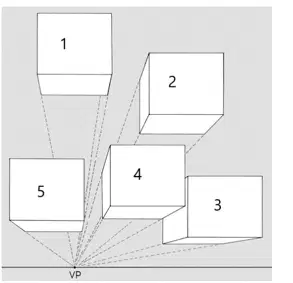
1. Which one(s) is drawn by One point perspective ?
1,2,4
3,4,5
1,3,5
All of them
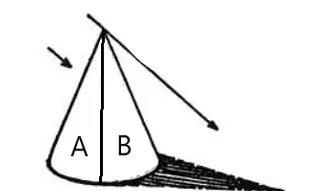
1. Where is the shade of this cone?
A
B
A,B
1. What is diminution ?
Objects of equal size appear smaller as their distance from the observer increases
s
Lines and surfaces always appear longest when parallel to the observer’s face (i.e., to the picture plane). As they revolve away from this position they appear increasingly shorter
Our eyes can see objects which are in the front or in the back
What is foreshortening ?
Objects of equal size appear smaller as their distance from the observer increases
Lines and surfaces always appear longest when parallel to the observer’s face (i.e., to the picture plane). As they revolve away from this position they appear increasingly shorter
Our eyes can see objects which are in the front or in the back.
What is overlapping ?
Objects of equal size appear smaller as their distance from the observer increases
Lines and surfaces always appear longest when parallel to the observer’s face (i.e., to the picture plane). As they revolve away from this position they appear increasingly shorter
Our eyes can see objects which are in the front or in the back.
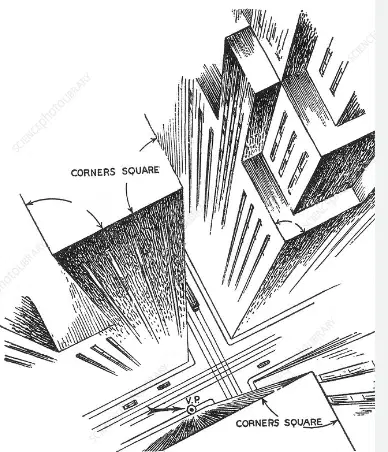
What's kind of the perspective in this picture?
One - point Perspective
Two – point Perspective
Three – point Perspective
None of them
What are the visual principles in perspective?
Diminution, Shade and Shadow
Foreshortening, Focus effect
Overlapping,
Convergence, Color and value perspective
All of them
“Lines or edges of objects which in reality are parallel appear to come together (i.e., converge) as they recede from observer”. What is it?
Overlapping
Diminution
Convergence
Focus effect
What are Color and Value Perspective?
Values (black to white range) and colors are bright and clear when seen close up but become grayer, weaker, and generally more neutral as their distance from the observer reduces.
Values (black to white range) and colors are bright and clear when seen close up but become grayer, weaker, and generally more neutral as their distance from the observer increases.
Values (black to white range) and colors are bright and clear when seen close up but become darker, clearer, and generally more colorful as their distance from the
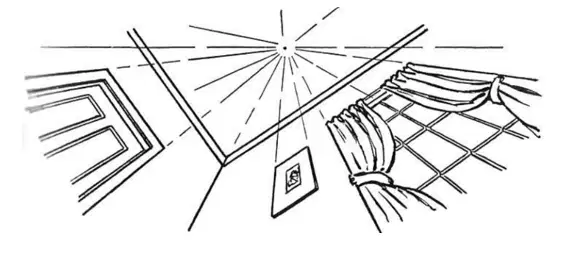
What's kind of the perspective in this picture?
One - point Perspective
Two – point Perspective
Three – point Perspective
Where is the reflection of this brick?
A&C
A&D
A&B
All of them
What should you do if too much distortion appears in your perspective drawing ?
Show only the undistorted center area.
Either spread the vanishing points apart (which means you have “stepped back” from the subject until that subject appears within the cone of vision)
Both of them
Neither of them
Fill in the blank.
“Convergence is minimal at the center of a picture and increases as you approach the circumference of the cone of vision. Beyond this range unrealistic and unacceptable ……………… begins to occur. And naturally the further you go, the worse things get.”
diminution
distortion
overlapping
focus effect
Choose the right statement.
Placing vanishing points closer apart eliminates distortion at edges of drawing. It means observer has stepped back and sees more with his fixed cone of vision.
Placing vanishing points further apart eliminates distortion at edges of drawing. It means observer has stepped back and sees more with his fixed cone of vision.
Placing vanishing points further apart increases distortion at edges of drawing. It means observer has stepped back and sees more with his fixed cone of vision.
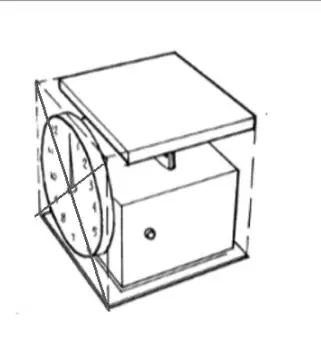
What is Perspective sketching-freehand drawing technique used in this picture?
Simple shape
Diagonals
Both of them
1. In perspective drawing, you draw…
what you see from a specific viewpoint
what you don’t see from a specific viewpoint
what you think
The reflected line must be not equal in length to the actual one and perpendicular to reflection plane. True or False
True
False
In perspective projection, we can subdivide equal surfaces by Measuring lines. True or false?
True
False

