wayground logo

Free Printable Worksheets

Font size

S
M
L
XL
Worksheets

Molecular Motion - Unit 2

Total questions: 59

Worksheet time: 52mins

Name
Class
Date
1.
Which state of matter has closely packed and organized particles?
a)
Solid
b)
Liquid
c)
Gas
d)
Plasma
2.
Which state of matter has closely packed and disorganized particles?
a)
Solid
b)
Liquid
c)
Gas
d)
Plasma
3.
Which state of matter has loosely packed and unorganized particles?
a)
Solid
b)
Liquid
c)
Gas
d)
Plasma
4.
Particles in this state of matter do not move around a lot.
a)
Solid
b)
Liquid
c)
Gas
d)
Plasma
5.
Particles in this state of matter slide past each other and take the shape of the bottom of their container.
a)
Solid
b)
Liquid
c)
Gas
d)
Plasma
6.
Particles in this state of matter take the shape of their entire container.
a)
Solid
b)
Liquid
c)
Gas
d)
Plasma
7.
Particles in this state of matter are positively and negatively charged.
a)
Solid
b)
Liquid
c)
Gas
d)
Plasma
8.
What causes the Eiffel Tower to be six inches taller in summer than winter. 
a)
Thermal Expansion
b)
Thermal Energy
c)
Kinetic Theory
9.
In this demonstration, what causes the balloon to expand?
a)
The heat from the room causes the balloon to expand.
b)
The heat from the hot plate heats the glass and the air inside it expands.
c)
The balloon spontaneously blows up to try to escape the bottle. 
d)
I don't know.
10.

Which type of motion in the figure best represents the movement of gas particles?

a)

Motion 1

b)

Motion 2

c)

Motion 3

d)

Motion 4

11.

Matter with a definite shape and a definite volume is known as

a)

gas

b)

solid

c)

liquid

12.

What happens to matter as its temperature increases?

a)

The average kinetic energy of its particles decreases

b)

The average thermal energy of its particles decreases

c)

The particles gain kinetic energy

d)

The particles lose potential energy

13.

What must happen for molecules to move slower?

a)

Kinetic energy is not changing. Temperature decreases.

b)

Kinetic energy and temperature depend on the molecules.

c)

Kinetic energy is decreasing and temperature is decreasing.

d)

Kinetic energy is decreasing and temperature is increasing.

14.

What happens to molecules when their kinetic energy increases?

a)

They move slower.

b)

They move faster.

c)

They get heavier

d)

It depends on the type of molecules

15.

The energy of movement is ___.

a)

potential energy

b)

kinetic energy

c)

mechanical energy

16.

The more energy that particles have, the ___ they move.

a)

slower

b)

faster

17.

The temperature at which solid turns to liquid

a)

boiling point

b)

melting point

c)

freezing point

d)

condensation point

18.

The temperature at which liquid turns into vapor

a)

melting point

b)

freezing point

c)

boiling point

d)

condensation point

19.

What to is it called when a substances loses or gains energy to change from one state of matter to another.

a)

phase change

b)

average kinetic energy

c)

temperature

d)

Endothermic process

20.

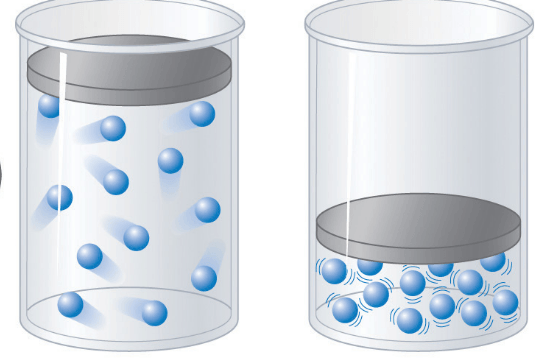
Looking at the picture, you can see that the volume has decreased. Which of these statements is also true.

a)

The number of particles has increased.

b)

The temperature has increased.

c)

The pressure has increased.

d)

The gas has turned into a liquid.

21.

Gas pressure is caused by

a)

gas molecules colliding with surfaces

b)

gas molecules condensing to a liquid

c)

gas molecules hitting other gas molecule

d)

barometers

22.
When the temperature of matter increases the particles...
a)
speed up and move closer
b)
speed up and move farther apart
c)
slow down and move closer together
d)
slow down and move farther apart
23.
What does Boyle's law relate to?
a)
Temperature and Volume
b)
Volume and Pressure
c)
Temperature and Pressure
24.
In Charles' Law the pressure remains constant.
a)
True
b)
False
25.
True or False: Gases can be compressed. 
a)
True
b)
False
26.
When Pressure increases then the Volume must...
a)
Increase
b)
decrease
27.
When Volume increases then Pressure must...
a)
Increase
b)
Decrease
28.
Which container will have a lower pressure?
a)
left
b)
right
c)
they both have the same pressure
d)
I don't know
29.
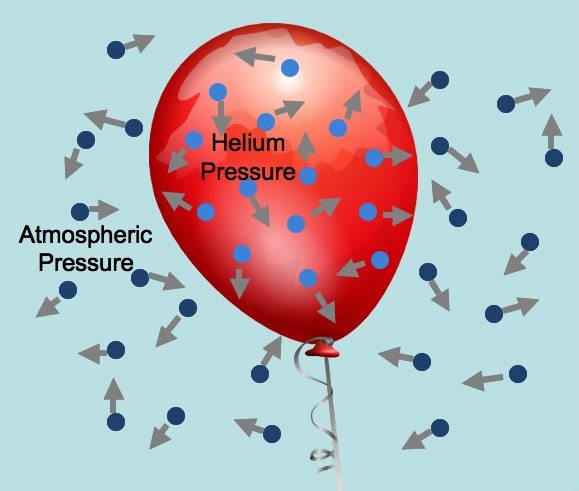
What causes pressure?
a)
The walls of the container
b)
The vacuum in the container
c)
The collisions of the particles
d)
Atmospheric pressure acting on the outside walls
30.
Boyle's law : When _______ is held constant, the pressure and volume of a gas are ________  proportional
a)
temperature,  equally
b)
mass, inversely
c)
temperature, inversely
d)
mass, equally
31.

A student inflates a balloon with helium then places it in the freezer. The student should expect

a)

the balloon's volume to increase

b)

the balloon's volume to decrease

c)

the balloon's moles to increase

d)

the balloon's moles to decrease

32.

If a hairspray can is heated, what can be expected of the pressure of the gas inside the can?

a)

The pressure will increase

b)

The pressure will decrease

c)

The pressure will remain constant

d)

The pressure will equalize

33.
Which of the following would increase the (gas) pressure of a system?
a)
Increase the Temperature
b)
Pump in more gas
c)
Decrease the volume
d)
All of these
34.
Charles' Law States...
a)
As Pressure goes up volume goes down
b)
As Pressure goes up temperature goes up
c)
As Volume goes up temperature goes up 
d)
As Pressure goes down volume goes down 
35.
Charles' Law States...
a)
As Pressure goes up volume goes down
b)
As Pressure goes up temperature goes up
c)
As Volume goes up temperature goes up 
d)
As Pressure goes down volume goes down 
36.
Whose law states that as pressure goes up, volume goes down?
a)
Charles 
b)
Boyle
c)
Aglow
d)
Mazias 
37.
A balloon will pop in the atmosphere because..
a)
Pressure goes down volume goes up
b)
Pressure goes up volume goes down
c)
temperature goes down volume goes up
d)
volume goes down temperature goes down
38.
Charles's law shows the relationship between which two factors of a gas ?
a)
volume and temperature 
b)
volume and pressure 
c)
pressure and volume
d)
volume and mass
39.
When a basketball is left outside in the cold it goes flat because the volume of air inside the ball has been reduced. What  gas law does this represent?
a)
Boyle's Law
b)
Charles's Law
40.
If a balloon is cooled what will happen to the volume?
a)
Volume will increase
b)
Volume will decrease
c)
Volume will not change
41.
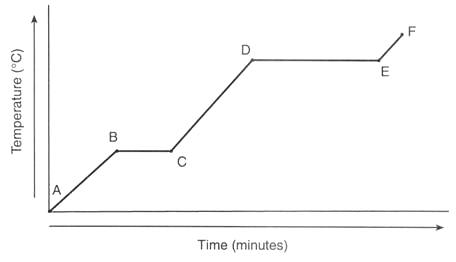
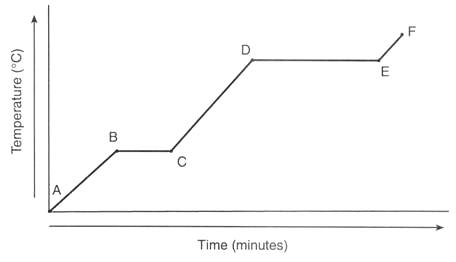
What line segment represents only the solid state?
a)
A-B
b)
B-C
c)
C-D
d)
D-E
42.
In which segment is the kinetic energy remaining constant?
a)
A-B
b)
B-C
c)
C-D
d)
E-F
43.
Which process takes the longest to occur?
a)
melting
b)
boiling
c)
freezing
d)
heating the solid
44.
What state(s) of matter are present at D-E?
a)
Solid-liquid
b)
Liquid
c)
Liquid-gas
d)
Gas-Solid
45.
Between which points is the temperature of the substance remaining constant?
a)
A-B only. 
b)
A-B, C-D, E-F
c)
B-C only. 
d)
B-C, D-E
46.
Between which points is the temperature of the substance increasing?
a)
A-B only. 
b)
A-B, C-D, E-F
c)
B-C only. 
d)
B-C, D-E
47.
Between which points is the substance changing state?
a)
A-B only. 
b)
A-B, C-D, E-F
c)
B-C only. 
d)
B-C, D-E
48.
This type of graph is called a:
a)
Phase diagram
b)
Heating curve
c)
State of matter
d)
Temperature chart
49.

The melting point of the sample is

a)

-60 ºC

b)

-100 ºC

c)

60 ºC

d)

100 ºC

50.
True or false: melting and freezing occur at the same temperature!
a)
True
b)
False
c)
I don't know
51.

Given the heating curve of a solid being heated at a constant rate, how much total time was required to boil this substance after it reached its melting point?

a)

3 minutes

b)

4 minutes

c)

10 minutes

d)

14 minutes

52.

NaCl(s) was heated up starting at an initial temperature of 0°C. The heating curve is shown in the picture. What is the melting point of this substance?

a)

0°C

b)

801°C

c)

1000°C

d)

1465°C

53.

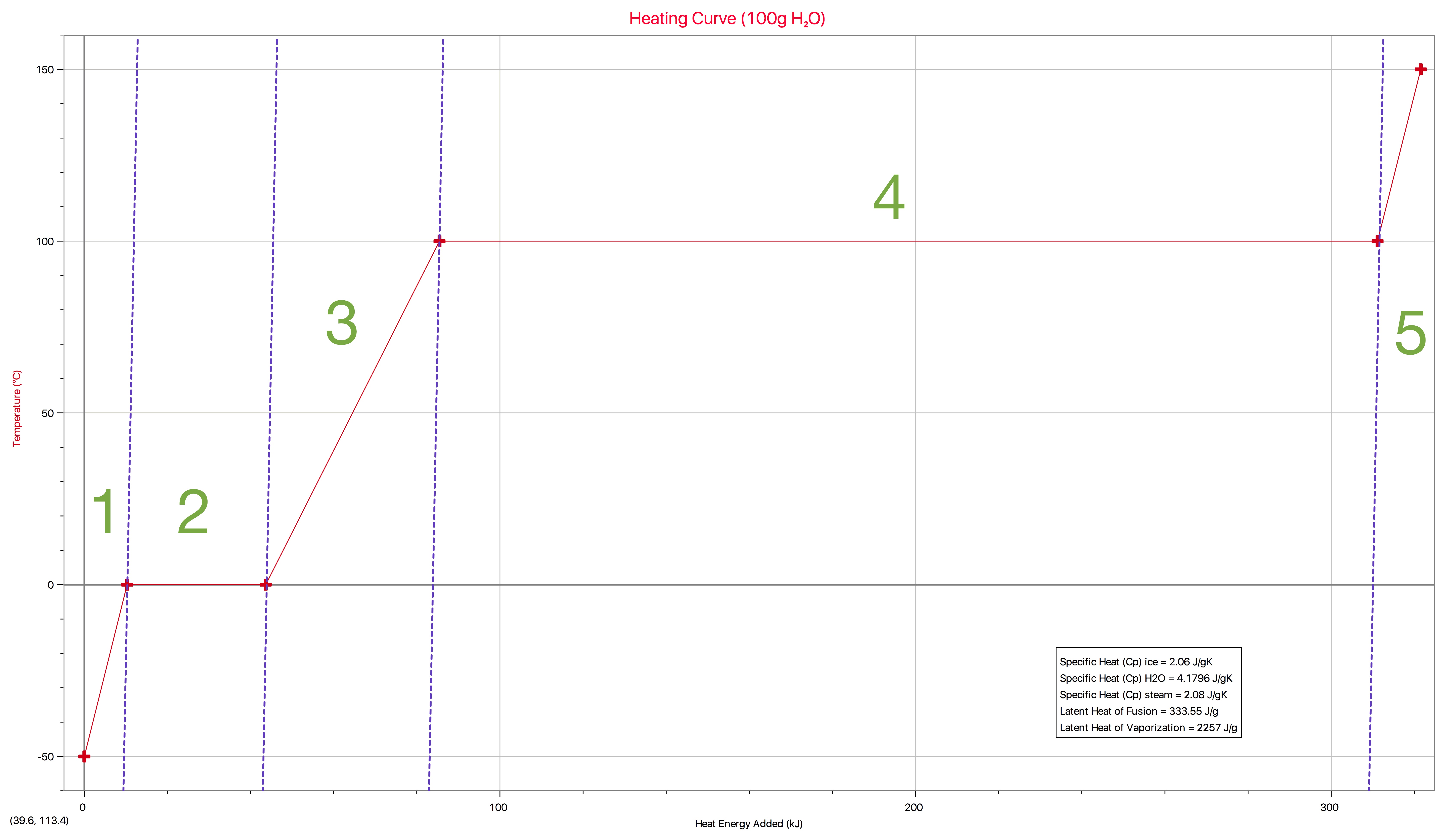
Given the heating curve of water, what is happening to potential and kinetic energy during segment CD?

a)

the potential energy and kinetic energy both increase

b)

the potential energy increases while the kinetic energy decreases

c)

the potential energy is constant while the kinetic energy increases

d)

the potential energy increases while the kinetic energy is constant

54.

Given the heating curve for water, during which line segment could I find water in both the solid and liquid phase at the same time?

a)

AB

b)

BC

c)

CD

d)

DE

e)

EF

55.
In which region(s) does temperature remain constant?
a)
Region 1, 3, & 5
b)
Region 2 & 4
c)
Region 1 only
d)
Region 1 & 2
56.
In which region(s) does temperature increase?
a)
Region 1, 3, & 5
b)
Region 2 & 4
c)
Region 1 only
d)
Region 1 & 2
57.

This curve indicates what about the heat energy?

a)

Heat energy is being added or absorbed

b)

Heat energy is being released

58.

What is the freezing point of the substance?

a)

0oC

b)

60oC

c)

120oC

d)

180oC

59.

From point A to point F, the sample is going through an __________ process by __________.

a)

exothermic, releasing heat to the surroundings

b)

exothermic, absorbing heat from the surroundings

c)

endothermic, releasing heat to the surroundings

d)

endothermic, absorbing heat from the surroundings