Wayground logo

Free Printable Worksheets

Font size

S
M
L
XL
Worksheets

Introduction to Physics Test Review

Total questions: 38

Worksheet time: 30mins

Name
Class
Date
1.
This part of the experiment serves as a basis of comparison; the one variable being tested has been omitted. 
a)
experimental group
b)
control group
c)
data
d)
variables
2.
This variable in an experiment is the one being deliberately changed by the scientist. 
a)
dependent variable
b)
independent variable
c)
data
d)
control group
3.
Which type of data involves numbers that are obtained by counting or measuring?
a)
quantitative
b)
qualitative
4.
Which type of data involves descriptions that cannot be counted or measured?
a)
qualitative
b)
quantitative
5.
An experiment is performed on plants to see how different liquids affect plant growth. Each plant in the experiment is given a different liquid: water, apple juice, or milk. Each plant has the same amount of soil, sunlight, and listens to the same music. In this investigation, the independent variable is ...
a)
The type of plant
b)
The amount of sunlight
c)
The type of music
d)
The type of liquid
6.
A testable prediction about a scientific investigation is a(n)
a)
Question
b)
Observation
c)
Hypothesis
d)
Experiment
7.
If you increase the amount of spinach you eat, then you will increase the iron in your blood. 
What's the dependent variable?
a)
increase the amount of iron in your blood
b)
spinach you eat
8.
There are __?__ significant digits in the number 0.00076
a)
2
b)
4
c)
5
d)
6
9.
There are __?__ significant digits in the number 2,000,000
a)
1
b)
2
c)
6
d)
7
10.
Why is the zero significant in the digit 706?
a)
It is an ending zero after the decimal point.
b)
It is a beginning zero.
c)
It is between 2 significant digits.
d)
It is not a significant digit.
11.
Why is the 0 a significant digit in the number 15.92340?
a)
It is an ending zero after the decimal point.
b)
It is a beginning zero.
c)
It is between 2 significant digits.
d)
It is not a significant digit.
12.
Which is correct regarding the significant digits for the number 0.0054?
a)
The zeroes are not significant digits since they are beginning zeroes.
b)
The zeroes are not significant digits since they are ending zeroes.
c)
They are significant since they are between significant digits.
d)
All zeroes are not significant digits.
13.
Which of the following is the answer for the problem with the correct number of significant digits?
24.32 + 1.2 = 25.52
a)
25.6
b)
25.52
c)
25.5
d)
25
14.
Which of the following is the answer for the problem with the correct number of significant digits?
53 + 23.4 = 76.4
a)
77.0
b)
77
c)
76.4
d)
76
15.
Which of the following is the answer for the problem with the correct number of significant digits?
19.008 - 14.53 = 4.478
a)
5
b)
4.5
c)
4.48
d)
4
16.
Which of the following is the answer for the problem with the correct number of significant digits?
23.91 x 12.861 = 307.50651
a)
308
b)
307.51
c)
307.5
d)
307
17.
Which of the following is the answer for the problem with the correct number of significant digits?
65 ÷ 10.01= 6.4935064
a)
7.0
b)
6.5
c)
6.494
d)
6.0
18.

When using scientific notation, a negative exponent means ...

a)

the standard number is greater than one

b)

the standard number is less than one

c)

the negative sign doesn't have a meaning

d)

None of the above

19.

Convert this number to standard notation: 7.1 x 10⁴

(a)  

20.

Which value is the greatest

a)

5.0 x 10⁻⁹

b)

5.0 x 10⁻⁴

c)

5.0 x 10⁶

d)

5.0 x 10⁸

21.
Write 6,700 in scientific notation.
a)
6.7 x 10³
b)
6.7 x10⁻³
c)
67 x 102
d)
67 x 10-2
22.
It is a measure of how close measurements come to each other when they are made in the same way
a)
Accuracy
b)
Precision
c)
Error
d)
Extrapolation
23.
a)
Student A
b)
Student B
c)
Student C
d)
Cannot be determined
24.

How close a measurement is to the accepted value is called..

a)

Accuracy

b)

Precision

c)

Significant

d)

Estimate

25.
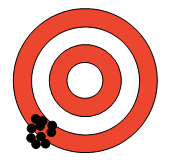
This bullseye demonstrates...
a)
High Accuracy & High Precision
b)
High Accuracy & Low Precision
c)
Low Accuracy & High Precision
d)
Low Accuracy & Low Precision
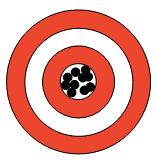
26.
?
a)
High Accuracy & High Precision
b)
High Accuracy & Low Precision
c)
Low Accuracy & High Precision
d)
Low Accuracy & Low Precision
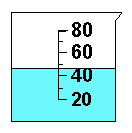
27.
volume?
a)
48 mL
b)
48.2 mL
c)
48.25 mL
d)
4 mL
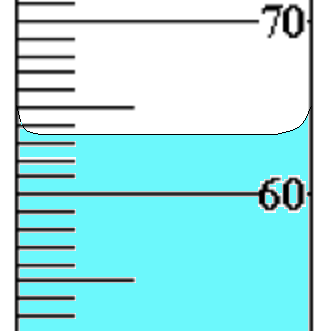
28.
Volume?
a)
63.5 mL
b)
63 mL
c)
63.55 mL
d)
6 mL
29.

What is 4000g in kg?

a)

400

b)

40

c)

0.4

d)

4

30.

What is 3.75 litres in ml

a)

3750

b)

375

c)

3705

d)

37.5

31.

Convert into kilometers.

452.159 meters.

a)

0.452159

b)

4.52159

c)

45.2159

d)

452159

32.
Convert into grams.
763.1247 milligrams.
a)
7631.247
b)
76312.47
c)
0.7631247
d)
7631247
33.

64,600,000 cm = ____ km

a)

646

b)

64.6

c)

6,460

d)

6.46

e)

64,600

34.

425,000 mL = ___ L

a)

425

b)

42.5

c)

4,250

d)

4.25

e)

42,500

35.

0.000238 m = ___ cm

a)

0.0238

b)

0.238

c)

2.38

d)

0.00238

e)

0.000238

36.

6.81 cm = ___ m

a)

0.0681

b)

0.681

c)

0.00681

d)

0.000681

e)

6.81

37.

0.00817 km = ___ cm

a)

817

b)

81.7

c)

8.17

d)

0.817

e)

8,170

38.

0.0000000332 km = ___ mm

a)

0.0332

b)

0.332

c)

3.32

d)

0.00332

e)

0.000332