Wayground logo

Free Printable Worksheets

Font size

S
M
L
XL
Worksheets

Geom Unit 1 Review

Total questions: 110

Worksheet time: 2hrs 50mins

Name
Class
Date
1.
An exact location in space with no length or width.
a)
Ray
b)
Point
Point
c)
Line
d)
Line segment
2.
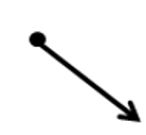
Name the image
a)
Line
b)
Ray
c)
Line segment
d)
Angle
3.
Name the image
a)
Line segment
b)
Line
Ray
c)
Point
Point
d)
Ray
Line Segment
4.
Name the Image. 
a)
Ray
b)
Point
c)
Line
d)
Line segment
5.
Name the Image
a)
Angle
b)
Line
c)
Line Segment
d)
Ray
6.
A line is named by...
a)
Any 2 points on the line, or a lowercase script letter.
b)
Any 3 points on the line.
c)
Any 1 point on the line.
d)
Any 3 points on the line, or a uppercase script letter.
7.
A plane is named by...
a)
Any 1 point on the plane.
b)
Any 3 collinear points on the plane or a lowercase script letter.
c)
Any 3 non-collinear points on the plane or an uppercase script letter.
d)
All points on the plane that aren't part of a line.
8.
Name 4 collinear points
a)
HMNO
b)
IKNO
c)
MJOL
d)
HNKI
9.
A line that contains point M.
a)
Line q
b)
Line p
c)
Line r
d)
Line NH
10.
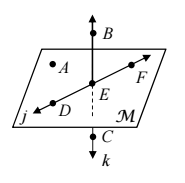
An example of coplaner points
a)
D, E, B
b)
C, B, A
c)
M, E, C
d)
A, F, E
11.
Give another name for line k.
a)
Line BC
b)
Line BCE
c)
Line ED
d)
Line k is the only name, there isn't another name.
12.
How would you describe points I, L, C?
a)
collinear
b)
non-coplanar
c)
symmetric
d)
coplanar
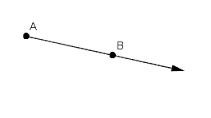
13.
What is the name of this ray?
a)
Ray AB
b)
Ray BA
c)
Ray ABC
d)
Ray AC
14.

Find the length between H and F.

a)

-5

b)

5

c)

-6

d)

6

15.
Use the figure to write and solve an equation for x.
a)
5
b)
6
c)
7
d)
8
16.
Find measurement for QT.
a)
10
b)
6
c)
-10
d)
2
17.

What are the coordinates of point H?

a)

(-4, 2)

b)

(4, -2)

c)

(-2, 4)

d)

(4, 4)

18.
If you were to plot the point (4, -12) what would be the correct method?
a)
Up 4, left 12
b)
Right 4, up 12
c)
Down 4, left 12
d)
Right 4, down 12
19.
What letter is at (1,-7 )
a)
There is no letter at those coordinates.
b)
B
c)
C
d)
K
20.

Find AC

a)

3

b)

4

c)

5

d)

2

21.

If AB = 2x+3, BC = 3x-5, and AC = 38, what is the value of x ?

a)

11

b)

12

c)

8

22.
There is a missing line segment. What is the length of BC, when AB = 2 and 
AC= 10 ?
a)
12
b)
8
c)
5
d)
4
23.
Use the figure to write and solve an equation for x.
a)
11
b)
12
c)
24
d)
25
24.

Name the angle. Choose the correct answer.

a)
b)
c)
d)
25.

Choose another name for angle 2.

a)
b)
c)
d)
26.

Name the angle. Choose all options that apply.

a)
b)
c)
d)
27.

Find the angle measurement.

a)
b)
28.

Find the x-value.

a)
b)
29.
a)
b)
30.

Classify the angle.

a)

acute

b)

right

c)

octuse

d)

straight

31.

Classify the angle.

a)

acute

b)

right

c)

obtuse

d)

straight

32.

Estimate the angle measurement.

a)
b)
33.
2x and 10x are two angles that are supplementary. What do the angles measure? (Hint: 2x + 10x = 180)
a)
30°,150°
b)
5°,10°
c)
15°, 75°
d)
90°, 180°
34.
Find what the value of x.
a)
56
b)
66
c)
156
d)
166
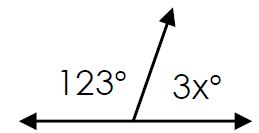
35.
What is the measure of the missing angle?
a)
39
b)
129
c)
119
d)
129
36.
Find the value of x.
a)
15
b)
16
c)
18
d)
19
37.
Identify the angle pair.
a)
Complementary angles
b)
Congruent angles
c)
Linear Pair
d)
Vertical Angles
38.
Identify the angle pair.
a)
complementary angles
b)
linear pair
c)
supplementary 
d)
vertical angles
39.
Identify the angle pair.
a)
adjacent angles
b)
complementary angles
c)
linear pair
d)
vertical angles
40.
Identify the angle pair
a)
adjacent angles
b)
complementary angles
c)
consecutive angles
d)
supplementary angles
41.
Identify the angle pair.
a)
complementary angles
b)
congruent angles
c)
linear pair
d)
vertical angles
42.
What is the midpoint between (3, -1) and (8, -6)
a)
(11, -7)
b)
(-5.5, -3.5)
c)
(5.5, -3.5)
d)
(2, -2)
43.
Find the y-coordinate of the midpoint of the line
a)
1
b)
2
c)
-2
d)
3
44.
What is the midpoint between (3, -1) and (7, -5)
a)
(5, -2)
b)
(10, -6)
c)
(5, -3)
d)
(2, -2)
45.
What is the distance between -8 and 4 on the integer number line?
a)
-4
b)
4
c)
12
d)
0
46.

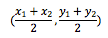
Which of the following is the correct midpoint formula given two endpoints (x1, y1) and (x2, y2)?
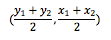
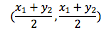
a)
b)
c)
d)
47.
Find the midpoint of the segment with the endpoints:(4, 12) and (-6, 14)
a)
(-1, 13)
b)
(13, 1)
c)
(13, -1)
d)
(5, 13)
48.

What is the distance between (4,5) and (-7,-18)? Round to the nearest whole number

a)

25

b)

26

c)

22

d)

14

49.

What is the distance from (5,10) to (10,10)?

a)

5

b)

0

c)

101

d)

undefined

50.

Determine the exact distance from (-7,12) to (0,6).

a)

80\sqrt{80}

b)

85\sqrt{85}

c)

21\sqrt{21}

d)

10

51.
Point M with coordinates (3,4) is the midpoint of the line AB and A has the point (-1,6). What is the point of B?
a)
(1,5)
b)
(2,10)
c)
(7,2)
d)
(1,2)
52.

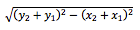
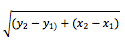
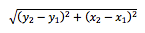
Given two points (x1, y1), (x2, y2) the distance between them is:
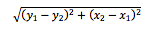
a)
b)
c)
d)
53.

Determine the distance between PQ.

a)

7 units

b)

10 units

c)

13units

d)

16 units

54.
Complete the conjecture.  Think of examples to help.
The product of any two odd numbers is _____________
a)
even
b)
odd
c)
zero
d)
positive
55.
Complete the conjecture.  Think of examples to help.
The sum of an odd number and an even number is ________________
a)
even
b)
odd
c)
zero
d)
positive
56.
The type of reasoning where a person makes  conclusions based on observations and patterns is called...
a)
Inductive reasoning
b)
Deductive reasoning
c)
Conjecture
d)
Experiments
57.
What are the missing numbers in this pattern?
23, 33, ___, 53, ___, 73
a)
32, 62
b)
42, 63
c)
43, 63
d)
42, 62
58.
Where would the next red square be?
a)
bottom left
b)
top right
c)
top left
d)
bottom right
59.
What are the missing numbers in this pattern?
12, 15, ___, 21, ____, 27
a)
18,23
b)
18, 24
c)
17, 25
d)
17, 24
60.
How would you describe this pattern's rule?
65, 62, 59, 56, 53, 50
a)
Subtract 2
b)
Subtract 3
c)
Subtract 4
d)
Add 3
61.
How many blocks would be in the next picture?
a)
14
b)
9
c)
10
d)
12
62.
Complete the conjecture.  Think of examples to help.
The difference of any two odd numbers is _______
a)
even
b)
odd
c)
zero
d)
positive
63.
What comes next in the pattern?
a)
up, down, right
b)
down, up, left
c)
up, right, down
d)
down, left, right
64.
What comes next?
a)
The next term will have 16 blocks
b)
The next term will have 15 blocks.
c)
The next term will have 14 blocks.
d)
This is the end of the pattern.
65.
If you extended the pattern, how many dots would be in the 10th figure?
a)
25
b)
20
c)
100
d)
30
66.
Use inductive reasoning to predict the next three numbers in the pattern.  9, 3, 1, 1/3, 1/9
a)
1/27, 1/81, 1/243
b)
1, 2, 3
c)
27, 81, 243
d)
6, 12, 15
67.
What number belongs in the blank?
18,24,___,36,42
a)
28
b)
31
c)
30
d)
35
68.
Identify the hypothesis and conclusion of the conditional statement:
If you give me twenty dollars, then I will be your best friend.
a)
Hypothesis: I will be your best friend
Conclusion: you give me twenty dollars
b)
Hypothesis: you give me twenty dollars
Conclusion: I will be your best friend
c)
Hypothesis: if you have to pay for friends
Conclusion: then you probably should reevaluate your life
d)
Hypothesis: you will not have to pay twenty dollars
Conclusion: if you have lots of friends
69.
Given, "If I have a Siberian Husky, then I have a dog." Identify the hypothesis.
a)
If I have a Siberian Husky.
b)
I have a Siberian Husky.
c)
Then I have a dog.
d)
HI have a dog.
70.
Given, "If angles are congruent, then the measures of the angles are equal." Identify the conclusion.
a)
If the angles are congruent.
b)
The angles are congruent.
c)
Then the measures of the angles are equal.
d)
The measures of the angles are equal.
71.
Given, "If angles are congruent, then the measures of the angles are equal." Identify the converse.
a)
If the measures of the angles are equal, then the angles are congruent.
b)
"If angles are not congruent, then the measures of the angles are not equal."
c)
If the measures of the angles are not equal, then the angles are not congruent.
d)
If the angles are not congruent, then the measure of the angles are equal.
72.
Is this statement true?
a)
True.  Class can't happen if a chair isn't occupied.
b)
False.  There are empty chairs here.
c)
True. 
d)
True.  There are no chairs here, so the hypothesis is true.
73.
If something is an angle, then it is acute. What is an appropriate counterexample?
a)
70⁰
b)
45⁰
c)
120⁰
d)
True. There is no counterexample.
74.
If something is a vehicle, then it is a Ford. What is an appropriate counterexample?
a)
Ford Mustang
b)
Dodge Charger
c)
Ford F150
d)
Both A and C are counterexamples.
75.
If an animal is furry, then it is a hamster. What would be an appropriate counterexample?
a)
goldfish
b)
frog
c)
elephant
d)
cat
76.
When taking the converse we ___________ the hypothesis and conculsion
a)
negate
b)
switch
c)
highlight
d)
switch and negate
77.
Which is the correct if-then statement for: "you will be late to school if you miss the bus."
a)
If you are late to school, then you will miss the bus.
b)
If you miss the bus, then you will be late to school
c)
If you sleep late, then you don't have to go to school.
d)
If you miss the bus, then you'll have to walk and be late.
78.
Given, "If angles are congruent, then the measures of the angles are equal." Identify the contrapositive.
a)
If the measures of the angles are equal, then the angles are congruent.
b)
If angles are not congruent, then the measures of the angles are not equal.
c)
If the measures of the angles are not equal, then the angles are not congruent.
d)
If the angles are not congruent, then the measure of the angles are equal.
79.
Original: If Emily is not late to class, then she will not be marked tardy.
What is this? If Emily is late to class, then she will be marked tardy.
a)
Converse
b)
Inverse
c)
Contrapositive
d)
Negation
80.
Which of the following is the inverse to the statement: 
"If you diet and exercise, then you will lose weight."
a)
If you don't diet and exercise, then you will not lose weight.
b)
If you don't diet and exercise, then you will lose weight.
c)
If you lose weight, then you dieted and exercised.
d)
If you don't lose weight, then you diet and exercise. 
81.
Using the statements:
If it is Friday, then I will get paid.
It is Friday.
What is the conclusion?
a)
It is not Friday
b)
It is Friday
c)
I will not get paid
d)
I will get paid
82.
Using deductive reasoning, which of the following completes the statement to form a valid conclusion?
If it is snowing heavily, then school will be canceled.
If school is canceled, the big test will not be given today.
It is snowing heavily, then...
a)
Look out for the snowplows while driving to school.
b)
The big test will not be given today.
c)
The roads will be hard to drive on.
d)
You should call the school to see if school is canceled.
83.
What conclusion can be drawn from the following statements?
If the stereo is on, then the volume is loud.  
If the volume of the stereo is loud, then the neighbors will complain.
a)
If the neighbors complain, then the stereo will be loud.
b)
If the stereo is on, then the neighbors will complain.
c)
If the stereo is volume is loud, then the stereo is on.
d)
If the stereo is on, then the volume is loud.
84.
What conclusion can be drawn from the following statements?
If the sun is shining, then it is a beautiful day.  
If it is a beautiful day, then we will have a picnic.
a)
If the sun is shining, then it is a beautiful day.
b)
If it is a beautiful day, then the sun is shining.
c)
If the sun is shining, then we will go on a picnic.
d)
If we go on a picnic, then the sun is shining.
85.
What conclusion can be drawn from the following statements?
If Todd goes to the movies, then Sarah will go to the movies.  
If Chris goes to the movies, then Todd will go to the movies.
a)
If Chris goes to the movies, then Sarah will go to the movies.
b)
If Todd goes to the movies, then Chris will go to the movies.
c)
If Sarah goes to the movies, then Chris will go to the movies.
d)
If Chris goes to the movies, then Todd will go to the movies.
86.
What is the correct outcome based on the statement?
A dog with proper training will not misbehave.
a)
If a dog has proper training, then it will not misbehave.
b)
If a dog does not behave, then it had proper training.
87.
What conclusion can be drawn from the following statements?
If Todd goes to the movies, then Sarah will go to the movies.  
If Chris goes to the movies, then Todd will go to the movies.
a)
If Chris goes to the movies, then Sarah will go to the movies.
b)
If Todd goes to the movies, then Chris will go to the movies.
c)
If Sarah goes to the movies, then Chris will go to the movies.
d)
If Chris goes to the movies, then Todd will go to the movies.
88.
Inductive Reasoning means...
a)
Guessing
b)
Testing and observing patterns to make conjectures
c)
Explaining why
d)
Ura nok seblu!
89.
Deductive reasoning means...
a)
Guessing
b)
Ura nok seblu!
c)
Testing and observing patterns to make conjectures
d)
Making general observations of situations and applying them to specific situations.
90.
What can be concluded from the following statements?
If Tom goes fishing then he brings a pole.
If Tom brings his pole then he catches a fish.
a)
If Tom goes fishing then he catches a fish.
b)
If Tom brings his pole then he goes fishing
c)
 If Tom catches a fish then he brought his pole.
d)
If Tom brings his pole then he catches a fish.
91.
Which of the following statements is valid based on the given scenario?
If Jason plays basketball, then Steve sits on the bench.
 
If Steve sits on the bench, then Ronald starts at center.
  
a)
If Steve sits on the bench then Jason plays basketball.
b)
If Ronald starts at center then Jason plays basketball.
c)
If Steve sits the bench then Ronald does not start at center.
d)
If Jason plays basketball then Ronald starts at center.
92.
What can be concluded from the following statements?  
If Mike rakes leaves, then he bags them .
If Mike bags the leaves he then mows the lawn.
a)
If Mike mows the lawn then he bags the leaves.
b)
If Mike bags the leaves, he rakes.
c)
If Mike does not mow the lawn, then he did not rake the leaves.
d)
If Mike mows the lawn then he bags the leaves.
93.
Which statement is the converse (opposite but meaning the same thing) of the given statement?
If you make an insurance claim, then your rates will go up.
a)
If your insurance rates do not go up , then you have not maid a claim.
b)
If you do not make an insurance claim, then your rates will not go up.
c)
If your insurance rates go up, then you have made an insurance claim.
d)
If you make an insurance claim, then your rates will not go up.
94.
__________________________ uses specific observations to make generalizations.
a)
Deductive reasoning
b)
Inductive reasoning
95.
__________________________ uses generalizations to make specific conclusions.
a)
Deductive Reasoning
b)
Inductive Reasoning
96.
Which property says that if k = 3, then 3 = k?
a)
Substitution Property
b)
Reflexive Property
c)
Symmetric Property
d)
Transitive Property
97.
Which is an example of transitive property?
a)
If a=b and b=m, then a = m.
b)
If a=b then b=a.
c)
Given a number a, a=a
d)
If a=5, then 3a-5 = 3(5)-5
98.
Which property says that if -5x - 1 = -11, then -5x = -10?
a)
Addition Property
b)
Subtraction Property
c)
Multiplication Property
d)
Division Property
99.
Which property says -7(x - 4) = -7x + 28?
a)
Addition Property
b)
Multiplication Property
c)
Division Property
d)
Distributive Property
100.

Which reason justifies the statement below?


If <T and <U are complementary, then <T + <U = 90∘.

a)

Complements Theorem

b)

Definition of Right Angles

c)

Definition of Complementary Angles

d)

Congruent Complements Theorem

101.

Which reason justifies the statement below?


If MN = PQ, then MN ≅ PQ.

a)

Definition of Congruence

b)

Definition of Midpoint

c)

Reflexive Property

d)

Symmeric Property

102.
Which is the correct reason for statements 2 and 4 in the proof?
a)
Corresponding Angles
b)
Substitution
c)
Definition of Congruent Angles
d)
Vertical Angles are congruent.
103.
Which property states that if 2x = 14, then x = 7?
a)
Addition Property
b)
Subtraction Property
c)
Multiplication Property
d)
Division Property
104.

What allows you to say that AM = AM?

a)

Symmetric Property

b)

Reflexive Property

c)

Transitive Property

d)

Identity Property

105.

Find the value of x.  

a)

150

b)

30

c)

145

d)

15

106.

Find the value of x.  

a)

28

b)

30

c)

32

d)

90

107.

Find  m∠AEB.m\angle AEB.  

a)

150

b)

30

c)

130

d)

50

108.

Find  m∠ECDm\angle ECD  

a)

13

b)

64

c)

90

d)

180

109.

Find  m∠Am\angle A  if  ∠A\angle A  is congruent to its supplement,  ∠B.\angle B.  

a)

45

b)

90

c)

180

d)

impossible to determine

110.

Find  m∠Am\angle A  if  ∠A\angle A  is twice as large as its complement,  ∠B.\angle B.  

a)

30

b)

45

c)

60

d)

90