wayground logo

Free Printable Worksheets

Font size

S
M
L
XL
Worksheets

Spotlight- Precalc Spiral Review

Total questions: 107

Worksheet time: 4hrs 12mins

Name
Class
Date
1.
Simplify:  (m9)2
a)
m11
b)
2m9
c)
m18
d)
m4.5
2.
Factor:
x+ 7x - 30
a)
(x + 10)(x - 7)
b)
(x - 10)(x + 3)
c)
(x + 10)(x + 3)
d)
(x + 10)(x - 3)
3.
Simplify:  x8/x2
a)
x16
b)
x4
c)
x5
d)
x6
4.
According to exponent rules, when we raise the power to a power we _______ the exponents.
Example: (d2)5
a)
add
b)
subtract
c)
multiply
d)
divide
5.

Identify where the function is positive.

a)

7<x<3,  x > 5-7<x<3,\ \ x\ >\ 5

b)

x<7, 3<x<5x<-7,\ -3<x<5

c)

x <7, x >5x\ <-7,\ x\ >5

d)

7<x<5-7<x<5

6.
According to exponent rules, when we multiply two power with the same base we _______ the exponents.
Example: c6 ⋅ c4
a)
add
b)
subtract
c)
multiply
d)
divide
7.
Write the following in interval notation
x < 3 or x ≥ 5
a)
(3, -∞) or (∞, 5]
b)
[-∞, 3) or [5, ∞]
c)
(-∞, 3) or [5, ∞)
d)
(3, -∞] or [∞, 5]
8.
According to exponent rules, when we divide two powers with the same base we _______ the exponents.
Example: h8 / h3
a)
add
b)
subtract
c)
multiply
d)
divide
9.

Simplify using your exponent rule(s) x⁵⁄x³

a)

b)

x

c)

1

d)

x⁸

10.
Simplify:  x10⋅x4
a)
x40
b)
x14
c)
x6
d)
2x14
11.

Simplify using your exponent rule(s) x⁻⁶

a)

1 ⁄ x⁶

b)

x⁶

c)

-x⁶

d)

-1 ⁄ x⁶

12.

Simplify using your exponent rule(s) -14x7/7x

a)

-2x6

b)

-2x

c)

-2x5

d)

-2x8

13.

Simplify using your exponent rule(s) (53x2y4)0

a)

5xy

b)

1

c)

0

d)

5

14.

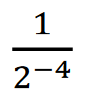
Rewrite using positive exponents

a)

24

b)

1/24

c)

42

d)

1/42

15.

Simplify using your exponent rule(s) (2x3y)6

a)

2x18y6

b)

64x18y6

c)

64x3y6

d)

2x3y6

16.
True or False?
a)
True
b)
False
17.
Rewrite using a positive exponent.
7-10
a)
1/710
b)
710
c)
1/7-10
d)
-70
18.
Simplify:  (5p9q3)(2pq7)
a)
7p10q10
b)
10p9q21
c)
10p10q10
d)
10p8q-4
19.
Simplify.
s-5 ⋅ s-2
a)
s-3
b)
1/s7
c)
s-7
d)
1/s3
20.
Simplify.
a)
y60
b)
1/y16
c)
y-16
d)
y4
21.
Factor x2-2x-15
a)
(x+5)(x-3)
b)
(x-5)(x-3)
c)
(x-5)(x+3)
d)
(x+5)(x+3)
22.
Factor x2 + 7x + 12
a)
(x + 2)(x + 10)
b)
(x + 3)(x + 4)
c)
(x + 4)(x + 5)
d)
(x + 4)(x + 6)
23.
Simplify:  (-5p)2
a)
-25p2
b)
25p2
c)
-5p2
d)
5p2
24.
Factor
x+ 9x - 36
a)
(x + 12)(x - 3)
b)
(x + 9)(x - 4)
c)
(x - 12)(x + 3)
d)
(x - 9)(x - 4)
25.
Factor
n2 + 5n - 6
a)
(n - 2)(n - 3)
b)
(n - 1)(n + 6)
c)
(n + 1)(n - 6)
d)
(n + 2)(n - 3)
26.
Factor
a2 - a - 12
a)
(a - 4)(a + 3)
b)
(a + 6)(a - 4)
c)
(a - 6)(a + 4)
d)
(a + 4)(a - 3)
27.
Factor
r2 -16r + 60
a)
(r - 15)(r + 4)
b)
(r - 6)(r + 10)
c)
(r - 6)(r - 10)
d)
(r +30)(r - 2)
28.
Factor
x-16x + 48
a)
(x - 12)(x - 4)
b)
(x + 6)(x - 8)
c)
(x + 12)(x - 4)
d)
(x -16)(x - 3)
29.
Factor:
p2 - 14p
a)
p(1 - 14)
b)
2p(p - 7)
c)
p2(1-14)
d)
p(p - 14)
30.
Factor:
x-15x + 36
a)
(x - 18)(x + 2)
b)
(x - 12)(x - 3)
c)
(x - 12)(x + 3)
d)
(x + 18)(x - 2)
31.
Factor:
x2 - 8x - 128
a)
(x - 16)2
b)
(x - 16)(x + 8)
c)
(x + 16)(x - 8)
d)
(x - 16)(x - 8)
32.
x2 + 5x + 6
a)
(x+2)(x+3)
b)
(x+1)(x+6)
c)
(x-1)(x+6)
d)
(x-2)(x-3)
33.
Factor
n2 + 16n + 63
a)
(n-7)(n+4)
b)
(n+7)(n-9)
c)
(n-3)(n-10)
d)
(n+7)(n+9)
34.
Factor: x2 – 5x – 24
a)
(x - 5)(x + 19)
b)
(x - 8)(x + 3)
c)
(x - 3)(x + 8)
d)
(x - 19)(x + 5)
35.
Factor the Trinomial:
x2 - 8x + 15
a)
(x + 5) ( x + 3)
b)
(x - 5) (x - 3)
c)
(x + 15) (x - 1)
d)
(x - 7) (x - 8)
36.
x- 16
a)
Prime
b)
( x - 4) ( x + 4) 
c)
( x - 8) ( x + 8) 
d)
( x - 4) ( x - 4) 
37.
Factor:
x2 - 5x
a)
1(x - 5)
b)
x(x - 5x)
c)
x(x - 5)
d)
x2(1 - 5)
38.

Factor the following: x21x^2-1  

a)

(x+1)(x +1)

b)

(x - 1)(x - 1)

c)

prime

d)

(x + 1)(x - 1)

39.
x- 25
a)
( x + 5 ) ( x - 5 ) 
b)
( x - 5 ) ( x - 5 ) 
c)
( x + 5 ) ( x + 5 ) 
d)
Prime
40.
x- 400
a)
( x - 200) ( x + 200) 
b)
( x + 20) ( x + 20) 
c)
Prime
d)
( x - 20) ( x + 20) 
41.

4x2 - 25

a)

(2x + 5) (2x - 5)

b)

(2x - 5)2

c)

(2x + 5)2

d)

2x + 5(2x - 5)

42.

25x2 - 36y2

a)

5x + 6y(5x - 6y)

b)

(5x + 6y) (5x - 6y)

c)

(5x + 6y)2

d)

(5x - 6y)2

43.

x4 - 100y2

a)

(x2 + 10y) (x2 - 10y)

b)

(x + 10y) (x - 10y)

c)

(x + 10y) (x3 - 10y)

d)

(x3 + 10y) (x - 10y)

44.

We can't factor using difference of two square this

49x2 + 4y2. Why?

a)

Because 4 is not a perfect cubed number.

b)

Because 4 is not a perfect squared number.

c)

Because 49 is not a perfect squared number.

d)

Because we can't factor using difference of two squares if it is addition sign.

45.

Factor:

4x + 6

a)

4(x + 2)

b)

2(2x + 3)

c)

2(2x + 4)

d)

4(x + 2/3)

46.
Express the following in Interval Notation
-8 ≤ x < 8
a)
[-8, 8]
b)
[-8,8)
c)
(-8, 8]
d)
(-8, 8)
47.
Express the following in Interval Notation
-9 < x ≤ -4
a)
[-9, -4]
b)
(-9,-4]
c)
[-9, -4]
d)
(-9,-4)
48.
Express the following in Interval Notation
 -9 < x ≤ -4
a)
[-9, -4]
b)
(-9,-4]
c)
[-9, -4]
d)
(-9,-4)
49.
Look at the graph. Write the inequality in interval notation.
a)
(-2,5)
b)
(-∞,-2)⋃(5,∞)
c)
[-2,5]
d)
(-∞,-2]∪[5,∞)
50.
Write the following in interval notation
 x < 8
a)
(8, ∞)
b)
(8, -∞)
c)
(-∞, 8)
d)
[-∞, 8]
51.
Simplify:  (6m7)/(4m3)2
a)
(6m)/16
b)
(3/8)m
c)
3/(8m)
d)
(3m)/4
52.
Write the following in interval notation
x ≥ 100
a)
(0, 100]  (Real quick)
b)
(∞, 100]
c)
[100, ∞)
d)
(∞, 100)
53.
Look at the Graph. Write the inequality in interval notation.
a)
[-4, -1)
b)
(-4, -1)
c)
(-4, -1]
d)
[-4, -1]
54.
Look at the picture. Which graph best represents the solution set (-∞, -2) U (5, ∞)?
a)
Graph 1
b)
Graph 2
c)
Graph 3
d)
Graph 4
55.
On what interval is the graph decreasing?
a)
(∞, 3)
b)
(3, -∞)
c)
(3, ∞)
d)
(-∞, 3)
56.
On which interval is the graph increasing?
a)
[-5,-3]
b)
[-3,-1]
c)
[1,4]
d)
[5,∞)
57.
What is the maximum?
a)
None
b)
(0,4)
c)
(3,1)
d)
y = -1
58.
What is the minimum?
a)
None
b)
(0,4)
c)
(3,1)
d)
y = -1
59.
What is the domain of the function?
a)
(-∞,5]
b)
(-∞,5)
c)
(-∞,2]
d)
(-∞,2)
60.
Where is the function increasing?
a)
(-∞,5]
b)
(-∞,0]
c)
(-∞,2]
d)
[0,2]
61.

Identify where the function is positive.

a)

x<5  ,   x>0x<-5\ \ ,\ \ \ x>0

b)

5<x<0  ,   x>6-5<x<0\ \ ,\ \ \ x>6

c)

x<5  , 0<x<6x<-5\ \ ,\ 0<x<6

d)

x>5  ,   x<6x>-5\ \ ,\ \ \ x<6

62.

Identify where the function is negative.

a)

x >3x\ >-3

b)

All Real Numbers

c)

3<x<3-3<x<3

d)

x<3, x>3x<-3,\ x>3

63.

Identify where the function is positive.

a)

3<x<3-3<x<3

b)

All Real Numbers

c)

x<3,  x>3x<-3,\ \ x>3

64.

Identify where the function is negative.

a)

x<7,   x >5x<-7,\ \ \ x\ >5

b)

7<x<3,   x >5-7<x<-3,\ \ \ x\ >5

c)

x<7,   3<x<5x<-7,\ \ \ -3<x<5

d)

7<x<5-7<x<5

65.

Identify where the function is increasing.

a)

x <4     ,    x >1x\ <-4\ \ \ \ \ ,\ \ \ \ x\ >1

b)

 4<x<1-\ 4<x<1

c)

6<x<2-6<x<-2

d)

x<6    ,   x >2x<-6\ \ \ \ ,\ \ \ x\ >-2

66.

Identify where the function is decreasing.

a)

x < -5 , x > -1

b)

-5 < x < 1 , x > 8

c)

x < -5 , -1 < x < 8

d)

All Real Numbers

67.

Identify where the function is increasing.

a)

x < 0

b)

x > 0

c)

x < -3 , x > 3

d)

-3 < x < 3

68.
On which interval is the graph decreasing?
a)
[-5,-3]
b)
[-3,-1]
c)
[1,4]
d)
[5,∞)
69.
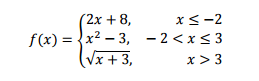
What is g(7) if:
a)
-17
b)
-13 
c)
13       
d)
17
70.
What is m(-3) if:    
a)
-3
b)
0.5
c)
3
d)
-3.5
71.
Using the pictured graph, what is f(-3)? 
a)
-3
b)
-1
c)
1
d)
3
72.
What is f(-1)?
a)
6
b)
-2
c)
sqrt(2)
d)
DNE
73.
What is f(-2)?
a)
4
b)
1
c)
1
d)
DNE
74.
What is f when x equals 4?
a)
-5
b)
0
c)
3
d)
6
75.
What is f(6)?
a)
20
b)
33
c)
3
d)
3, -3
76.
What is f when x equals 0?
a)
-5
b)
0
c)
1/2
d)
1
77.
What is f when x equals 8?
a)
0
b)
5
c)
11
d)
16
78.

Describe the transformation that occurred

p(x) = f(x + 3)

a)

Right 3 units

b)

Vertical Stretch

c)

Up 3 units

d)

Left 3 units

79.

Describe the transformation that occurred.

h(x) = f(x) + 2

a)

up 2 units

b)

left 2 units

c)

Vertical Strech

d)

right 2 units

80.

Describe the transformation that occurred.

w(x) = f(x - 7)

a)

Down 7

b)

Up 7

c)

Right 7

d)

vertical compression

81.

Describe the transformation that occurred

m(x) = f(x + 1)

a)

Left 1 Unit

b)

Right 1 unit

c)

vertical stretch

d)

up 1 unit

82.

Describe the transformation that occurred

k(x) = f(x) - 9

a)

vertical compression

b)

Down 9 units

c)

Left 9 units

d)

Right 9 Units

83.

Describe the transformation that occurred

g(x) =2f(x)

a)

Up 2 units

b)

vertical compression

c)

vertical stretch

d)

Right 2 Units

84.

Describe the transformation that occurred

h(x) = 1/5f(x)

a)

Up 5 Units

b)

vertical compression

c)

vertical stretch

d)

Down 5 Units

85.

Describe the transformation that occurred

t(x) = f(x) - 1

a)

Right 1 Unit

b)

Down 1 Unit

c)

vertical compression

d)

vertical stretch

86.

Describe the transformation that occurred

s(x) = 7f(x)

a)

vertical compression

b)

Up 7 Units

c)

Over 7 Units

d)

vertical stretch

87.
Describe the transformation that occurred 
d(x) = f(x) - 1
a)
Left 1 Unit
b)
Right 1 Unit
c)
Up 1 Unit
d)
Down 1 Unit
88.

0.5f(x)

a)

vertical compression

b)

vertical stretch

c)

vertical shift up 3

d)

vertical shift down 3

89.

3f(-x)

a)

reflection over x-axis, vertical compression

b)

reflection over y-axis, vertical stretch

c)

reflection over x-axis, horizontal compression

d)

reflection over y-axis, horizontal stretch

90.

¼f(x) + 1

a)

vertical stretch, shift up 1

b)

vertical compression, shift up 1

c)

vertical stretch, shift up ¼

d)

vertical compression, shift down ¼

91.

-f(x) + 2

a)

horizontal reflection, translation up 2

b)

vertical reflection, translation up 2

c)

vertical reflection, translation right 2

d)

vertical reflection, translation down 2

92.

¾f(x − 7)

a)

vertical compression, translation right 7

b)

vertical stretch, translation down 7

c)

vertical compression, translation left 7

d)

vertical stretch, translation right 7

93.

Write in function form: translation 3 units right

a)

g(x) = f(x − 3)

b)

g(x) = f(x) − 3

c)

g(x) = -3f(x)

d)

g(x) = f(-3x)

94.

vertical compression

a)

2f(x)

b)

f(½x)

c)

½f(x)

d)

f(2x)

95.

reflection over y-axis, shift right 1

a)

f(-x - 1)

b)

-f(x + 1)

c)

-f(x) - 1

d)

-f(x - 1)

96.

translation up 1

a)

f(x) + 1

b)

f(x - 1)

c)

f(x) - 1

d)

f(x + 1)

97.

vertical stretch, translation left 3

a)

½f(x + 3)

b)

4f(x - 3)

c)

4f(x) + 3

d)

4f(x + 3)

98.

vertical reflection, horizontal stretch

a)

g(x) = ½f(-x)

b)

g(x) = -f(¼x)

c)

g(x) = -3f(x)

d)

g(x) = -f(4x)

99.

horizontal compression

a)

g(x) = 3f(x)

b)

g(x) = ½f(x)

c)

g(x) = f(¼x)

d)

g(x) = f(5x)

100.

horizontal compression, translation up 3

a)

f(4x) + 3

b)

4f(x) - 3

c)

4f(x) + 3

d)

f(4x) - 3

101.
What are the transformations?
y=(x-2)3+4
a)
Horz shift right 2      Vert shift up 4
b)
Horz shift left 2    Vert shift up 4
c)
Horz shift right 2      Vert shift down 4
d)
Horz shift left 2      Vert shift up 4
102.
Describe the transformation from dotted to solid.
a)
f(x + 5) + 3
b)
f(x +3) + 5
c)
f(x - 5) + 3
d)
f(x - 3) + 5
103.
Which parent function matches the graph?
a)
y = |x|
b)
y = x
c)
y = x2
d)
y = 2x
104.
What type of function is shown?
a)
linear
b)
quadratic
c)
square root
d)
absolute value
105.
Which equation below is a quadratic function translated up 5 units?
a)
y = x2 + 5
b)
y = (x + 5)2
c)
y = 5x2
d)
y = -x2 - 5
106.
a)
g(x)=2x2
b)
g(x)=0.5x2
c)
g(x)=x2+2
d)
g(x)=(x+2)2
107.
Vertical stretch is af(x) when...
a)
a is greater than 0
b)
a is less than 0
c)
a is greater than 1
d)
a is a fraction/decimal