wayground logo

Free Printable Worksheets

NEW

Font size

S
M
L
XL
Worksheets

Unit 2 Test Review

Total questions: 57

Worksheet time: 56mins

Name
Class
Date
1.

What is the name of the matter that waves transfer energy through?

a)

medium

b)

energy transfer

c)

wave matter

d)

wave force

2.
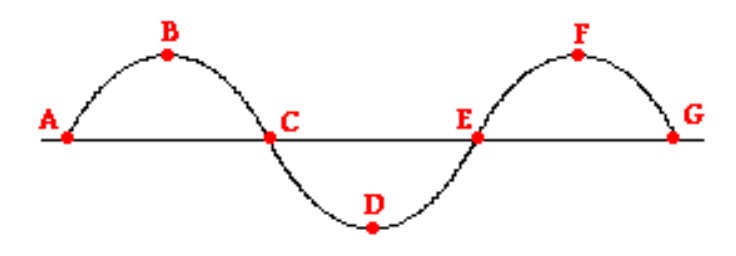
Which letter(s) represent the trough of the wave?
a)
A
b)
B & D
c)
D
d)
C & G
3.
Which letter(s) represent the crest of the wave?
a)
A
b)
B & D
c)
B & F
d)
F
4.
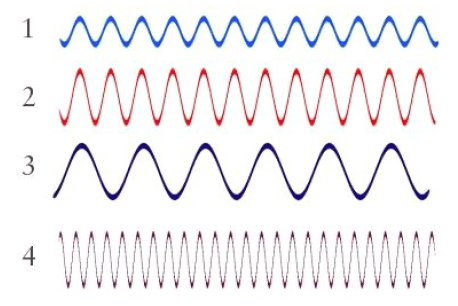
Which wave in the diagram has the greatest wavelength?
a)
1
b)
2
c)
3
d)
4
5.
The type of waves that require medium to pass:
a)
Mechanical Waves
b)
Electromagnetic Waves
6.
A mechanical wave cannot travel through...
a)
a vacuum(empty space).
b)
water.
c)
air. 
d)
glass.
7.
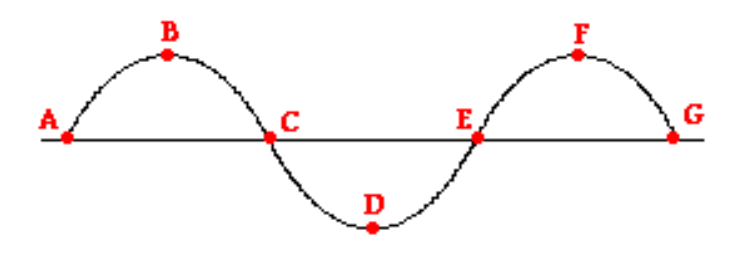
Which letter(s) represent the trough of the wave?
a)
A
b)
B & D
c)
D
d)
C & G
8.
Which letter(s) represent the crest of the wave?
a)
A
b)
B & D
c)
B & F
d)
F
9.
Which wave in the diagram has the greatest wavelength?
a)
1
b)
2
c)
3
d)
4
10.

The bottom part of a transverse wave below the resting point is called a _________________________.

a)

Crest

b)

Crust

c)

Trough

11.

The spread out part of a longitudinal wave is called a ________________.

a)

Rarefaction

b)

Compression

c)

Space

d)

Transverse

12.

A wave that requires a medium to travel.

a)

Mechanical

b)

Electromagnetic

13.

How far the medium (crests and troughs, or compressions and rarefactions) moves from rest position.

a)

Amplitude

b)

Frequency

c)

Wavelength

d)

Speed

14.
What is the source that causes a wave to start?
a)
the moon
b)
vibration
c)
splash
d)
motion
15.
When the particles of a medium are vibrating perpendicular to the direction of the wave,  this is a __________wave.
a)
sound
b)
water
c)
transverse
d)
longitudinal
16.
The number of complete waves that pass a point in a certain amount of time is:
a)
speed
b)
frequency
c)
amplitude
d)
wavelength
17.
when the particles of a wave are spread out
a)
rarefaction
b)
compression
c)
node
d)
antinode
18.
the lowest point of a transverse wave
a)
crest
b)
trough
c)
compression
d)
rarefaction
19.

The bouncing back of light, heat or sound from surface without absorption.

a)

Reflection

b)

Refraction

c)

Transmission

d)

Medium

20.

The phenomenon of light bending as it travels through a medium.

a)

Refraction

b)

Medium

c)

Reflection

d)

Transmission

21.

Explain what phenomenon is occurring the picture above.

a)

Light is being refracted as it passes from the air into the water. Therefore, the pencil looks broken

b)

Sunlight is being reflected as it passes from the air into the water. Therefore, the pencil looks broken

c)

waves is being refracted as it passes from the air into the water. Therefore, the pencil looks fixed

d)

None of the above

22.
What is a wave?
a)
A repeated disturbance that moves energy.
b)
A repeated disturbance that moves a substance.
c)
A repeated back-and-forth or up-and-down motion.
d)
The way that light and sound transfer through space.
23.
If a student is making a wave with a slinky, what is the medium?
a)
the air around it
b)
the earth beneath it
c)
the slinky
d)
the wave itself
24.
What is a big difference between mechanical and electromagnetic waves?
a)
Mechanical do not need a medium and electromagnetic do.
b)
Mechanical waves are faster than electromagnetic.
c)
All mechanical waves are transverse.
d)
Electromagnetic do not need a medium and mechanical do.
25.
Why does an apple appear red?
a)
All colors are absorbed & none are reflected
b)
All colors are absorbed except for blue, which is reflected
c)
All colors are reflected and none are absorbed
d)
All colors are absorbed except for red, which is reflected
26.

Which of the following is the best example of an object absorbing light?

a)

A black sweater in the sun.

b)

A clean window in the sun.

c)

A curved mirror in the sun.

d)

A long shadow in the sun.

27.
The bouncing of light off an object is ....
a)
a mirror
b)
absorption
c)
reflection
d)
refraction
28.
What surface best reflects light?
a)
dull
b)
shiny
c)
clear
d)
black
29.
If a black and white car were in the parking lot all day. Compare the temperatures of the two cars.
a)
The black car would be cooler.
b)
The white car would be hotter.
c)
The black car would be hotter.
d)
They would be the same
30.
Objects that reflect ALL colors will appear _____?
a)
Black
b)
White
c)
Gray
d)
Multi-colored
31.
Objects that ABSORB all colors of light will appear _______.
a)
white
b)
black
c)
multi-colored
d)
gray
32.
If you are using a green color filter, what color will you only see?
a)
blue
b)
green
c)
white
d)
red
33.
Which of the following would not reflect light?
a)
Mirror
b)
Water
c)
Glasses
d)
Brick Wall
34.
Which term describes when light bounces off of a smooth surface?  
a)
Refraction
b)
Transmission
c)
Absorption
d)
Reflection
35.

This is an example of

a)

Reflection

b)

Refraction

c)

Absorption

d)

None of the above

36.

What happen to the light as it passess from air to the transparent window

a)

Light changes speed but not direction

b)

All light is reflected

c)

Light changes speed and direction

d)

All light pass through

37.

A window is an example of which of the following

a)

Transparent

b)

Translucent

c)

Opaque

38.

What is an example of transparent

a)

glass cup

b)

brick wall

c)

computer

d)

table

39.

The number of times a wave repeats in a given period of time is called the _________ and it is measured in _______.

a)

amplitude; centimeters

b)

wavelength; inches

c)

frequency; Hertz

d)

pitch; Hertz

40.

What scientific phenomena is shown here?

a)

light refraction

b)

light absorption

c)

light reflection

d)

light transmission

41.

Where do sound waves travel the fastest

a)

solid

b)

liquid

c)

gas

42.

Where does am EM wave travel the slowest

a)

solid

b)

liquid

c)

gas

43.
Which electromagnetic waves have the highest frequencies and the shortest wavelengths?
a)
microwaves
b)
visible light
c)
gamma rays
44.
Which electromagnetic waves are used in ovens and cell phone communications?
a)
Infrared rays
b)
ultraviolet rays
c)
microwaves
45.
Electromagnetic waves that help your body produce vitamin D are called?
a)
ultraviolet rays
b)
x-rays
c)
gamma rays
46.
For waves in any medium, as the wavelength decreases, what happens to the frequency?
a)
It also decrease
b)
It stays the same
c)
It increases
47.
Which of the following has wavelengths longer than microwaves?
a)
Infrared waves
b)
Radio waves
c)
Visible light
48.
Which electromagnetic waves help doctors detect broken bones inside your body?
a)
gamma rays
b)
x-rays
c)
ultraviolet rays
49.
Which of the following lists the electromagnetic waves in order of increasing wavelength?
a)
X-rays, visible light, radio waves
b)
gamma rays, microwaves, UV rays
c)
infrared rays, radio waves, x-rays
50.
Which of the following lists the electromagnetic waves in order of decreasing frequency?
a)
X-rays, microwaves, infrared rays
b)
UV rays, visible light, x-rays
c)
infrared rays, microwaves, radio waves
51.

Waves with short wavelengths will have high frequency

a)

True

b)

False

52.

Which is not a part of the electromagnetic spectrum?

a)

X-rays

b)

Gamma rays

c)

Visible light

d)

Magnetic field

53.
A wave with a large wavelength will have a ______ frequency and _____ energy
a)
high, low
b)
high, high
c)
low, high
d)
low, low
54.
Select the correct order of waves on the EMS 
a)
Radio, Micro, Infra, Visible, Ultra, X-ray, Gamma
b)
Gamma, X-ray, Ultra, Vis, Infra, Micro, Radio
c)
Vis, Micro, Infra, Ultra, X-ray, Gamma, Radio
d)
Micro, Radio, Vis, Infra, Ultra, X-ray, Gamma
55.
Which has the LONGEST wavelength and, therefore, the lowest frequency/energy
a)
Gamma Rays
b)
Radio Waves
c)
Visible Light
d)
Infrared rays
56.
Which has the SHORTEST wavelength and, therefore, the highest frequency/most energy
a)
Radio waves
b)
Ultraviolet Rays
c)
Gamma Rays
d)
X-rays
57.
Which section of the spectrum is the ONLY one we can see?
a)
X-rays
b)
Visible Light
c)
Gamma Rays
d)
Ultraviolet Rays