
 Worksheets
Interactions in matter
Total questions: 20
Worksheet time: 18mins
Whats your favorite bond
Ionic bond
Covalent bond
metallic bond
van der waals interactions
Why does ice float in water?
Compared to water, the stronger bonds between molecules in ice require a molecular arrangement that results in greater volume per mass
only ice that traps gas molecules will float in water
only ice from salt water will float because of crystal imperfections that result in greater volume per mass.
Which of the following is true regarding molecular formula for an ionic compound?
Ionic compounds don't have molecular formula
A molecule of ionic compounds is made up of the relative numbers of its constituent ions
At what point does the following paragraph lead to a false conclusion
(1) A system having more potential energy requires comparatively less amount of energy to leave its current state, (2) and a system having less potential energy requires a larger amount of energy to leave the system. (3) The time a system spends in its current state depends on how probable it is to gain the extra energy. Therefore, lower the energy greater the stability.
1
2
3
Its fully true

Fluorine is more electronegative than oxygen, yet water has more boiling point than HF. What is the most reasonable explanation for this observation?
H2O is more polar than HF.
H2O can form a densely connected network of hydrogen bonds
H2O has a higher molecular weight.
H2O has more atoms.
H2O does not have a higher boiling point than HF.
What is the result of balancing between inter-molecular forces and thermal energy?
Matter
Three states of matter
Four states of matter
Chemical bond formation
Which is the dominant inter-molecular force of attraction between the following.
Gaseous nitrogen, liquid nitrogen, solid nitrogen
London dispersion, London dispersion London dispersion
London dispersion, dipole - dipole interaction, ionic interaction
London dispersion, bridge bonding, molecular orbitals
London dispersion, Molecular orbitals, metallic bonds
A more accurate definition for boiling point could be
the temperature above which the substance cannot exist as a liquid regardless of the pressure.
the temperature at which the gas molecules have more kinetic energy than the molecules in the liquid.
the only temperature at which there can be equilibrium between liquid and gas.
the temperature at which the vapor pressure equals 760 torr.

At which of the points A-D on the following graph will two interacting species experience the greatest force of attraction?
A
B
C
D
Non-polar molecules can contain polar bonds.
True
False
Study the following paragraph and identify the point at which it turns false.
(1) Hydrophobic interactions are not really chemical bonds, but it is a phrase used to describe the relations between water and hydrophobes. (2) Water and fat doesn’t mix because the Van der Waals forces that are acting between water and fat molecules are repulsive. (3) This means that when fat molecules are introduced in water, they tend to form a droplet so as to reduce the surface area of interaction. (4) This is the driving force in the formation of micelles of amphipathic compounds in water.
1
2
3
4
The paragraph is correct

The molecular structure of cholesterol is shown. When in cell, where does cholesterol prefer to be localized?
Cell membrane
cytosol
nucleus
all of these
Which of the following statements is true regarding an explosion?
Unstable substances become stable in a violent reaction that takes place within a very short time span
Stable substances become unstable in a violent reaction that takes place within a very short time span
Stable substance are induced to be unstable and then they convert into stable substances through a violent reaction that takes place within a very short time span
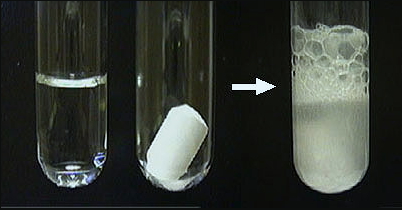
How could we make this reaction happen more quickly?
Decrease the concentration of the acid
crush the chalk to increase the surface area
Put the test tube in an ice bath
What criteria must be met for reactant collisions to result in a successful product?
The reactants must collide with each other
The reactants must collide with enough energy and be in the right positions
The reactants must have enough energy to form the activated complex

In a TLC experiment, a stationary phase with high surface area is made to adsorb a chemical sample. Using another liquid component called as the mobile phase the chemical sample is pushed along the stationary phase. A stronger interaction of the sample with the stationary phase will retard this movement.
Observe the TLC experiment shown. Labelling from left to right, which of the lanes has a colored component that has the lowest interaction with the stationary phase?
lane 2
lane 3
lane 4
lane 5
What is the basis of hydrogen bond?
Attraction forces between hydrogen atom bonded with another hydrogen atom
Attraction forces between hydrogen atom bonded with a high electronegativity atom (F, O, N)
Attraction forces between hydrogen atom bonded with a high electronegativity atom (F, O, N) with atom (F, O, N) of another molecule
Attraction forces between hydrogen atom with another hydrogen atom of another molecule
When hair is dry, protein molecules in the hair structure form hydrogen bonds with...
other protein molecules in the same hair structure
water molecules, H2O
other protein molecules from another hair structure
water molecules, H2O which also forms hydrogen bonds with protein molecules from another hair structure

