
 Worksheets
Function Families Review
Total questions: 40
Worksheet time: 40mins

Which type of function is represented by the graph?
Exponential
Quadratic
Square Root
Absolute Value

Which type of function is shown in the graph?
Quadratic
Square Root
Natural Logarithm
Rational

Which is the parent function of the graph?
f(x) = log x
f(x) = x3
f(x) = 1 ∕ x
f(x) = ∛x

Which type of function is the graph?
Absolute Value
Rational
Exponential
Logarithmic

Which of the graphs could represent the graph of y = − (x − 3)2 ?
Graph A
Graph B
Graph C
Graph D

Which graph represents
y = |x + 3| − 4 ?
Graph A
Graph B
Graph C
Graph D

What is the correct transformed equation for the graph?
y = x−4
y = x+4
y = x−4
y = x+4
y = 4x

What is the correct transformed equation for the graph?
y = ln(x - 4)
y = ln(x) - 4
y = ln(x + 4)
y = ln(x) + 4

Which most likely represents the equation of this graph?
y = |x + 2| + 3
y = |x - 3| + 2
y = |x + 3| + 2
y = |x - 2| + 3

What is the range of the function graphed?
(-∞, ∞)
(-∞, 2] and [2, ∞)
[2, ∞)
(2, -∞)

What is the domain of the function graphed?
(-∞, ∞)
[-5, ∞)
[-5, -4]
[-4, ∞)

What is the range of the function graphed?
(-∞, -3]
(-∞, ∞)
[-4, -1]
[-3, ∞)

Name the y-intercept(s) of the function in the graph.
(-1, 0) and (4, 0)
(-2, 0)
(0, -2)
(0, 4) and (0, -1)

Name the x-intercept(s) in the graph.
(-4, 0) and (2, 0)
(-2, 0)
(0, -2)
(0, -4) and (0, 2)
Which function increases throughout
the interval (-2, 2)?


Name the interval(s) where the function is increasing? Click all that apply.
(−∞, −1)
(−1, 1)
(−2, 2)
(1, ∞)
Which statement is true about the end behavior of the function
y = -3x2?
As x approaches negative infinity, y approaches 0.
As x approaches positive infinity, y approaches negative infinity.
As x approaches positive infinity, y approaches 0.
As x approaches negative infinity, y approaches positive infinity.

Which of the following describes an end behavior of the function graphed? Select all that apply.
As x → -∞, y → -∞
As x → -∞, y → +∞
As x → +∞, y → -∞
As x → +∞, y → +∞
What is the domain of the function:
f(x) = x2−3(0,∞)
(−∞,0)
(3,∞)
(−∞,3)
(−∞,∞)
What is the range of this function:
f(x)=x+2−1[−2,∞)
(−1, ∞)
[−1,∞)
(−∞,−1]
(−∞,∞)

Which function family does this graph belong to?
Exponential
Linear
Cubic
Absolute Value

Which function family does this graph belong to?
Absolute Value
Cubic
Quadratic
Exponential

What is the domain?
(−∞, ∞)
[0, ∞)
(−∞, 0]
[−∞, ∞]
Identify the transformation(s).
y=3∣x+1∣+4
down 4
right 1
left 1
vertical stretch
up 4

What is the range?
[0, ∞)
(−∞, ∞)
None of the answer choices

What is the range of the graph?
[2, ∞)
[1, ∞)
(−∞, ∞)
None of these

Describe the end behavior of the graph.
x→∞ as f(x)→∞ and x→−∞ as f(x)→−∞
x→∞ as f(x)→∞ and x→−∞ as f(x)→∞
None of these
x→∞ as f(x)→−∞ and x→−∞ as f(x)→−∞

Describe the end behavior of the graph.
x→∞ as f(x)→∞ and x→−∞ as f(x)→−∞
x→∞ as f(x)→∞ and x→−∞ as f(x)→∞
x→∞ as f(x)→∞ and x→−∞ as f(x)→0
x→∞ as f(x)→0 and x→−∞ as f(x)→−∞

Describe the end behavior of the graph.
x→∞ as f(x)→∞
and x→−∞ as f(x)→−∞
x→∞ as f(x)→∞ and x→−∞ as f(x)→∞
x→∞ as f(x)→∞ and x→−∞ as f(x)→0
x→∞ as f(x)→−∞ and x→−∞ as f(x)→−∞

What are the increasing interval(s)?
( - ∞, 0)
(-7, ∞)
(0, 2)
( -∞, -3)
(2, ∞ )

What are the extrema of the graph?
Max = (2, -3), (1, 2)
Min = (-3, -1), (-1, 4)
Max = (-3, -1), (-1, 4)
Min = (2, -3), (1, 2)
Max = (-1, -3), (4, -1)
Min = (-3, 2), (2, 1)
Max = (-3, 2), (2, 1)
Min = (-1, -3), (4, -1)
Which of the following is the graph of y=(x−2)3−4


What are the zeros of the given graph? Select all that apply.
−3
0
1.5
3
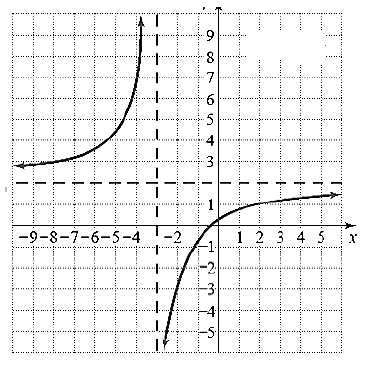
Which of the following represents the graph below?
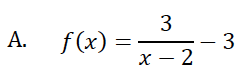
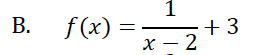
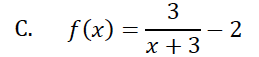
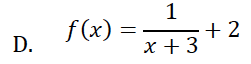

What is the range for the following function?
(−∞, ∞)
(−∞, −2)∪(−2, ∞)
(−∞, 2)∪(2, ∞)
(−∞, −4)∪(−4, ∞)
(−∞, 4)∪(4, ∞)

Describe the transformations of the function.
Shifted right by 4 units
Shifted down by 7 units
Stretched Vertically
Shifted right by 4 units
Shifted up by 7 units
Stretched Vertically
Shifted right by 4 units
Shifted down by 7 units
Compressed Vertically
Shifted left by 4 units
Shifted down by 7 units
Compressed Vertically

What of the domain of the function?
(−∞, ∞)
(−∞, −2)∪(−2, ∞)
(−∞, −3)∪(−3, ∞)
(−∞, 2)∪(2, ∞)
(−∞, 3)∪(3, ∞)

What is the range of y = sin x ?
(−1, 1)
[−1, 1]
(−∞, ∞)
[−1, 0)
What is the range of y=3sin(x+1)-2
(−∞, ∞)
[−3, 3]
[−5, 1]
(−3, 3)
(−5, 1)
A function is vertically shrunk, shifted down, shifted left and reflected over the x axis. Which of the following could be that function? (check all that apply)
f(x)=45(x+1)2−6
f(x)=−65x+2−3
f(x)=−6∣x+3∣+4
f(x)=−2x+61−3
f(x)=−43e(x−2)−7

