
 Worksheets
Geo Ch. 3&4 Vocabulary
Total questions: 119
Worksheet time: 1hrs 3mins

Area that shares a large number of cultural traits.
Cultural diffusion/Culture borrowing
Culture Region
Fine Arts
Economy
People's occupations, their behavior, and their beliefs are a part of their
culture
technology
government
climate
Two important features of a culture are
economy and climate
natural resources and climate
language and religious beliefs
weather and writing

Which statement is true?
Community is bigger than society.
Society is smaller than community.
Society is a group of community.
Community is a group than society.

the beliefs, customs, values, and ways of doing things of a particular society
religion
history
culture
geography
A community or group of people who share common ancestors and a common culture often including a common history, religion, language and other characteristics is called?
descendant
ethnic group
ancestor
Cultural diffusion is best described as...
sharing music from one culture to another
the spreading of ideas, languages, and traditions fromone culture to another
the spreading of religion
An example of cultural diffusion is
spread of popular music
a new type of computer
importance of religion
Which of these is NOT a example of cultural diffusion?
McDonald's in China
Mexican restaurants in Texas
storms in both Canada and Brazil
A group of people who share a common culture and ancestry
ethnic group
multicultural society
cultural diffusion
A place where new ideas and technology spread to surrounding areas best describes...
cultural diffusion
culture
cultural hearth
Cultural diffusion is...
The spreading of religions only to each area.
cultures that only celebrate their own holidays
cultures spreading and interacting from one area to another.
What is acculturation?
When you accept one culture while keeping your own
When you keep your culture and reject the new one
When you don't addapt to a new culture
When you adopt one culture and retain your own.
In general, this process happens when a minority culture adopts the practices and values of a majority culture.
True
False
wealth
Which of the below is part of the Infrastructure system:
Residential Buildings
Population growth
Transportation system
Social Organization
Which of the below is not part f the infrastructure system:
Police, fire and ambulance systems
Social organization
Cell phone, radio, TV and internet
Water, electric and gas supplies
Infrastructure elements should have distribution systems that reach every place (or nearly every place) in a community
True
False
Which is a dialect?
Southwestern English
Arabic
Russian
Japanese
T/F: All languages have dialects.
True
False
T/F: You can speak the same language as somebody but a different dialect.
Tue
False
T/F: You cannot communicate with people who do not share the same dialect with you.
True
False
We usually refer to dialects by their:
Intelligence
Communication style
Religion
Region
Number of deaths each year per 1,000 people
population growth
population density
birth rate
death rate
Study of population patterns and change
census
demographics
migration
death rate
Number of births each year per 1,000 people
birth rate
population growth
population density
migration
the number of people in a defined area such as a square kilometre
population density
birth rate
death rate
population
Population divided by Area =
population density
population growth
What is GDP?
Gross Domestic Product
Grand Domestic Product
Gross Domestic Produce
Gross Dominating Product
What does domestic mean?
Produced within the borders of a country
Produced outside the borders of a country
Bought from another country
Purchased from a bordering country

The total value of all goods and services produced in a country every year.
Imports
Exports
Gross Domestic Product (GDP)
Literacy Rate

A person’s level of comfort.
Voluntary Trade
Scarcity
Specialization
Standard of Living
A country’s GDP divided by its total population.
GDP per capita
GDP growth rate
Gross Domestic Product
Literacy rate
The difference between GDP and GNP is
net property income from abroad
capital consumption
taxation and subsidies
imports and exports
the beliefs, customs, arts and other products of human thought of a particular society.
Culture
Cultural Divergence
Cultural Convergence
Cultural Transformation
The spreading of cultural ideas from their place of origin to other places
Cultural Convergence
Cultural Diffusion
Culture
Ethnicity
A group of persons related by common descent or heredity
Culture
Ethnicity
Race
'Merica
the mean income of the people in an economic unit such as a country or city
Developed
Stacking them dollar bills
Gross Domestic Product (GDP)
Per Capita Income
The monetary value of all the finished goods and services produced within a country's borders in a specific time period (usually a year)
Gross Domestic Product (GDP)
More Developed
Per Capita Income
Cultural Convergence
Extraction of raw materials and natural resources from earths surface, such as farming, mining, lumbering
Primary Sector
Secondary Sector
Tertiary Sector
Quaternary Sector
Processing and manufacturing raw materials into a finished product
Primary Sector
Secondary Sector
Tertiary Sector
Quaternary Sector
Service sector that focuses on moving, selling, and trading products such as retail, marketing, food service
Primary Sector
Secondary Sector
Tertiary Sector
Quaternary Sector
Knowledge based sector, focusing on research and information creation and transfer
Secondary Sector
Quaternary Sector
Primary Sector
Quinary Sector
Highest levels of decision making, includes top officials in government and business
Primary Sector
Quaternary Sector
Quinary Sector
Secondary Sector
Total value of goods and services by the citizens and corporations of a country as well as foreign investments in a given year.
Gross National Product
Gross Domestic Product
Gross National Income
GINI Coefficient
Total value of goods and services by the citizens and corporations within a country’s borders in a given year.
Gross Domestic Product
Gross National Income
Gross National Product
GINI Coefficient
Economic activities that are mostly illegal and not sanctioned by the government.
Formal Economy
Informal Economy
Infrastructure is not an important part of the city.
True
False
Which of the below is part of the Infrastructure system:
Residential Buildings
Population growth
Transportation system
Social Organization
Which of the below is not part f the infrastructure system:
Police, fire and ambulance systems
Social organization
Cell phone, radio, TV and internet
Water, electric and gas supplies
True or False:
Non-renewable resources can be replenished within our lifetime?
true
false
Choose 2: Fossil fuels are formed from decayed _______ and ________.
plants
animals
rocks
minerals
A renewable energy source that is very plentiful in Florida is ____________.
coal
phosphate
limestone
sunlight

Coal is a _______________ resource because it cannot be replaced easily.
valuable
nonrenewable
renewable
Florida

What are some examples of Florida's renewable resources that we will never use up?
oil
coal
wind
sunlight
(a) resource is a type of resource that can be used again
What is the non-renewable source?
Fossil fuels
Coal
None of the above
All of the above
What is one ADVANTAGE of using renewable resources?
They will never run out.
They are more expensive.
They are bad for the environment.
What is one DISADVANTAGE of using fossil fuels?
Fossil fuels will never run out.
Fossil fuels are very efficient forms of energy and are readily available, making them cheaper.
Burning fossil fuels contributes to the greenhouse effect which causes global warming.
Fossil fuels are better for the environment.
One ADVANTAGE of using fossil fuels is that:
They are better for the environment.
They can produce extremely high amounts of energy.
They contribute to the greenhouse effect.
They will never run out.
What is a free-market economy?
A system driven by private ownership of property & resources, competition, and profit motive. Consumer is king.
A system run with central ownership (usually by government) of property and resources. The consumer gets what the government offers.
Individuals and businesses are owners and decision makers for the private sector while the government is owner and decision maker for the public sector.
A system based on custom and historical precedent.
What is a command economy?
A system based on custom and historical precedent.
A system driven by private ownership of property & resources, competition, and profit motive. Consumer is king.
Individuals and businesses are owners and decision makers for the private sector while the government is owner and decision maker for the public sector.
A system run with central ownership (usually by government) of property and resources. The consumer gets what the government offers.
What is a traditional economy?
A system driven by private ownership of property & resources, competition, and profit motive. Consumer is king.
A system based on custom and historical precedent.
A system run with central ownership (usually by government) of property and resources. The consumer gets what the government offers.
Individuals and businesses are owners and decision makers for the private sector while the government is owner and decision maker for the public sector.
What is a mixed economy?
Individuals and businesses are owners and decision makers for the private sector while the government is owner and decision maker for the public sector.
A system driven by private ownership of property & resources, competition, and profit motive. Consumer is king.
A system based on custom and historical precedent.
A system run with central ownership (usually by government) of property and resources. The consumer gets what the government offers.
What type of economy do we have in the U.S.?
Command
Traditional
Free-Market
Mixed
What does laissez-faire mean?
Hands off
French please
Government first
People first
Which type of economy has the most government involvement?
Mixed
Command
Traditional
Free-Market
Which type of economy has the least government involvement?
Free-Market
Command
Traditional
Mixed
In which type of economy do people usually perform the same job as their parents, grandparents and children?
Traditional
Free-Market
Command
Mixed
In which type of economy does the consumer have the most choice?
Command
Free-Market
Traditional
Mixed
In which type of economy does the consumer have the least choice?
Traditional
Mixed
Command
Free-Market
What is a city-state?
A city that turned into a state
Small, independent countries with their own farmland
Large cities that were used for trading
Another name for a town

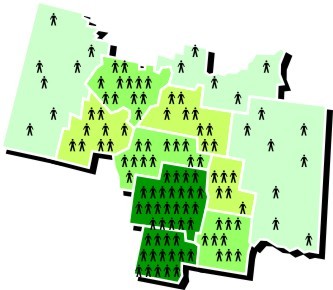
According to the settlement map, what do we know about the midwest region of the United States?
They are heavily populated.
They have lots of cows.
They are sparsely populated.
Nothing

Which are the most densely populated states?
Northeast
West
South
Midwest

Relating to, or being in a city is known as a:
urban area
suburban area
rural area

Relating to the country, country people or life, or agriculture is known as an:
Urban area
Suburban area
Rural area
A city and the surrounding area that are influenced economically and culturally by the city
Conurbation
Edge city
Megalopolis
Metropolitan area
A typically fast-growing community outside of or on the edge of an urban area beyond the suburbs
Exurb
Megacity
Metacity
Settlement
The growth and development of cities
Counterurbanization
Globalization
Territoriality
Urbanization
The shifting of population away from cities into less densely populated residential and commercial areas surrounding cities
Reurbanization
Segregation
Suburbanization
Urbanization
The maximum number of organisms an ecosystem can hold
limiting factor
carrying capacity
biodiversity
limit
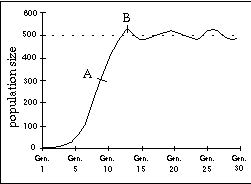

What happens if a population grows past its carrying capacity?
The population keeps growing
The population starts to die off
The entire species will go extinct
The carrying capacity just increases

What age groups does the bottom of a population pyramid represent?
The elderly
The working adults
The children
Males

What does the whole right side of the population pyramid represent?
Males
Females
Unemployed
Young people

What age group does the top of the population pyramid represent?
The working people
The rich people
The elderly
The young people
What word describes a country with a well developed economy?
more developed nation
less developed nation
independent population
dependent population
Lower birth rate
More developed
Less developed
More people living in poverty
More developed
Less developed
More doctors
More developed
Less developed
Less people working on farms
More developed
Less developed

Is this country Developed or Developing?
Developed
Developing

Predict the future population growth of this country.
Negative Growth (the population will shrink)
Slow/No Growth (the population will stay about the same)
Growth (the population will definitely grow)
Fast Growth (the population will explode)

Which country, A or B, has an ageing population?
A
B

What is a problem Italy will face in the future?
An increase in population of almost 3 million people
The death rate will increase
Italy will have a high elderly dependency ratio
Italy's fertility will increase
Which of the following represents the maximum number of people an area can support with its environmental and natural resources?
Physiological density
Carrying capacity
Demographic Transition
Infrastructure

