wayground logo

Free Printable Worksheets

Font size

S
M
L
XL
Worksheets

Unit 1 Review_Anatomy

Total questions: 80

Worksheet time: 52mins

Name
Class
Date
1.
This section is
a)
frontal
b)
transverse
c)
coronial 
d)
sagittal
2.
This section is 
a)
transverse
b)
frontal
c)
sagittal
3.
This section is 
a)
frontal
b)
transverse
c)
sagittal
4.
The cavity that contains the lungs and heart is
a)
pelvic
b)
abdominal
c)
thoracic
d)
spinal
5.
The muscle that separates the abdominal and thoracic cavities is the 
a)
diaphragm
b)
plantar fascia
c)
oblique
d)
deltoid
6.
The body cavity that contains the reproductive organs is the 
a)
thoracic
b)
abdominal
c)
cranial
d)
pelvic
7.
The region labeled 1 is 
a)
cervical
b)
acromial 
c)
brachial 
d)
popliteal
8.
The region labeled 4 is 
a)
lumbar
b)
sternal
c)
antecubital
d)
axillary
9.
The region labeled 13 is 
a)
inguinal
b)
gluteal
c)
pubic
d)
lumbar
10.
The region labeled 12 is 
a)
vertebral
b)
lumbar
c)
sacral
d)
deltoid
11.
The region labeled 26 is 
a)
patellar
b)
popliteal
c)
sural
d)
calcaneal
12.
The region labeled 24 is 
a)
popliteal
b)
fibular
c)
patellar
d)
sural
13.
If a person gets a black eye, they are injured in which area?
a)
occipital
b)
orbital
c)
oral
d)
coxal
14.
An injury to which area of the body would most likely require the use of crutches?
a)
antecubital
b)
buccal
c)
tarsal
d)
lumbar
15.
Carpal tunnel syndrome sometimes requires the wearing of a brace on the
a)
ankle 
b)
knee
c)
wrist
d)
elbow
16.

All anatomical terms refer to a person in the ____________ position.

a)

Astronomical

b)

Anatomcycle

c)

Anamatronics

d)

Anatomical

17.

Your head contains the ____________ cavity.

a)

Thoracic

b)

Spinal

c)

Cranial

d)

Pelvic

18.

We are divided into a superior and inferior sections by the ___________ body plane.

a)

Sagittal

b)

Median

c)

Frontal

d)

Transverse

19.

If you have a pain in your Upper, Outer abdominal regions your pain is in the ___________ region.

a)

Umbilical

b)

Hypochondriac

c)

Inguinal

d)

Epigastric

20.

Anatomy refers to

a)

the function of the parts of the body

b)

the structure and shape of the body

c)

the flow of blood through the body

d)

how all the parts of an organ system work together

21.

Physiology refers to

a)

how the body and its parts work or function

b)

the structure and shape of the body

c)

organs within an organ system

d)

how the structure of the body relates to its function

22.

Which of these is NOT required for life?

a)

water

b)

food

c)

tissues

d)

oxygen

e)

pressure

23.

Which of these is NOT a characteristic of life?

a)

movement

b)

growth

c)

excretion

d)

sleeping

e)

reproduction

24.

The sum of all chemical reactions in the body is called

a)

metabolism

b)

assimilation

c)

growth

d)

digestion

25.

Which of the following is the most complex level of organization?

a)

cell

b)

organ

c)

organ system

d)

organelle

26.

Measuring an organ's size would relate more closely to the science of ...

a)

anatomy

b)

physiology

c)

both anatomy and physiology

27.

Measuring the acid content of the stomach would relate more closely to the science of ...

a)

anatomy

b)

physiology

c)

both anatomy and physiology

28.

What are the two main types of anatomy?

a)

Gross

b)

Microscopic

c)

Physiology

d)

Microbiology

e)

Radiographic

29.

The human body is made up of 60-80% of this molecule?

a)

carbon dioxide

b)

glucose

c)

water

d)

oxygen

30.

What systems allows the body to move and controls movement within the body?

a)

Digestive

b)

Sensory

c)

Muscular

d)

Integumentary

31.

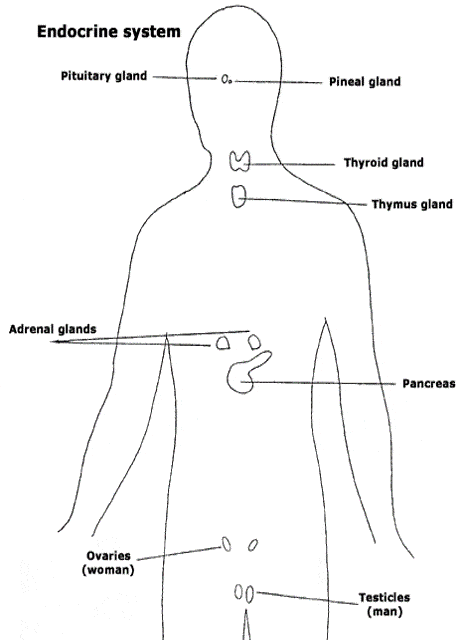
What system coordinates body activity through hormones?

a)

Integumentary

b)

Endocrine

c)

Reproductive

d)

Respiratory

32.

What system covers the body and protects other body system?

a)

Integumentary

b)

Sensory

c)

Skeletal

d)

Cardiovascular

33.

What system exchanges gases between the air and blood?

a)

Circulatory

b)

Respiratory

c)

Urinary

d)

Nervous

34.
Which system takes food into the body, breaks down food, and absorbs the digested materials?
a)
respiratory
b)
circulatory
c)
digestive
d)
excretory
35.

The state of steady internal balance maintained by living systems is called?

a)

Anatomy

b)

Physiology

c)

Homeostasis

d)

Homosapiens

36.

The study of disease is called:

a)

Epidemiology

b)

Physiology

c)

Prevalence

d)

Pathology

37.

Which of the following is an example of positive feedback?

a)

Thermoregulation

b)

Blood Pressure

c)

Childbirth

d)

Blood Sugar Levels

38.
Homeostasis
a)
allows for a wildly fluctuating internal environment
b)
is impossible in vertebrates
c)
is the maintenance of a relatively stable internal environment and often incorporates a form of feedback regulation
d)
is the maintenance of a relatively stable external environment and often incorporates a form of feedback regulation
39.
When you get cut, your skin cells release hormones that signal platelets to come and stop the bleeding. Platelets then release more hormones that signal even more platelets to help stop bleeding. The hormone signals continue until the cut is closed.
a)
Positive Feedback Response
b)
Negative Feedback Loop 
40.

Which body system controls the body to maintain homeostasis?

a)

excretory

b)

nervous

c)

circulatory

d)

skeletal

41.

The group of organisms that use the process of homeostasis includes

a)

mammals, only

b)

animals, only

c)

plants and animals

d)

all living things

42.
a body system that controls growth and homeostasis by secreting hormones from glands.
a)
skeletal system
b)
nervous system
c)
endocrine sytem
d)
integumentary system
43.
Rapid growth during puberty causes your body to release more and more growth hormones. As you grow, more and more growth hormones are released until puberty is reached, and then the hormones stop.
a)
Positive Feedback Response
b)
Negative Feedback Loop 
44.
Negative Feedback Loops:
a)
amplify processes
b)
prevent small changes from getting larger
c)
are initiated during childbirth
d)
are found only in plants
45.

The ultimate cause of death

a)

Over Heating

b)

Diabetes

c)

Bad Hair

d)

Loss of Homeostasis

46.

When the body temperature drop below normal ranges, arterioles in the skin will

a)

dilate to allow less blood to flow to skin surface

b)

constrict to allow less blood to flow to skin surface

c)

dilate to allow more blood to flow to skin surface

d)

constrict to allow more blood to flow to skin surface

47.
Homeostasis in the human body is often maintained by a: 
a)
neutral feedback loop 
b)
solar feedback loop
c)
positive feedback loop
d)
negative feedback loop
48.
When you are cold, you shiver and your blood vessels contract, which warms you up. When you are hot, you sweat and your blood vessels expand, which cools you down.  
a)
Positive Feedback Response
b)
Negative Feedback Loop 
49.

Identify 2

a)

Spinal cavity

b)

Dorsal cavity

c)

Orbital cavity

d)

Cranial cavity

50.

Identify 1

a)

Ventral cavity

b)

Dorsal cavity

c)

Cranial cavity

d)

Abdominopelvic cavity

51.
The heart is contained within this cavity (most specific)
a)
mediastinum
b)
pericardial
c)
pleural
d)
thoracic
52.
The lungs are located within this cavity
a)
pleural
b)
mediastinum
c)
brachial
d)
pelvic
53.
The __ contains the trachea, esophagus, and large blood vessels such as the aorta
a)
cranial
b)
abdominopelvic
c)
dorsal
d)
thoracic
54.

Armpit area

a)

Acrominal

b)

Axillary

c)

Deltoid

d)

Nasal

55.

Mouth area

a)

Occipital

b)

Orbital

c)

Oral

d)

Vertebral

56.

Forehead area

a)

Mental

b)

Otic

c)

Buccal

d)

Frontal

57.

Chin area

a)

Buccal

b)

Mental

c)

Otic

d)

Cephalic

58.

Stomach area (between thorax and pelvis)

a)

Abdominal

b)

Dorsum

c)

Coxal

d)

Flank

59.

Finger area

a)

Carpal

b)

Coxal

c)

Digital

d)

Dorsum

60.

Hip area

a)

Coxal

b)

Pelvic

c)

Pubic

d)

Lumbar

61.

Front of the knee

a)

Femoral

b)

Popiteal

c)

Patellar

d)

Sural

62.

Wrist area

a)

Tarsal

b)

Carpal

c)

Lumbar

d)

Sacral

63.

Upper arm area

a)

Antebrachial

b)

Brachial

c)

Antecubital

d)

Cubital

64.
Most of the digestive system is contained within the __ cavity
a)
thoracic 
b)
dorsal 
c)
vertebral
d)
ventral
65.

What is section 1?

a)

Epigastric

b)

Left Hypochondriac

c)

Right Hypochondriac

d)

Right iliac

66.

What is section 2?

a)

Epigastric

b)

Left Hypochondriac

c)

Right Hypochondriac

d)

Right iliac

67.

List the cavities of the dorsal side of the human body.

a)

Cranial, spinal

b)

Cranial, spinal canal, thoracic, abdominopelvic

c)

Cranial, vertebral/spinal canal, thoracic, diaphragm, abdominal, pelvic

d)

None of these

68.
Superior means...
a)
below
b)
to the left or right
c)
above
69.
Anterior means...
a)
on the backside of the body/dorsal
b)
on the frontside of the body/ventral
c)
to the midline of the body
70.
The elbow is  ____ to the shoulder.
a)
Proximal
b)
Distal
c)
Anterior
d)
Lateral
71.
The skin is ____ to the muscles
a)
deep 
b)
superficial
c)
medial
d)
anterior
72.
the metatarsals are ____ to the phalanges
a)
proximal 
b)
distal
73.
The chin is _____ to the orbital socket.
a)
superior
b)
deep
c)
inferior
d)
lateral
74.

This term refers to the elbow

a)

brachial

b)

cubital

c)

palmar

d)

acromial

75.
Heel Area
a)
Plantar
b)
Popiteal
c)
Patellar
d)
Calcaneal
76.

Mrs. Thomas has a cut on the inner part of her leg. You would document that the abrasion is on the _______ side of her left leg.

a)

Lateral

b)

Proximal

c)

Posterior

d)

Medial

77.

The arms are lateral to the chest

a)

True

b)

False

78.

Which of the following terms are opposite in meaning?

a)

Superficial and proximal

b)

Medial and anterior

c)

Posterior and medial

d)

Superficial and deep

79.

___ Feedback Mechanism occurs to reduce change or output and brings the system back into a stable state. Regulation of Blood Pressure and Body Temperature are two examples.

a)

Positive

b)

Neutral

c)

Negative

d)

Nothing

80.

Bob is walking towards you. You are looking at him from a(an) ______ view.

a)

Posterior

b)

Dorsal

c)

Anterior

d)

Proximal