
 Worksheets
NSTC
Total questions: 70
Worksheet time: 35mins
MagLev trains...cool, huh?). The fastest trains travel about 250 km in a half an hour. What is their
average speed in km/hour?
Match the graph to the description:
"The car is stopped."
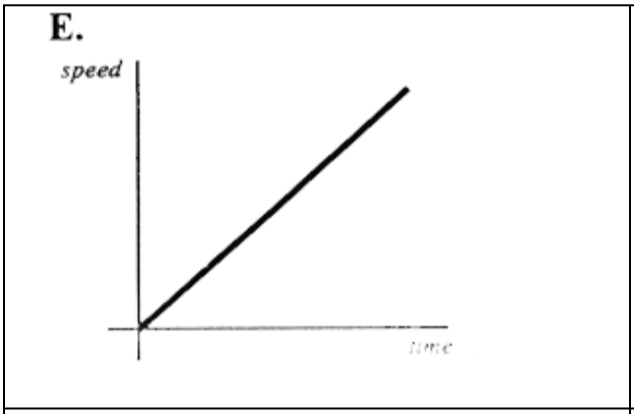
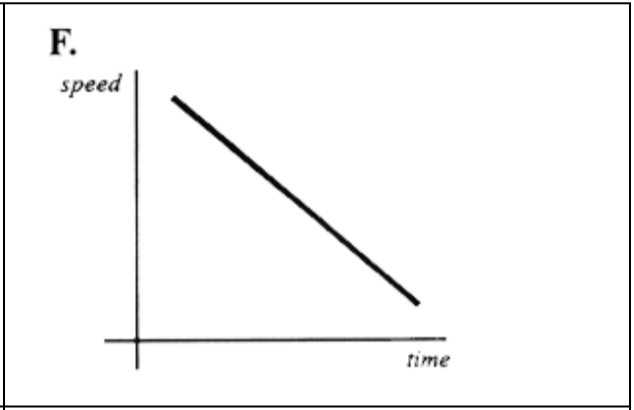
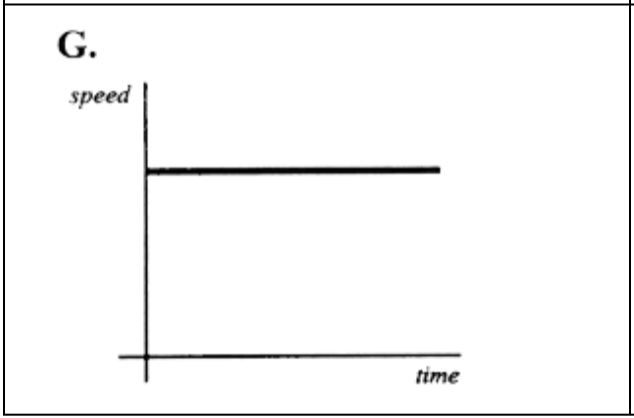
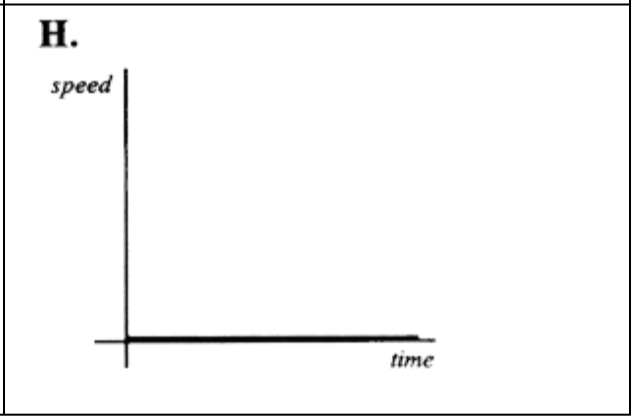
Match the graph to the description:
"The car is accelerating speeding up (positive acceleration)."
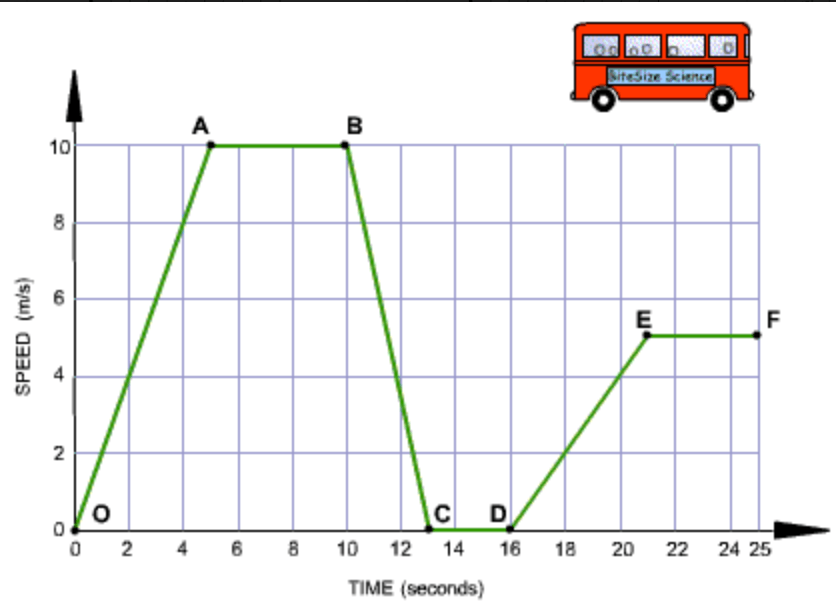
Segment O-A: The bus is _________________. It's speed changes from 0m/s to 10 m/s in 5 seconds.
accelerating
decelerating
constant speed
at rest


If a ball thrown straight up into the air takes 4 seconds to reach the top (peak), how long will it take to travel from the peak back to the original position?
0s
1s
3s
4s
The fact that an apple and a watermelon, dropped simultaneously from the same height, would hit the ground at the same time indicates that
you don't like apples or watermelons.
greater masses have greater acceleration.
lesser masses have greater acceleration.
acceleration is independent of mass.
If two projectiles are launched at two different heights, 2m and 10m, which one will reach the ground first?
2m
10m
they both will hit the ground at the same time
In the context of projectile motion, if the X-axis represents time and the Y axis represents the height, what do the X-intercepts represent?
When the object is on the ground
The maximum height of the object
The object going underground
The starting point of the object

What is the height of the object after 5 seconds?
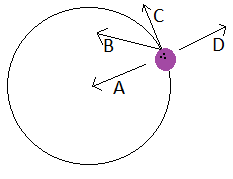
Which vector pair (arrow pair) correctly represents the acceleration and velocity at point P?


Inertia depends on __________.
Weight
Velocity
Mass
Acceleration
Newton's third law states.......
For each action there is a larger reaction associated with it.
None of these choices
For each action there is an equal and opposite reaction.
For each action there is a smaller reaction associated with it.
my science chair is on wheels and moves easily across my floor as a result of this type of friction.
Static
Sliding
Rolling
Fluid
My file cabinet stays in the corner of the room as a result of this type of friction.
Static
Rolling
Sliding
Fluid (Air Resistance)
Nuclear sizes are expressed in a unit named
Fermi
Angstrom
Newton
Tesla
Metals are good conductors of electricity because
they contain free electrons
the atoms are lightly packed
they have high melting point
All of the above
Elastic potential energy is energy in an object that is compressed or __________.
at rest
stretched
in equilibrium
The equation for spring force is
Fsp = mgh
Fsp = 1/2kx2
Fsp = Fd
Fsp = -kx

The spring constant of an object tells you?
What type of spring you are dealing with
How long the spring will stretch or compress
It gives you a value on how easy or hard it is to change the objects length.
A spring constant gives you a number which tells you what material the spring is made of.
What happens to the force between two charged objects when you halve the distance between them?
2X
1/2X
4X
1/4X
If one of the charges doubles, what happens to the force?
it doubles
it gets cut in half
it quadruples
it is cut by 1/4

Which of the following is a true statement about the electric field between the two plates?
The field is attractive between the plates and uniform in strength
The field is repulsive between the plates and uniform in strength
The field is attractive between the plates and strongest near the positive
The field is repulsive between the plates and strongest near the positive
What is the current in a circuit with 6 ohms of resistance and a battery containing 24 Volts?
1/4 A
144 A
4 A
0.4 A
What is the resistance of a lightbulb that experiences 9 Volts and 3 amps of current?
1/3 ohms
3 ohms
27 ohms
9 ohms
What is the voltage of a circuit with 4 ohms of resistance and 3 amps of current?
12 V
21 V
4/3 V
3/4 V

An alarm clock draws 0.5 A of current when connected to a 120 volt circuit. Calculate its resistance.
60Ω
120Ω
180Ω
240Ω
An alarm clock draws 0.5 A of current when connected to a 120 volt circuit. Calculate its resistance.
60Ω
120Ω
180Ω
240Ω
An alarm clock draws 0.5 A of current when connected to a 120 volt circuit. Calculate its resistance.
60Ω
120Ω
180Ω
240Ω

A 12 Volt car battery pushes charge through the headlight circuit resistance of 10 ohms. How much current
is passing through the circuit?
1A
1.2A
1.4A
1.6A
A kilowatt-hour is equivalent to
1000 W.
3600 J.
3,600,000 J/s.
3,600,000 J.
If the resistance in a constant voltage circuit is doubled, the power dissipated by that circuit will
increase by a factor of two.
increase by a factor of four.
decrease to one-half its original value.
decrease to one-fourth its original value.
If the voltage across a circuit of constant resistance is doubled, the power dissipated by that circuit will
be four times as large.
be two times as large.
decrease to one-half the original power.
decrease to one-fourth the original power.
A 4000-Ω resistor is connected across a 220-V power source. What current will flow through the resistor?
0.055 A
1.8 A
5.5 A
18 A
Which factor does not affect resistivity?
Length
Mass
Cross-sectional area
Temperature
The unit of resistivity is
Ω/m
Ω/m2
Ω.m
Ω.m2
A copper wire of length 2.5 m and cross-sectional area 2.4 × 10⁻⁷ m2 has a resistivity of 1.7x10⁻⁸Ωm. What is the resistance of the wire?
1.6x10⁻¹⁵Ω
1.0x10⁻¹⁴Ω
0.18Ω
5.6Ω
Resistance of a material would be equal to resistivity when
l = T
A = l
A = T
l = R
A wire of uniform diameter 0.28mm and a length of 1.50m has a resistance of 45Ω. It's resistivity is
2.2 x 10⁻⁸Ωm
36 Ωm
1.8 x 10⁻⁶Ωm
3.4 x 10⁻⁷Ωm
A wire of uniform diameter 0.28mm and a length of 1.50m has a resistance of 45Ω. It's resistivity is
2.2 x 10⁻⁸Ωm
36 Ωm
1.8 x 10⁻⁶Ωm
3.4 x 10⁻⁷Ωm
1.If you were in spaceship traveling at the speed close to the speed of light (with respect to the earth) you would notice that___________
your pulse rate is different than normal
your mass is different than normal
some of your physical dimensions were smaller than the normal
none of these effects occur

The speed of light (c) =
186,282 miles per second
300,000,000 meters per second
3.0 x 10⁵ km/sec (kilometers per second)
All answers are correct and equal to one another
This expression 1−c2v21 represents
time dilation
the relativistic (Lorentz) factor
length contraction

