
 Worksheets
Nervous System
Total questions: 60
Worksheet time: 45mins
What is the main function of the nervous system?
to inhale oxygen and exhale carbon dioxide
to break down food consumed by a person for nutrients
to control the body's activities by relaying messages
to control the body's movements
What are the two divisions of the nervous system?
Central and Lower nervous systems
Central and Peripheral nervous systems
Lower and Cerebral nervous systems
Central and Muscular nervous systems
A nerve cell is called a:
neutron
nerve
neuron
synapse
Dendrites are part of a neuron that carries electrical signals _______ the cell body.
to
away
in between
Axons are part of a neuron that send electrical signals ________ the cell body
to
away from
in between
True or False: the cell body of a neuron has a nucleus.
True
False
The space between an axon of a neuron that is communicating with a dendrite of another neuron is called a ________________.
Neuron
Brain message
Stimulus
Synapse

The cerebellum is labeled as #...
1
2
3

The brain stem/medulla is labeled as #...
1
2
3

#1 is pointing to the...
cerebrum
cerebellum
medulla
Which part of the brain controls involuntary movements such as digestion and your heartbeat?
cerebrum
cerebellum
medulla/spinal cord
Which part of the brain controls senses, thinking, and memory?
cerebrum
cerebellum
medulla
Which part of the brain controls balance and coordination?
cerebrum
cerebellum
medulla
When the spinal cord responds in an emergency to a stimulus before the brain, this is called a...
response
synapse
cerebral response
reflex
Which of the following is NOT a sense?
hearing
nose
smell
touch
Someone who is "right-brained" is considered to be more...
logical
creative
What are the three major parts of your brain?
Cerebrum
Nerves
Cerebellum
Spinal Cord
Brain Stem
What part of your brain controls your voluntary muscle movements as well as interprets senses?
Cerebellum
Cerebrum
Spinal Cord
Nerves
What part of your brain controls involuntary muscle movements?
olfactory
Cerebrum
Brain Stem
cerebellum
What part of your brain is responsible for coordinating muscle movements between the voluntary and involuntary muscles?
Cerebellum
Cerebrum
Brain Stem
Nerves
How do your nerves work?
They carry messages back and forth from the brain to the rest of the body
The send messages only to the spinal cord
They only receive messages from the spinal cord
They really don't work. They are lazy and want everything done for them.
What other systems does your nervous system work with?
Circulatory
Respiratory
Skeletal
Muscular
Immune
What is considered the command center of the nervous system?
Neurons
Heart
Spinal Cord
Brain
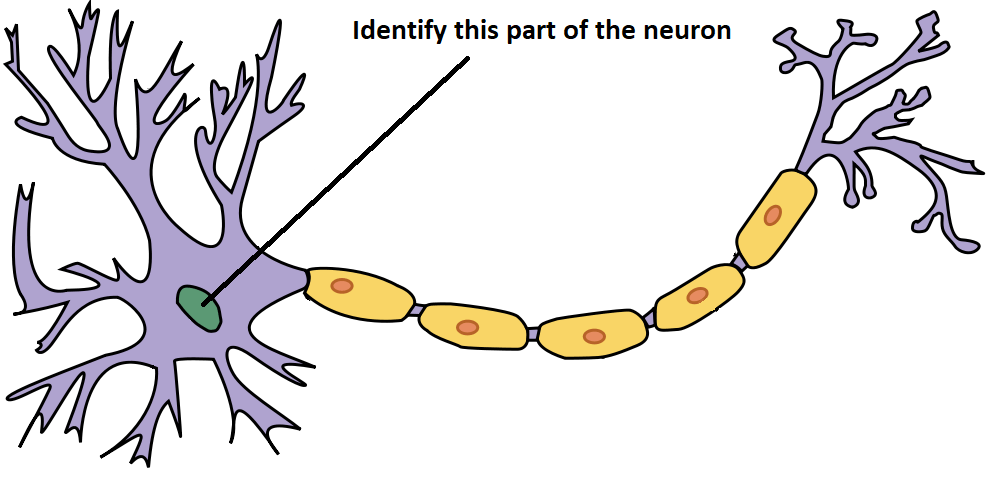
Nucleus
Cell Body
Axon
Node of Ranvier
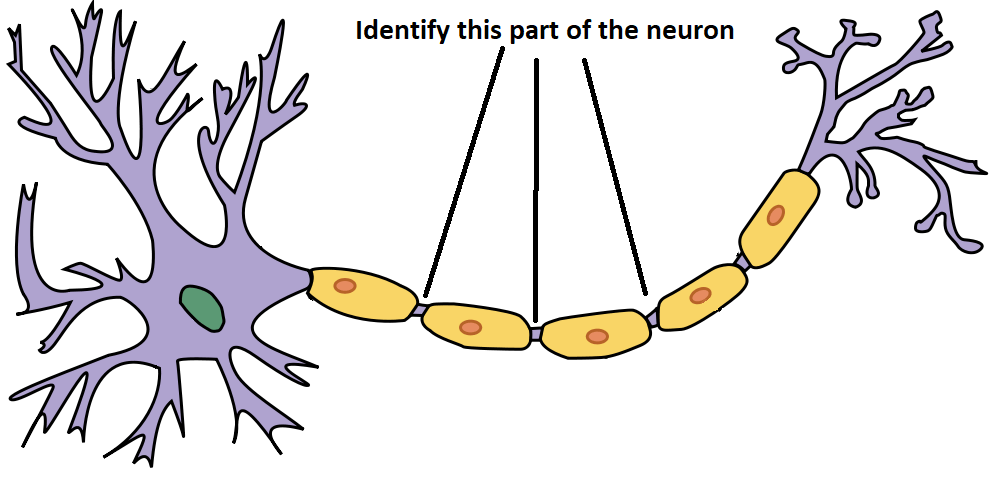
Nucleus
Cell Body
Axon
Node of Ranvier
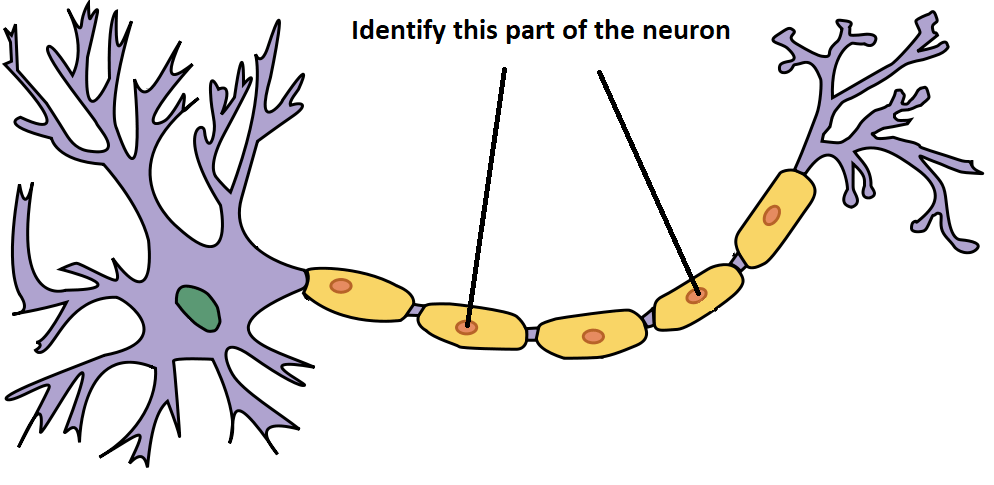
Dendrites
Axon Terminals
Myelin Sheath
Schwann Cells
What direction foes the electrical signal travel through the neuron?
From dendrites, down the Axon, and out Axon terminals
From Axon terminals, down the Axon, & out of the dendrites
Any direction up or down the cell
From the Axon, to the Dendrites, and out the Axon terminals
What does the neuron's Myelin Sheath do?
Controls the actions of the neuron
Produces food for the neuron
Carries information from the cell body to other neurons
Surrounds and insulates the axon
What do Nodes of Ranvier do?
Intakes information from other neurons
Produces fatty tissue for the Myelin Sheath
Sends information to the next cell
Controls the speed of electrical signal through the axon
What do Schwann Cells do?
Intakes information from other neurons
Produces fatty tissue for the Myelin Sheath
Sends information to the next cell
Controls the speed of electrical signal through the axon
Which is the correct sequence in the transmission of a neural impulse?
axon, dendrite, cell body, synapse
dendrite, axon, cell body, synapse
synapse, axon, dendrite, cell body
dendrite, cell body, axon, synapse

Neuroglial cells that form the fatty myelin sheath on neurons in the CNS are ___________ in the PNS are ________________?
ganglia and oligodendroglia
astrocytes and schwann cells
schwann cells and oligodendroglia
oligodendroglia and schwann cells

Produce cerebrospinal fluid in the brain & spinal cord
ependymal cells
oligodendrocytes
microglia
astrocytes
If you picked up a hot coal, the signal from the sensory neurons in your fingertips would travel to ____________ in your spinal cord.
Sensory Neurons
Motor Neurons
Interneurons
Type of neuron that perceive information about your environment.
Motor Neuron
Interneuron
Sensory Neuron
Type of neuron that sends nerve impulses to muscles and gland, by the command of other neurons.
Motor Neurons
Interneurons
Sensory Neurons
Neurons that only have on process?
Multipolar
Bipolar
Unipolar
Unpolar
The Central Nervous System is almost all ....
Unpolar
Bipolar
Multipolar
Unipolar

The innermost layer of meninges that supplies blood vessels to the brain
pia mater
dura mater
arachnoid mater

