
NEW
Font size
 Worksheets
SBI 4U Unit 1 Biochemistry
Total questions: 50
Worksheet time: 40mins
Select the molecule that is the monomer of proteins.


Which of the following is true of both starch and cellulose?
They are both polysaccharides.
They have the same structure.
They can both be digested by humans
They are both used for energy storage in plants.
Which part of an amino acid has different chemical properties?
the amino group
the peptide bond
the R group (or side chain)
the carboxyl group
Which macromolecule does not form polymers?
protein
lipid
carbohydrate
nucleic acid
What are the monomers and polymers of proteins called?
nucleotide...nucleic acid
nucleic acid...protein
amino acid...polypeptide
monosaccharide...polysaccharide

What is this molecule?
Saturated fatty acid
Unsaturated fatty acid
Phospholipid
Triglycerol
What is the polarity of the phosphate heads on phospholipids?
Polar
Nonpolar
Hydrophobic
Bananaphobic
What are the parts of a nucleotide?
nitrogen base and phosphate group
Nitrogen base
5 carbon sugar and nitrogen base
nitrogen base, 5 carbon sugar, and phosphate group
What are fats made of ?
lipid with 3 fatty acids
lipids
lipid with 2 fatty acids
none of the above
Protein loses shape in high temp and high solute this is called?
hydrolysis
protein function
dehydration
denature
This process removes water to make polymers.
denature
hydrolysis
dehydration
protein function
DNA is...
single stranded
doesn't exist
double stranded
is RNA but in disguise
Amino acids are the monomers of,
carbohydrates
lipids
proteins
amino acids
What are the functions of proteins ?
enzymes
energy
transport, enzyme, structual support and hormone
storage


How are the subunits of proteins linked together?
ether linkage
glycosidic linkage
Ester linkage
peptide (amide) linkage

Which is NOT an organic compound?
carbohydrates
water
nucleic acids
proteins
Which of the following is NOT paired correctly?
glucose- carbohydrate
fat- lipid
starch-nucleic acid
enzyme-protein

A lipid molecule is best represented by which diagram.
A
B
C
D

Which diagram represents a macromolecule that is responsible for genetic coding?
A
B
C
D

Which diagram represents a macromolecule that is found in fish, meat, and eggs?
A
B
C
D

Which diagram represents a molecule that is found in sugar, starches, and grains?
A
B
C
D
Enzymes affect the reactions in living cells by changing the
products of the reaction
pH of the reaction
temperature of the reaction
speed of the reaction

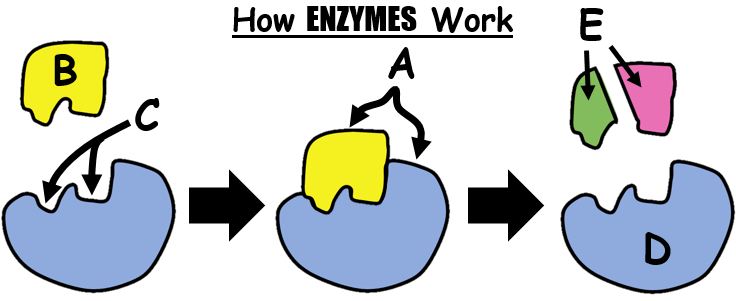
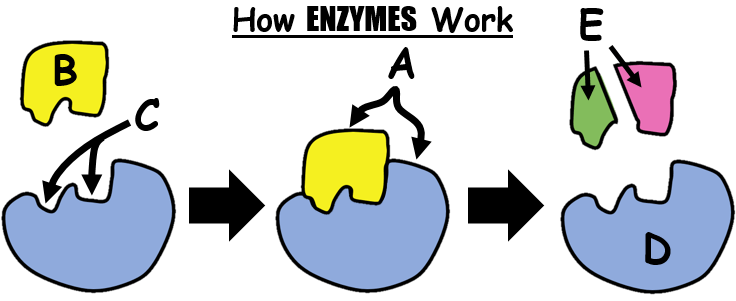
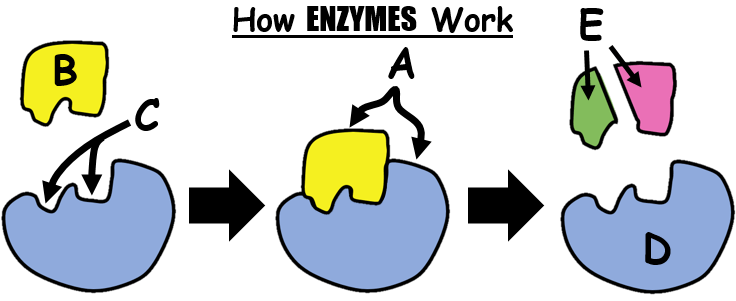
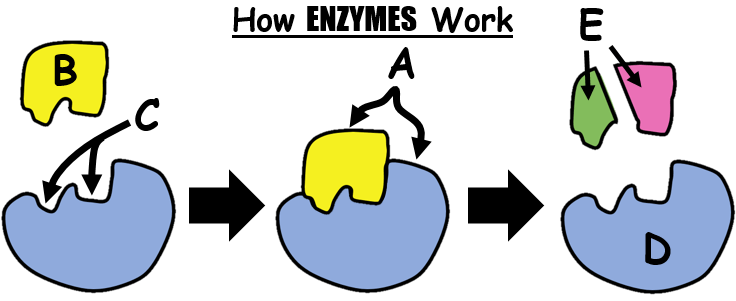
Use the diagram to identify the enzyme, substrate, active site and products (in that order)
c,d,a,b
d,a,b,c
b,c,a,d
c,a,b,d

Why can’t a denatured enzyme do it’s job?
it’s shape has been altered
it’s a polypeptide
too many reactants involved
to many products created

Some of the enzymes possess additional sites, known as
Active site
Binding site
Allosteric sites
Inhibitor site
Which of the following is a way to overcome competitive inhibition of an enzyme?
increase product concentration
increase substrate concentration
decrease enzyme concentration
decrease environmental temperature
Where does a substrate bind to an enzyme?
active site
allosteric site
How does a noncompetitive inhibitor decrease reaction rates?
binds to the active site
binds to the allosteric site
increases the free energy
increases the substrate concentration
A form of bulk transport in which materials are transported from the inside to the outside of the cell in membrane-bound vesicles that fuse with the plasma membrane.
Endocytosis
Exocytosis
Osmosis
Diffusion
white blood cells engulfing invading bacteria is an example of
Endocytosis
Exocytosis
Diffusion
Facilitated Diffusion


