
 Worksheets
CH 14-15 ICP
Total questions: 43
Worksheet time: 43mins

What kind of substance is composed of two or more elements that are chemically combined?
element
mixture
solution
compound

A combination of substances that are NOT chemically combined and can be physically separated is called a
mixture
compound
element

A substance that cannot be broken down and is made of the same type of atoms is a(n)
molecule
mixture
element
compound
Earth’s air is made up of gases like O2, CO2, H2O, and many more. Which term best describes air?
compound
mixture
pure substance
element
Salt water
Water
(H2O)
Which state of matter does NOT have a definite shape and takes the shape of its container?
An example of an element is
table salt (NaCl)
gold (Au)
Carbon dioxide (CO2)
salad

Which of the following is NOT correct?
Air: compound
Coffee: homogeneous mixture
Glucose (C6H12O6): compound
Cookies & Cream: heterogenous mixture

The upward force exerted by a fluid is called the...
buoyant force
density force
fluidity force
normal force
If an object has a density of 3.6 g/mL and you put it into water (density =1.0g/mL,) will it sink or float?
sink
float
Fluids consist of
solids and liquids
gases
gases and liquids
gases and solids
The measure of the force of gravity pulling on an object is called
mass
weight
buoyancy
pressure
Which of the following is an example of physical change?
Mixing baking soda and vinegar together, and this causes bubbles and foam.
A glass cup falls from the counter and shatters on the ground.
Lighting a piece of paper on fire and the paper burns up and leaves ashes.
Baking a birthday cake for your mother.
Which of the following is an example of chemical change?
Filling up a balloon with hot air.
Taking a glass of water and freezing it by placing it in the freezer.
A plant collecting sunlight and turning it into food.
Your dog ripping up your homework.
When a new substance is formed with different properties than the original substance it is called a
Chemical change
Physical change
Freezing
Boiling
Which is an example of a physical change?
Metal rusting
Silver tarnishing
Water boiling
Paper burning
Which is an example of chemical change?
Water freezes
Wood is cut
Bread is baked
Wire is bent

A change in phase is a
Chemical Change
Physical Change
Chemical reaction
What is an example of a physical property?

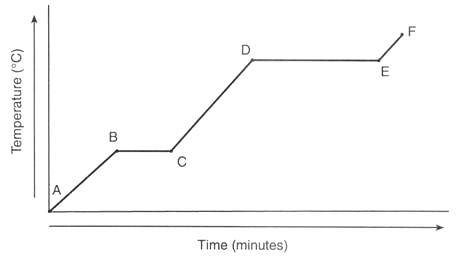
A change of state from a liquid to a solid is called....
Melting
Freezing
Evaporation
Boiling
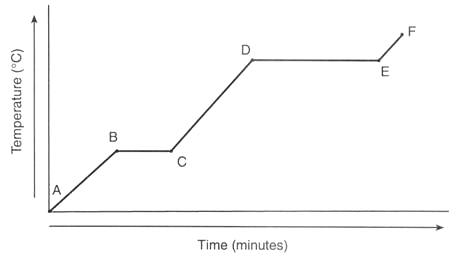
What is happening to the particles in the substance between points D and E?
Melting
Freezing
Vaporizing
Sublimating
What phase change is happening from E to D?
Melting
Freezing
Condensation
Evaporation
Viscosity can be described as...
a physical property of liquids
a physical property of solids
a chemical property of liquids
Which of the following liquids has a high viscosity?
honey
water
soy sauce
orange juice
As temperature increases ,viscosity of liquid _______________.
increases
stays the same
decreases
In CHARLES'S LAW, volume and temperature have a ______ proportionality. As the volume goes up, so does the temperature.
direct
inverse
opposite
In BOYLE'S LAW, pressure and volume are inversely proportional. This means when the pressure increases then the volume must...
Increase
Decrease
Stay constant

Dishwasher soap is an example of a
compound
heterogeneous mixture
homogeneous mixture
substance

M&M's is an examples of a
homogeneous mixture
heterogeneous mixture
an element
a compound

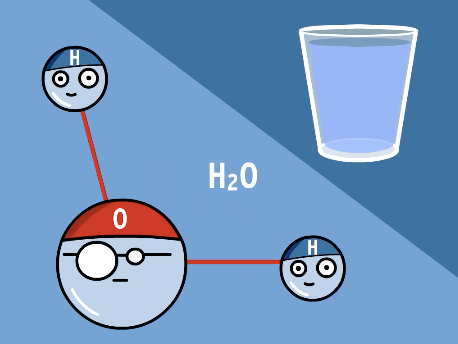
What type of matter is shown in the picture?
element
heterogeneous mixture
compound
homogeneous mixture
According to the Law of Conservation of Mass:
4 g of H2 and 32 grams of O2 will form how many grams of water?
28
8
36
128

