
NEW
Font size
S
M
L
XL
 Worksheets
Osmosis
Total questions: 15
Worksheet time: 8mins
Name
Class
Date
1.
The amount of particles in a given space.
a)
diffusion
b)
concentration
c)
permeable
d)
active transport
2.
Maintaining balance, while adjusting to conditions for survival.
a)
active transport
b)
concentration
c)
diffusion
d)
homeostasis
3.
The process where only water is allowed to pass through the cell membrane from a high to low concentration.
a)
meiosis
b)
respiration
c)
diffusion
d)
osmosis
4.
Osmosis is the movement of _____ across a membrane.
a)
food
b)
energy
c)
oxygen
d)
water
5.
During osmosis
a)
water moves from high to low concentration
b)
large or oddly shaped molecules move across a cell membrane
c)
water moves when energy is used
d)
proteins are built
6.
Passive transport requires no
a)
concentration gradients
b)
osmosis
c)
motion
d)
energy
7.

_______ regulates what enters and leaves a cell.
a)
Cell Membrane
b)
Nucleus
c)
Mitochondria
d)
Cytoplasm
8.
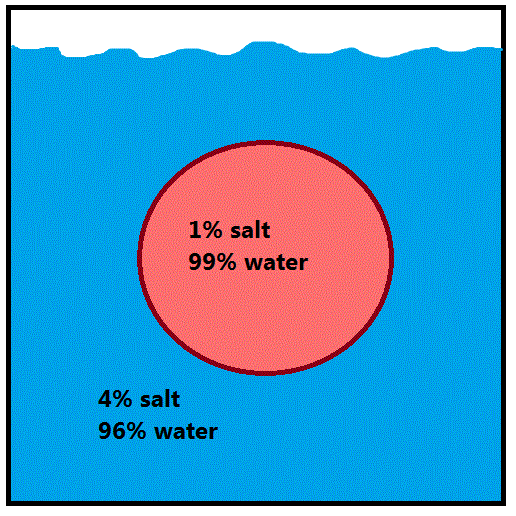
Where will the water go?
a)
Into the cell
b)
Out of the cell
c)
Equally in & out - it's isotonic
d)
There is no water
9.

Mr. Slug was salted. Where was there more solute immediately after salting?
a)
Outside of the slug
b)
Inside of the slug
c)
There was no solute anywhere
10.
If a cell containing 5% salt is placed into a glass of water with 20% salt, the water is _______ compared to the cell.
a)
hypertonic
b)
hypotonic
c)
isotonic
11.
HYPO means...
a)
Low
b)
High
c)
Equal
d)
Fat
12.
ISO means...
a)
Low
b)
A lot
c)
Equal
d)
Mammal
13.
Why can't you drink salt water?
a)
It's hypertonic to your cells
b)
It's hypotonic to your cells
c)
It's isotonic to your cells
d)
It's paratonic to your cells
14.

The cell below is in a _________ solution.
a)
Hypotonic
b)
Hypertonic
c)
Isotonic
15.

The cell below is in a _____________ solution.
a)
Hypertonic
b)
Hypotonic
c)
Isotonic
Reset

