Wayground logo

Free Printable Worksheets

Font size

S
M
L
XL
Worksheets

Unit Review - PreCalculus

Total questions: 87

Worksheet time: 7hrs 15mins

Name
Class
Date
1.
The function shown in the graph is:
a)
even
b)
odd
c)
neither even nor odd
d)
both even and odd
2.
The function in the graph is:
a)
even
b)
odd
c)
neither even nor odd
d)
both even and odd
3.
The function shown in the graph is:
a)
even
b)
odd
c)
neither odd nor even
d)
both odd and even
4.

Is the graph an even, odd, or neither function?

a)

Even

b)

Odd

c)

Neither

5.
Is the graph an even, odd, or neither function?
a)
Even
b)
Odd
c)
Neither
6.

Is the graph an even, odd, or neither function?

a)

Even

b)

Odd

c)

Neither

7.
Is the graph an even, odd, or neither function?
a)
Even
b)
Odd
c)
Neither
8.
Is the graph an even, odd, or neither function?
a)
Even 
b)
Odd
c)
Neither
9.

Even, odd, or neither?

a)

Even

b)

Odd

c)

Neither

10.
Which one of the following functions is even?
a)
f(x) = x⁴ + x³
b)
g(x) = x⁴ + x²
c)
h(x) = x⁵ + x³
d)
k(x) = x³ + x
11.
Which one of the following functions is odd?
a)
f(x) = 3x⁴ - 4x³
b)
g(x) = 5x⁴ + 3x²
c)
h(x) = 6x⁵ - x³
d)
k(x) = x⁶ + 8x²
12.

Is the function even, odd, or neither?

f(x) = 4x3

a)

Even

b)

Odd

c)

Neither

13.
Is the graph an even, odd, or neither function?
a)
Even 
b)
Odd
c)
Neither
14.
a)
y = - √(x + 1)
b)
y = √(x + 1)
c)
y = - √(x) - 1
d)
y = - √(x) + 1
15.
What is the equation of the graph below? You can click the picture to zoom in!
a)
y = - | x + 2| + 4
b)
y = - | x - 2| + 4
c)
y = | x - 2 | + 4
d)
y = | x - 2| - 4
16.
What is the equation of the graph below?
a)
f(x) = I x I -1
b)
f(x) = I x I +1
c)
f(x) = - I x I -1
d)
f(x) = -I x I +1
17.
What is the equation of the graph below?
a)
f(x ) = I x + 4 I + 2
b)
f(x ) = -I x - 4 I + 2
c)
f(x ) = I x - 4 I + 2
d)
f(x ) = -I x + 4 I + 2
18.

Match the equation with the graph:

a)

y = (x - 2)2 + 4

b)

y = -(x - 4)2 + 2

c)

y = -(x - 2)2 + 4

d)

y = -(x + 2)2 + 4

19.

Which is an example of a function shifting downward 2 units and to the right 3 units

a)

 f(x) =(x−2)2−3f\left(x\right)\ =\left(x-2\right)^2-3 

b)

 f(x) =(x−3)2−2f\left(x\right)\ =\left(x-3\right)^2-2 

c)

 f(x) =(x−3)2−2f\left(x\right)\ =\left(x-3\right)^2-2 

d)

 f(x)= −2 x2+3f\left(x\right)=\ -2\ x^2+3 

20.

Which is an example of a reflection across the x-axis/ flip of the graph?

a)

f(x)=x−2f\left(x\right)=\sqrt{x-2}

b)

f(x) = −x−2f\left(x\right)\ =\ -\sqrt{x-2}

c)

f(x)=x−2f\left(x\right)=\sqrt{x}-2

d)

None of the above

21.
The original function has equation f(x).  State the transformations given the new function f(x) = ⅔(x - 7)2 
a)
Vertical Shrink of ⅔
Right 7
b)
Horizontal Shrink of ⅔
Left 7
c)
Left  ⅔
Vertical stretch of 7
d)
Right ⅔
Horizontal stretch of 7
22.
Which equation represents this graph.
a)
f(x)=(x - 4)2 - 3
b)
f(x)=-(x - 4)2 + 3
c)
f(x)=(x - 4)2 + 3
d)
f(x)=-(x + 4)2 + 3
23.
What is the equation of this graph?
a)
f(x) = (x + 2)2 - 3
b)
f(x) = (x - 2)2 - 3
c)
f(x) = |x + 2| - 3
d)
f(x) = |x - 2| - 3
24.
a)
f(x) = −(x−2)3−1
b)
f(x) = −(x+2)3−1
c)
f(x) = −(x−2)3 + 1
d)
f(x) = −(x+2)3 + 1
25.
What are the transformations of this functions compared to the parent function y = √(x)?
a)
Shifted right 5, shifted down 2, and reflected over the x-axis
b)
Reflected over the x-axis, vertical stretch, and shifted right 5
c)
Reflected over the x-axis, vertical stretch, and shifted left 5
d)
Shifted right 5, shifted down 2
26.
Which equation describes the transformation of shifting f(x)=x3 four units down?
a)
x3+ 4
b)
x3- 4
c)
(x - 4)3
d)
(x + 4)3
27.
What are the following transformations?
- f(x+2)
a)
reflection over the y axis and 2 units to the right
b)
reflection over the x axis and 2 units right
c)
reflection over the y axis and 2 units left
d)
reflection over the x axis and 2 units left
28.
. 
If the blue is f(x)=x2, the red must be
a)
g(x)=(x+3)2
b)
g(x)=(x-3)2
c)
g(x)=x2+3
d)
g(x)=x2-2
29.
a)
g(x)=2x2
b)
g(x)=0.5x2
c)
g(x)=x2+2
d)
g(x)=(x+2)2
30.
a)
g(x)=x3+1
b)
g(x)=x3-1
c)
g(x)=(x-1)3
d)
g(x)=(x+1)3
31.
f(x) = 5x2 + 2
a)
Stretch of 5
Up 2
b)
Shrink of 5
Up 2
c)
Stretch of 5
Down 2
d)
Shrink of 5
Down 2
32.
. 
If the blue is f(x)=x2, then the red must be
a)
g(x)=x2-5
b)
g(x)=x2+5
c)
g(x)=(x-5)2
d)
g(x)=(x+5)2
33.
Which parent function matches the graph?
a)
y = |x|
b)
y = ∛(x)
c)
y = x2
d)
y = a⋅bx
34.
What type of function is shown?
a)
absolute value
b)
quadratic
c)
linear
d)
exponential
35.
What type of function is shown?
a)
linear
b)
quadratic
c)
square root
d)
absolute value
36.
Which parent function matches the graph?
a)
f(x) = x
b)
f(x)= x2
c)
f(x) = |x|
d)
f(x) = abx
37.
Which parent function matches the graph?
a)
f(x) = x
b)
f(x)= x2
c)
f(x) = |x|
d)
f(x) = abx
38.
What type of function is shown?
a)
exponential
b)
linear
c)
quadratic
d)
square root
39.
What type of function is shown?
a)
Exponential 
b)
square root
c)
quadratic
d)
cube root
40.
What type of function is shown?
a)
exponential
b)
linear
c)
quadratic
d)
square root
41.
Which parent function matches the graph? 
a)
f(x) = x
b)
f(x) = x2
c)
f(x) =√(x)
d)
f(x) =∛(x)
42.
Which parent function matches the graph? 
a)
f(x) = a⋅bx
b)
f(x) = ∛(x)
c)
f(x) = √(x)
d)
f(x) = x2
43.
Which parent function matches the graph?
a)
f(x) = √(x)
b)
f(x) = ∛(x)
c)
f(x) = |x|
d)
f(x) = a⋅bx
44.
Name the parent function. 
a)
constant
b)
quadratic
c)
linear
d)
exponential
45.
Name the parent function. 
a)
constant
b)
square root
c)
linear
d)
absolute value
46.
g(x)=f(x)-4
Describe the transformation to f(x) that results in g(x).
a)
f(x) has been translated down 4.
b)
f(x) has been translated up 4.
47.
g(x)=f(x)+6
Describe the transformation to f(x) that results in g(x).
a)
f(x) has been translated up 6.
b)
f(x) has been translated down 6.
48.
g(x)=f(x-4)
Describe the transformation to f(x) that results in g(x).
a)
f(x) has been translated to the right 4.
b)
f(x) has been translated to the left 4.
49.
Match the equation to its description.
a)
Right 2 and up 2
b)
Left 2 and up 2
c)
Right 2 and down 2
d)
Left 2 and down 2
50.
What is the domain of the function?
a)
(-∞, ∞)
b)
[2, -2]
c)
(-∞, -2), (2, ∞)
d)
Trick question
51.
What is the range of the function?
a)
[0, - ∞)
b)
(-∞, 4]
c)
(2, -2)
d)
(-∞ , ∞ )
52.
What is the DOMAIN?
a)
(-∞, +∞)
b)
(-∞, -1] U [3, +∞)
c)
[-1, +∞)
d)
(-1, 0] U (0, +∞)
53.
What is the RANGE?
a)
(-∞, +∞)
b)
(-∞, -1] U [3, +∞)
c)
[-1, +∞)
d)
(-1, -∞)
54.
What is the range?
a)
(-3, 3]
b)
[-3, 3)
c)
(-3, 3)
d)
[-2, 2]
55.
What is the domain?
a)
[-4, 5)
b)
(-4, 5)
c)
[-4, 5]
d)
(-4, 5]
56.
What is the domain? 
a)
(-∞,-5)U(-5,5)U(5,∞)
b)
(-∞,-5)U(-5,4)U(4,∞)
c)
(-∞,-4)U(-4,5)U(5,∞)
d)
(-∞,-4)U(5,∞)
57.
State the Domain
a)
(-∞,-5)U(-5,∞)
b)
(-∞,7)U(7,∞)
c)
(-∞,0)U(0,∞)
d)
(-∞,-5)U(0,∞)
58.
What is the range? 
a)
(-∞,∞)
b)
(-6, 3)
c)
(-4, ∞)
d)
[-4, ∞)
59.
What is the domain? 
a)
(-∞,∞)
b)
(-6, 3)
c)
(-4, ∞)
d)
[-4, ∞)
60.
a)
Range:   (-∞,0) U (0,∞)
b)
Horizontal asymptote at x = 2.  
c)
Domain:  (−∞, -1) ∪ (-1, ∞)
d)
Domain:   (-∞,-3) U (-3,∞)
61.
a)
Domain:   (-∞,0)U(0,∞)
b)
Domain:   (-∞,3) U (3,∞)
c)
Range:   (-∞,-1) U (-1,∞)
d)
None of these are true
62.
Write the following in interval notation
x > 6 and x ≤ 10
a)
(-∞, 6) and (10, ∞)
b)
[6, 10)
c)
(-∞, 6] and [10, ∞)
d)
(6, 10]
63.

Look at the picture. Select the correct interval notation for the given number line.

a)

(-∞, -8] U [-4, ∞)

b)

(-∞, -8) U (-4, ∞)

c)

(-8, -4)

d)

[-8, -4]

64.

Using the pictured graph, what is f(2)?

a)

-2

b)

0

c)

3

d)

2

65.

Over what interval is this function constant?

a)

( - ∞ , 2 )

b)

( - ∞ , 2 ]

c)

[ 2 , ∞ )

d)

( 2 , ∞ )

66.

Over what interval is the function increasing?

a)

( - ∞ , -4 ) U ( 2 , ∞ )

b)

( 2 , ∞ )

c)

( - ∞ , -4 ) U [ 2 , ∞ )

d)

( -4 , 2 )

67.

What is the range of the function?

a)

( - ∞ , 2 )

b)

( - ∞ , 2 ]

c)

( - ∞ , - 3 ) U ( - 3 , 2 )

d)

( - ∞ , - 3 ) U ( - 3 , 2 ]

68.

What is the domain of the function?

a)

( - ∞ , - 5 ) U ( - 5 , ∞ )

b)

( - ∞ , 5 ) U ( 5 , ∞ )

c)

( - ∞ , - 5 ] U [ - 5 , 5 ] U [ 5 , ∞ )

d)

( - ∞ , - 5 ) U ( - 5 , 5 ) U ( 5 , ∞ )

69.
Name the discontinuity at x=2. 
a)
Infinite Discontinuity
b)
Removable Discontinuity
c)
Jump Discontinuity
d)
Continuous at x=2
70.
Name the discontinuity at x=2. 
a)
Infinite Discontinuity
b)
Removable Discontinuity
c)
Jump Discontinuity
d)
Continuous at x=2
71.
Name the discontinuity at x=2. 
a)
Infinite Discontinuity
b)
Removable Discontinuity
c)
Jump Discontinuity
d)
Continuous at x=2
72.

Identify the type of location of the discontinuity/discontinuities.

a)

Infinite at x = 4

b)

The function is continuous

c)

Removable at x = 4

d)

Jump at x = 4

73.

Identify the type of location of the discontinuity/discontinuities.

a)

Removable at x = 5 ; Infinite at x = -1

b)

Removable at x = -5 ; Infinite at x = 1

c)

Infinite at x = 1

d)

Infinite at x = 2

74.
Name the discontinuity at x=2. 
a)
Infinite Discontinuity
b)
Removable Discontinuity
c)
Jump Discontinuity
d)
Continuous at x=2
75.

Determine the type(s) and location(s) of discontinuities

a)

infinite at x = ∞.

b)

jump at x = -∞, removable at x = 2.

c)

the graph is continuous (no discontinuities)

d)

infinite at x = ∞, removable at x = 0

76.

Determine the type(s) and location(s) of all discontinuities.

a)

jump at x = -3, removable at x = 2

b)

removable at x = -3.

c)

infinite at x = 2.

d)

infinite at x = -3.

77.

Determine the type(s) and location(s) of all discontinuitie(s)

a)

jump at x = 1

b)

removable and x = 1

c)

infinite at x = 1

d)

jump at x = -3

78.
In the above graph complete the following end behavior:
As x --> -∞, f(x) --> ____
As x --> +∞, f(x) --> ____
a)
-∞
-∞
b)
+∞
-∞
c)
-∞
+∞
d)
+∞
+∞
79.
In the above graph complete the following end behavior: (f(x)=y)
As x --> -∞, f(x) --> ____
As x --> +∞, f(x) --> ____
a)
-∞
-∞
b)
+∞
-∞
c)
-∞
+∞
d)
+∞
+∞
80.

Describe the end behavior of the graph.

a)

x → -∞, f(x) → ∞ and x→∞, f(x) →⁻∞

b)

x → -∞, f(x) → ∞ and x→∞, f(x) →∞

c)

x → -∞, f(x) → ∞ and x→∞, f(x) → 0

d)

x → -∞,f(x) → -∞and x→ ∞, f(x) → ∞

81.
Describe the end behavior of the graph.
a)
x →∞, y→∞ and x→∞, y→⁻∞
b)
x →∞, y→∞ and x→⁻∞, y→∞
c)
x →∞, y→∞ and x→⁻∞, y→0
d)
x →∞,y→0 and x→∞, y→⁻∞
82.

Which type of regression model does the scatter plot appear to show?

a)

linear

b)

exponential

c)

quadratic

83.

Which type of regression model does the scatter plot appear to show?

a)

linear

b)

exponential

c)

quadratic

84.
The linear regression equation is y = 61.93x - 1.79.  Use the equation to predict how far this person will travel after 10 hours of driving.
a)
10 miles
b)
617.5 miles
c)
0.19 miles
d)
500 miles
85.
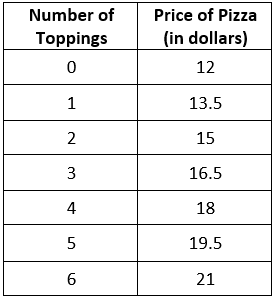
A restaurant sells pizza for the prices in the data table.  Calculate the linear regression equation of the data.
a)
y = 1.5x + 12
b)
y = 12x + 1.5
c)
y = 0.67x - 8
d)
y = -8x + 0.67
86.

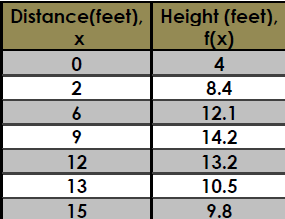
Find the quadratic equation for the relationship of the horizontal distance and the height of the ball.

a)

y= -18x2 + 2.11x + 4.21

b)

y= -.06x2 +1.06x + 7.9

c)

y= -6x2 +1.06x + 79

d)

y= -.12x2 + 2.11x + 4.22

87.

A chemist has a 100-gram sample of a radioactive material. He records the amount of radioactive material every week for 6 weeks and obtains the following data. Determine the exponential regression that best models these data.

a)

y = 100(8.7)x

b)

y = 100(1.87)x

c)

y = 100(.87)x

d)

y = 100(.13)x