wayground logo

Free Printable Worksheets

NEW

Font size

S
M
L
XL
Worksheets

Week 9_PhySci Summative Review_ALT

Total questions: 52

Worksheet time: 54mins

Name
Class
Date
1.
In order for an atom to be neutral what has to be true?
a)
The atom has more protons than neutrons
b)
The atom has more neutrons than protons
c)
The atom has the same number of protons and neutrons
d)
The atom has the same number of protons and electrons
2.
Most of the mass in an atom is made up of _____________________?
a)
protons and electrons
b)
protons and neutrons
c)
neutrons and electrons
d)
electrons and quarks
3.
What is the electrical charge of a proton?
a)
1+
b)
1-
c)
neutral
d)
2-
4.

What are electrons?

a)

an atom’s central regions, which is made up of protons and neutrons

b)

subatomic particles that have negative charges

c)

subatomic particles that have neutral charges

d)

subatomic particles that have positive charges

5.

One disadvantage of nuclear energy is ___.

a)

Requires Fossil Fuel

b)

it leaves behind radioactive waste

c)

there are no disadvantages

d)

it emits large amounts of pollution into the atmosphere

6.
Elements which are shiny, conduct electricity and heat are called
a)
metal
b)
nonmetal
c)
metalloid
d)
nonexistent
7.
The atoms along the staircase are called 
a)
metals
b)
nonmetals
c)
metalloids
d)
noble gases
8.

The number of protons in the nucleus of an atom is called the --

a)

atom

b)

proton

c)

atomic mass number

d)

atomic number

9.
all matter is made of what 
a)
energy 
b)
atoms 
c)
electrons 
d)
compounds 
10.
The particles that are found in the nucleus of an atom are
a)
neutrons and electrons
b)
electrons only
c)
protons and neutrons
d)
protons and electrons
11.
What Periodic Table family is represented by the Lewis dot diagram?
a)
Halogens
b)
Alkali Metals
c)
Transition Metals
d)
Noble Gases
12.
How many valence electrons does an alkaline earth metal have? 
a)
1
b)
2
c)
7
d)
8
13.

Sulfur is a...

a)

metal

b)

nonmetal

c)

metalloid

14.

The innermost energy level has a maximum of how many electrons?

a)

1

b)

2

c)

6

d)

8

15.

How many valence electrons?

a)

2

b)

3

c)

4

d)

5

16.
Who arranged the first periodic table.
a)
Mosely
b)
Einstein
c)
Mendeleev
d)
Bohr
17.

A scientist is examining an unknown solid. Which procedure would most likely help determine a chemical property of the substance?

a)

heating it to find the temperature at which it melts

b)

exposing it to a flame to see if it catches on fire

c)

hitting it with a hammer to determine if it breaks or bends

d)

placing it in water to find out whether or not it dissolves
18.
Why does ice float?
a)
Liquid water is less dense than solid water.
b)
Solid water is less dense than liquid water.
c)
Gaseous water is less dense than solid water.
d)
Liquid water is less dense than gaseous water.
19.
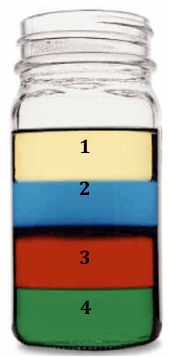
Put the liquids in order from most dense to least dense?
a)
4, 3, 2, 1
b)
1, 2, 3, 4
c)
3, 4, 2, 1, 
d)
4, 3, 1, 2
20.
What is the formula for density?
a)
density = mass x volume
b)
density = mass / volume
c)
density = mass + volume
d)
density = mass - volume
21.

What is the volume of the cylinder?

a)

10 mL

b)

15 mL

c)

8 mL

d)

5 mL

22.

Increase in temperature causes the particles to

a)

slow down

b)

move faster

c)

stay apart from each other

d)

move in the correct order

23.
How many iron atoms are in 
Fe(NO3)2
a)
1
b)
2
c)
3
d)
6
24.

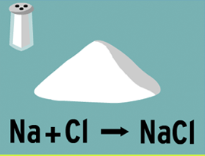
When sodium and chlorine combine to form sodium chloride, sodium chloride is the:

a)

Originator

b)

Reactant

c)

Product

d)

Produce

25.

In a reaction A + B ----> C, reactant A has 5g and product C has 9g. How many grams does reactant B have?

a)

4g

b)

5g

c)

9g

d)

14g

26.

How many elements are in C6H12O6?

a)

1

b)

2

c)

3

d)

4

27.

Is the following equation balanced?

4Fe + 3O2 ---> 2Fe2O3

a)

YES

b)

NO

28.

Ionic bonds form between ---

a)

nonmetals.

b)

metals and nonmetals.

29.

Covalent bonds form between ---

a)

nonmetals.

b)

metals and metals

c)

metals and nonmetals

30.

According to the Octet Rule, atoms of elements react with each other in order to attain ____ electrons in their outermost energy level or shell.

a)

2

b)

4

c)

8

d)

10

31.

Why do elements bond?

a)

To be friends

b)

To create a new element

c)

To become stable

d)

To get bigger

32.
If an atom loses two electrons what charge will it have?
a)
-2
b)
-1
c)
+1
d)
+2
33.
What kind of bond forms when atoms share electrons?
a)
ionic
b)
covalent
c)
artificial
d)
univalent
34.
Predict the bond that will form between Be and F.
a)
Ionic
b)
Covalent
35.

Predict the bond that will form between S and O.

a)

Ionic

b)

Covalent

36.
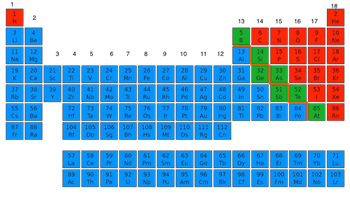
Where are the nonmetals located on the periodic table? 
a)
Blue
b)
Red
c)
Green
37.
Where are metals located on the periodic table?
a)
Blue
b)
Green
c)
Red
38.
The density of this material is 2 g/cm3.
There are 24 cm3  Find the total mass.
a)
12 grams
b)
48 grams
c)
12 g/cm3
d)
48 g/cm3
39.
What is the density of a liquid that has a mass of 27g and a volume of 30ml?
a)
0.9 g/ml
b)
3 g/ml
c)
57 g/ml
d)
810 g/ml
40.
A bar of copper has a mass of 216g and a volume of 24cm3. What is the density of copper?  
a)
9g/cm3
b)
.11g/cm3
c)
5184g/cm3
d)
322mL
41.

According to the Law of Conservation of Mass, what happens to the wood and oxygen when it is burned?

a)

The wood disappears.

b)

It stays the same chemically.

c)

The atoms in the wood and oxygen rearrange and form smoke and ash.

d)

Nothing.

42.
KNO3 --> KNO2 + O2
What coefficients are needed to balance the reaction?
a)
2, 2, 1
b)
2, 3, 2
c)
1, 2, 2
d)
1, 3, 1
43.

__ Al + __ FeO → Al2O2 + __ Fe

a)

1, 1, 2

b)

2,1,2

c)

2, 2, 2

d)

2,4,2

44.
The following is what type of reaction:
PbCl2 + AgNO3 → Pb(NO3)2 + AgCl
a)
Synthesis
b)
Decomposition
c)
Single Replacement
d)
Double Replacement
45.
The following is what type of reaction:
NH3 + HCl  → NH4Cl
a)
Synthesis
b)
Decomposition
c)
Single Replacement Replacement
d)
Double Replacement Replacement
46.
What type of chemical reaction is this?
Al(OH)3 → Al2O3  + H2O
a)
Decomposition
b)
Combustion
c)
Synthesis
d)
Single Replacement 
47.
C4H12 + O2 → CO2 + H2O
a)
Synthesis
b)
Combustion
c)
Single Replacement
d)
Double Replacement
48.

What reaction has the following general formula:

A + CD --> C + AD

a)

Combination

b)

Decomposition

c)

Single Replacement

d)

Double Replacement

e)

Combustion

49.
What is the name of N2O3
a)
Nitrogen trioxide
b)
Dinitrogen oxide
c)
Dinitrogen trioxide
d)
Nitrogen oxide
50.
What is the chemical formula for Tetrasulfur pentoxide?
a)
SO
b)
S4O
c)
S4O5
d)
S5O4
51.
What is the name of C3Cl?
a)
Carbon octachloride
b)
Tricarbon octachloride
c)
Carbon trichloride
d)
Octacarbon trichloride
52.
What is the chemical formula for Nitrogen triiodide?
a)
NI
b)
N3I
c)
NI3
d)
None of these