
 Worksheets
Living Environment Quiz #1
Total questions: 30
Worksheet time: 44mins

The variable in the experiment that YOU change (what is being tested) / La variable del experimento que TÚ cambias (lo que se está probando)
Independent variable
Dependent variable
Controlled variable (constants)

The variable that changes as a RESULT (What you measure) / La variable que cambia como RESULTADO (Lo que se mide)
Control (placebo)
Dependent variable
Scientific Theory
Independent Variable

Because water has a positive and a negative end, and is attracted to other molecules it is called a ______ molecule. / Como el agua tiene un extremo positivo y otro negativo, y es atraída por otras moléculas, se llama molécula ______.
mickey mouse
polar
special
miracle

The property where water molecules are attracted to other water molecules. / Propiedad por la que las moléculas de agua son atraídas por otras moléculas de agua.
adhesion
capillary action
cohesion
universal solvent

The property where water molecules are attracted to other types of molecules (surfaces). / Propiedad por la que las moléculas de agua son atraídas por otros tipos de moléculas (superficies).
adhesion
capillary action
cohesion
universal solvent

The property where water can pull itself up tubes or through spaces in paper or fabrics. / La propiedad por la que el agua puede subir por los tubos o atravesar los espacios del papel o los tejidos.
adhesion
capillary action
cohesion
universal solvent

A water strider can skate along the top of a pond because/Un patinador acuático puede patinar por la parte superior de un estanque porque:
covalent bonds result in water cohesion / los enlaces covalentes dan lugar a la cohesión del agua
hydrogen bonds result in water cohesion (surface tension) / los enlaces de hidrógeno dan lugar a la cohesión del agua (tensión superficial)
water striders have adapted to take advantage of water cohesion / Las zancadas acuáticas se han adaptado para aprovechar la cohesión del agua
low surface tension of water / baja tensión superficial del agua

Attractions between water molecules are called / Las atracciones entre las moléculas de agua se denominan
Covalent bonds
Ionic bonds
Polar bonds
Hydrogen bonds
Acids have more of what kind of ions? / ¿Qué tipo de iones tienen los ácidos?
OH ions
OH- ions
H+ ions
All of the above
A(n) ______ is a substance with a pH less than 7 / A(n) ______ es una sustancia con un pH inferior a 7
Acid
Alkaline
Base
Buffer
A(n) _______ is a substance with a pH greater than 7. / A(n) _______ es una sustancia con un pH superior a 7.
Base
Acid
Buffer
Water
This substance releases OH- into solution / Esta sustancia libera OH- en la solución
Acid
Base
Neutral
What is the only substance with a neutral pH of 7? / ¿Cuál es la única sustancia con un pH neutro de 7?
Milk
Orange Juice
Water
Blood

According to the pH range which substance is more acidic than lemon juice / Según el rango de pH, ¿qué sustancia es más ácida que el zumo de limón?
Hydrochloric acid
Cabbage
Milk
Water
What is a substance called if it speeds up a chemical reaction? / ¿Cómo se llama una sustancia que acelera una reacción química?
reusable
catalyst
specific
fragile
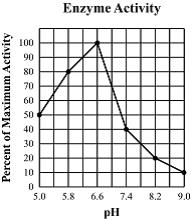
Which of the following conclusions can be drawn from this graph? / ¿Cuál de las siguientes conclusiones puede extraerse de este gráfico?
The optimum pH of the enzyme is 6.6. / El pH óptimo de la enzima es de 6,6.
The optimum pH of the enzyme is 5.8 / El pH óptimo de la enzima es de 5,8
The enzyme’s activity increases as pH increases 5.0 to 9.0 / La actividad de la enzima aumenta a medida que aumenta el pH 5,0 a 9,0
The enzyme’s activity is greater around pH of 8.0 / La actividad de la enzima es mayor alrededor de un pH de 8,0 .
Any substance that is acted upon by an enzyme is called a(n)? / Cualquier sustancia sobre la que actúe una enzima se denomina(n)
Coenzyme
Substrate
Vitamin
Polypeptide

Enzymes are... / Las enzimas son...
nucleic acids
proteins
lipids
carbohydrates
What is the function of an enzyme? / ¿Cuál es la función de una enzima?
enzymes break themselves into small pieces / las enzimas se rompen en trozos pequeños
enzymes slow down chemical reactions / las enzimas ralentizan las reacciones químicas
enzymes speed up chemical reactions / las enzimas aceleran las reacciones químicas
enzymes combine products to form reactants / las enzimas combinan productos para formar reactivos

Which enzyme is most efficient in a basic solution? / ¿Qué enzima es más eficaz en una solución básica?
A
B
After the enzyme and substrate bind together and perform the reaction, what does the substrate become? / Después de que la enzima y el sustrato se unan y realicen la reacción, ¿en qué se convierte el sustrato?
a substrate
an enzyme
a product
an active site
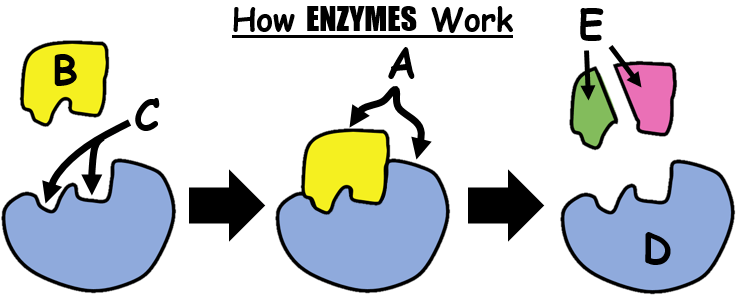
What is Letter D? / ¿Qué es la letra D?
active site
enzyme
substrate
products
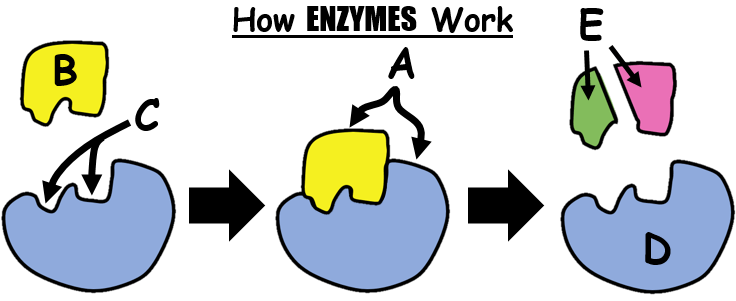
What is letter B? / ¿Qué es la letra B?
active site
enzyme
substrate
products
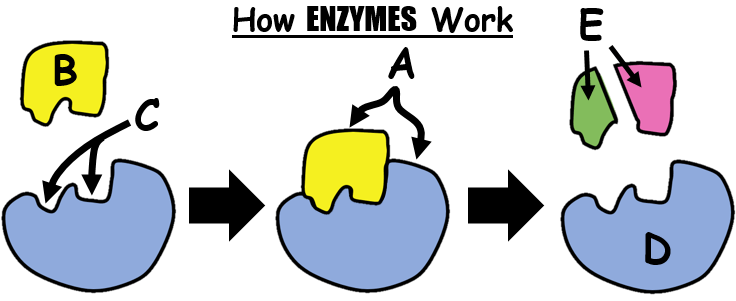
What is Letter C? / ¿Qué es la letra C?
active site
enzymes
substrate
products
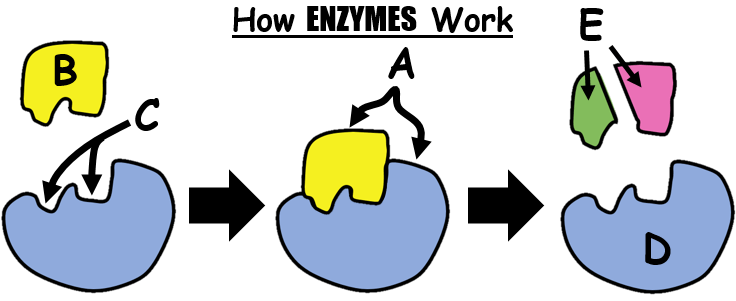
What is Letter E? / ¿Qué es la letra E?
active site
enzyme
substrate
products
Proteins are made of monomers called ___________ / Las proteínas están formadas por monómeros llamados ___________
Nucleotides
Monosaccharides
Amino Acids
Glycerol and fatty acids
DNA and RNA are examples of / El ADN y el ARN son ejemplos de
Carbohydrates
Lipids
Proteins
Nucleic Acids
Nucleotides are monomers of / Los nucleótidos son monómeros de
Carbohydrates
Lipids
Proteins
Nucleic Acids
Monosaccharides are monomers of / Los monosacáridos son monómeros de
Carbohydrates
Lipids
Proteins
Nucleic Acids
Waxes, oils and fats are examples of / Las ceras, los aceites y las grasas son ejemplos de
Carbohydrates
Lipids
Proteins
Nucleic Acids

