Wayground logo

Free Printable Worksheets

Font size

S
M
L
XL
Worksheets

8.5DE Test Review

Total questions: 49

Worksheet time: 49mins

Name
Class
Date
1.

A chemical formula is provided below. How many atoms are contained in the substance?

H2SO4

a)

3

b)

6

c)

7

d)

10

2.

A chemical formula is shown below. The subscripts in a chemical formula represent the-

NaNO2

a)

A. number of atoms of the element in front of the subscript.

b)

B. atomic mass of the heaviest element in the compound.

c)

C. atomic number of the element that follows the subscript.

d)

D. column on the Periodic Table of the element next to it.

3.

How many atoms of hydrogen (H) are found in (NH4)2CO3?

a)

8

b)

4

c)

2

d)

9

4.

During an investigation, two flasks of unknown, clear liquids are combined in a beaker and the following observations are recorded. Which of the listed observations indicate a new substance was formed during this investigation?


I. Solution color remains clear

II. The amount of solution in the beaker increased

III. Solution temperature changed from 10 degrees C to

20 degrees C

IV. Some of the liquid remained in the flasks

a)

A. I and II

b)

B. I, II, and IV

c)

C. III, only

d)

D. I and III

5.

Which of the following examples would support that a chemical reaction has occurred?

a)

A. After putting liquid batter into a hot pan, the batter solidifies and begins to turn brown.

b)

B. After turning on a blender filled with fruits, the fruit is chopped up and mixed together.

c)

C. After taking a tray filled with ice cubes out of the freezer, the cubes begin to melt.

d)

D. After adding a spoonful of sugar to a mug of hot coffee, the sugar dissolves completely.

6.

When vinegar and baking soda are combined, bubbles begin to form. Bubbles are evidence of a chemical reaction because they -

a)

A. are less dense than air.

b)

B. form at a fast rate.

c)

C. released a gas

d)

D. have no mass.

7.

An experiment is performed in which a crystalline substance is added to a beaker filled with room temperature water. All of the following observations would serve as evidence that a chemical change occurred, EXCEPT –

a)

A. the crystals dissolve.

b)

B. a precipitate is formed.

c)

C. the bottom of the beaker feels warm to the touch.

d)

D. bubbles begin forming within the water.

8.
A change in which NEW substances are formed.
a)
Chemical change
b)
Physical change
c)
Casual change
d)
Formal change
9.
A copper penny turning greenish after a few years is an example of...
a)
Chemical Change
b)
Physical Change
10.
Which of the following is a PHYSICAL change?
a)
Getting a haircut
b)
Rusty metal
c)
sour milk
d)
A compound
11.
Which of the following IS a chemical change
a)
using chalk
b)
water freezing
c)
slicing cheese
d)
digestion
12.
Can matter be created or destroyed?
a)
Yes, it can be created.
b)
Yes, it can be destroyed.
c)
No, matter is always conserved
d)
None of these
13.
The mass after a physical change, such as ice melting into water, stays the same
a)
True
b)
False
14.
Which is the correct formula for:
one carbon (C)
two oxygen (O)
a)
CO2
b)
CO
c)
C2O
d)
2CO
15.
Which of the following is NOT an element?
a)
H2O
b)
H2
c)
O2
d)
Au
16.
How many atoms are there TOTAL in:
H2SO4
a)
6
b)
5
c)
7
d)
3
17.
Element or compound?
H2O
a)
element
b)
compound
18.
Element or compound?
O2
a)
Element
b)
Compound
19.

Which substances have the same number of Carbon atoms?

a)

2 and 4

b)

1 and 2

c)

1 and 3

d)

3 and 4

20.

How many atoms of oxygen are found in aluminum nitrate, Al(NO3)3?

a)

3

b)

6

c)

7

d)

9

21.

Sodium sulfate is used in laundry detergent. It is a compound that contains 2 atoms of sodium, 1 atom of sulfur, and 4 atoms of oxygen. What is the correct chemical formula for sodium sulfate?

a)

NA2SO4

b)

Na2S2O4

c)

Na2SO4

d)

Na2SO8

22.

How many total atoms are represented in the chemical formula H3PO4 ?

a)

3

b)

7

c)

8

d)

12

23.

How would you tell that a chemical change is occurring in this beaker?

a)

The vinegar is evaporating.

b)

The temperature remains the same.

c)

The limestone is melting.

d)

A gas is being produced.

24.

Which of the following represents a chemical reaction?

a)

a sugar cube dissolving in water

b)

a cake baking in an oven

c)

ice cubes forming in a freezer

d)

ice cream melting in a bowl

25.
Which of the following is a compound?
a)
Co
b)
O2
c)
C
d)
CO2
26.
The red numbers in the image below represent ________
a)
subscripts
b)
coefficients
c)
I don't know, and don't want to try
d)
None of the answers are correct
27.
The blue numbers in the image below represent ________
a)
I don't know, and don't want to try
b)
coefficients
c)
subscripts
d)
none of the answers are correct
28.
How many Sodium (Na) are in 6NaCl?
a)
1
b)
12
c)
6
29.
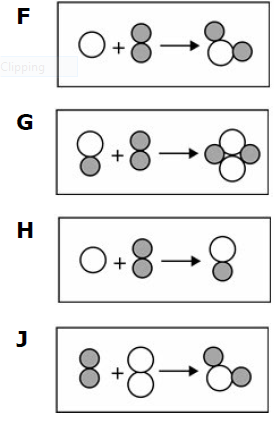
Which of the following models best demonstrates a balanced chemical equation?
a)
F
b)
G
c)
H
d)
J
30.
The reactants are on the left side of the chemical equation.
a)
True
b)
False
31.
What is the mass of H2O in the reaction above?
a)
70.01
b)
24.11
c)
21.44
d)
48.22
32.
The right side of the equation below is called the
a)
products
b)
reactants
33.

What is law of conservation of mass ?

a)

Mass of reactants = mass of products

b)

mass of reactants > mass of the products

c)

mass of the reactants < mass of the products

d)

mass of reactants > 2 mass of the reactants

34.

If reactants' mass is 18g , what is the mass of the products ?

a)

15

b)

36

c)

81

d)

18

35.
Consider the chemical equation CH4 + 2 O2 → CO2 + 2 H2O. In this equation, CH4 is a
a)
product
b)
reactant
c)
displacement
36.
2H2 + O2 ----> 2H2O What is the product?
a)
------>
b)
2H2O
c)
2H2+ O2
37.
Identify the reactant(s) and product(s) of the reaction.
a)
All three are reactants and none are products.
b)
Hydrogen and water are the reactants, and oxygen is the product.
c)
Water and oxygen are the reactants, and hydrogen is the product.
d)
Hydrogen and oxygen are the reactants, and water is the product.
38.
In the reaction methane + oxygen turns into carbon dioxide + water, the methane and oxygen are called _______________.
a)
reactants
b)
products
c)
neutrals
d)
energizers
39.

Which compounds are the PRODUCTS of this reaction?

a)

CO2 + H2O

b)

C6H12O6 + O2

c)

C6H12O6 + CO2

d)

H2O + O2

40.
If there are 4 H atoms on the reactant side, how many H atoms will be on the product side? 
a)
2
b)
4
c)
6
d)
You need more information to answer this question
41.
If an atom or molecule DOESN'T have a subscript or coefficient, what number should be used for that atom/molecule? 
a)
0
b)
1
c)
2
d)
No number should be used
42.
How many TOTAL atoms are on the REACTANT side of this equation?
CH4 + 2O2 → CO2 + 2H2O 
a)
5
b)
7
c)
9
d)
11
43.
Evidence of Chemical Change.
a)
New Substance 
b)
Size change
c)
State change
d)
Mixture 
44.
Evidence of a physical change.
a)
New substance
b)
Shape Change
c)
Light produced
d)
Gas released.
45.
Water boiling is a _______ change. 
a)
Physical Change 
b)
Chemical Change 
46.
Fireworks Exploding are a ________ change.
a)
Physical Change
b)
Chemical Change
47.
A characteristic that can only be determined by changing the identity of an object. 
a)
Physical Change
b)
Chemical Change
c)
Chemical Property 
d)
Physical Property 
48.
Sugar is dissolved into Kool Aid. What type of change is this? 
a)
Chemical 
b)
Physical 
c)
Multi
d)
Asystematic 
49.
What is the evidence of the chemical change seen here?
a)
Color change
b)
Light produced
c)
state change
d)
mixture