wayground logo

Free Printable Worksheets

Font size

S
M
L
XL
Worksheets

Force Motion and Newton

Total questions: 152

Worksheet time: 2hrs 22mins

Name
Class
Date
1.

An object and rest will stay at rest and an object in motion will stay in motion unless acted on by a force, is which one of Newton's Laws of Motion?

a)

4th Law of Motion

b)

1st Law of Motion

c)

3rd Law of Motion

d)

2nd Law of Motion

2.

The resistance to change in motion found in all objects with mass is called ________________.

a)

inertia

b)

force

c)

friction

d)

gravity

3.
For every action, thereʼs an equal and opposite reaction. *Action-Reaction*
a)
Newton's First Law
b)
Newton's Second Law
c)
Newton's Third Law
d)
force
4.
The force that pulls objects towards Earth.
a)
Gravity
b)
Friction
c)
Inertia
d)
Force
5.
What is Force?
a)
A Push
b)
A Pull
c)
Jumping
d)
Either a push or pull
6.
 What is the unit called that measures force?
a)
Isaac
b)
Yee
c)
Newton
d)
kilogram
7.
The scientist who is most famous for developing the Laws of Motion is _____.
a)
Albert Einstein
b)
Stephen Hawking
c)
Sir Isaac Newton
d)
Galileo Galilei
8.
A car starts from rest at a stop light and reaches 20 m/s in 3.5 s. Determine the acceleration of the car.
a)
2.2m/s2
b)
7.0m/s2
c)
5.7m/s2
d)
70m/s2
9.
An object at rest or moving at a constant speed in a straight path will continue to do so until a net force acts upon it.
a)
Newton's 1st Law
b)
Newton's 2nd Law
c)
Newton's 3rd Law
d)
Newton's 4th Law
10.
An object acted upon by a net force will accelerate in the direction of the force according to the equation 
Acceleration = net force/mass
a)
Newton's 1st Law
b)
Newton's 2nd Law
c)
Newton's 3rd Law
d)
Newton's 4th Law
11.

Changing the location of an object from one place to another.

a)

acceleration

b)

motion

c)

force

d)

push

12.

A push or pull on an object, causing it to move, stop, or change direction.

a)

motion

b)

gravity

c)

force

d)

inertia

13.

A force that slows down an object when it rubs against another object.

a)

gravity

b)

velocity

c)

inertia

d)

friction

14.

An object's resistance to any change in motion.

a)

inertia

b)

velocity

c)

speed

d)

friction

15.

The speed and direction of an object.

a)

inertia

b)

velocity

c)

gravity

d)

push

16.

The change of speed and direction over time.

a)

inertia

b)

velocity

c)

gravity

d)

acceleration

17.

A measurement of distance over time

a)

speed

b)

acceleration

c)

force

d)

distance

18.

The acceleration of an object as produced by net force. F = m*a

a)

Newton's 1st Law

b)

Motion

c)

Newton's 2nd Law

d)

Newton's 3rd Law

19.

For every action there is an equal and opposite reaction.

a)

Newton's 2nd Law

b)

Newton's 1st Law

c)

Newton's 3rd Law

d)

None of the above

20.

Equal forces that do not cause a change in an objects motion

a)

Unbalance force

b)

Push or a pull

c)

Balanced force

d)

Average speed

21.

Are unequal forces that cause a change in the motion of an object

a)

Balanced forces

b)

Unbalanced forces

c)

Inertia

d)

Gravity

22.

The overall force exerted on an object; measured in Newtons.

a)

Balanced forces

b)

Unbalanced forces

c)

Net forces

d)

Newtons

23.

The overall speed of an object during the entire course of a trip

a)

Velocity

b)

Average speed

c)

Acceleration

d)

Gravity

24.
Two skaters begin at rest. Skater 1 has a smaller mass than Skater 2. After they push off each other,...
a)
Skater 1 experiences a greater change in momentum
b)
Skater 2 experiences a greater change in momentum
c)
Skater 1 has a greater velocity than Skater 2
d)
Skater 1 experiences a greater force
25.

According to Newton's Laws, for every action there is an ....

a)

equal and opposite reaction.

b)

equal and parallel reaction.

c)

unequal and opposite reaction.

d)

unequal and unrelated reaction.

26.
If net force acting on object is 0, then the force is considered to be..
a)
Balanced
b)
Unbalanced
c)
Equal in Direction
d)
Distance/Time
27.
Which type of force(s) will cause a change in an object's motion?
a)
gravity
b)
zero net force
c)
balanced forces
d)
unbalanced forces
28.

If a force of 50 Newton's was applied to an object with a mass of 500 grams, what will the object's acceleration be?

a)

10 m/s2

b)

0.1 m/s2

c)

100 m/s2

d)

1 m/s2

29.
_____ is the force that slows and stops motion between touching objects.
a)
Friction
b)
Gravity
c)
Pull
d)
Push
30.
Which would require the most force to move?
a)
a toy car
b)
a sleeping cat
c)
a science book
d)
a chair with a friend sitting in it
31.
Which force produces a change in motion?
a)
unbalanced force
b)
balanced force
c)
gravitational force
d)
frictional force
32.
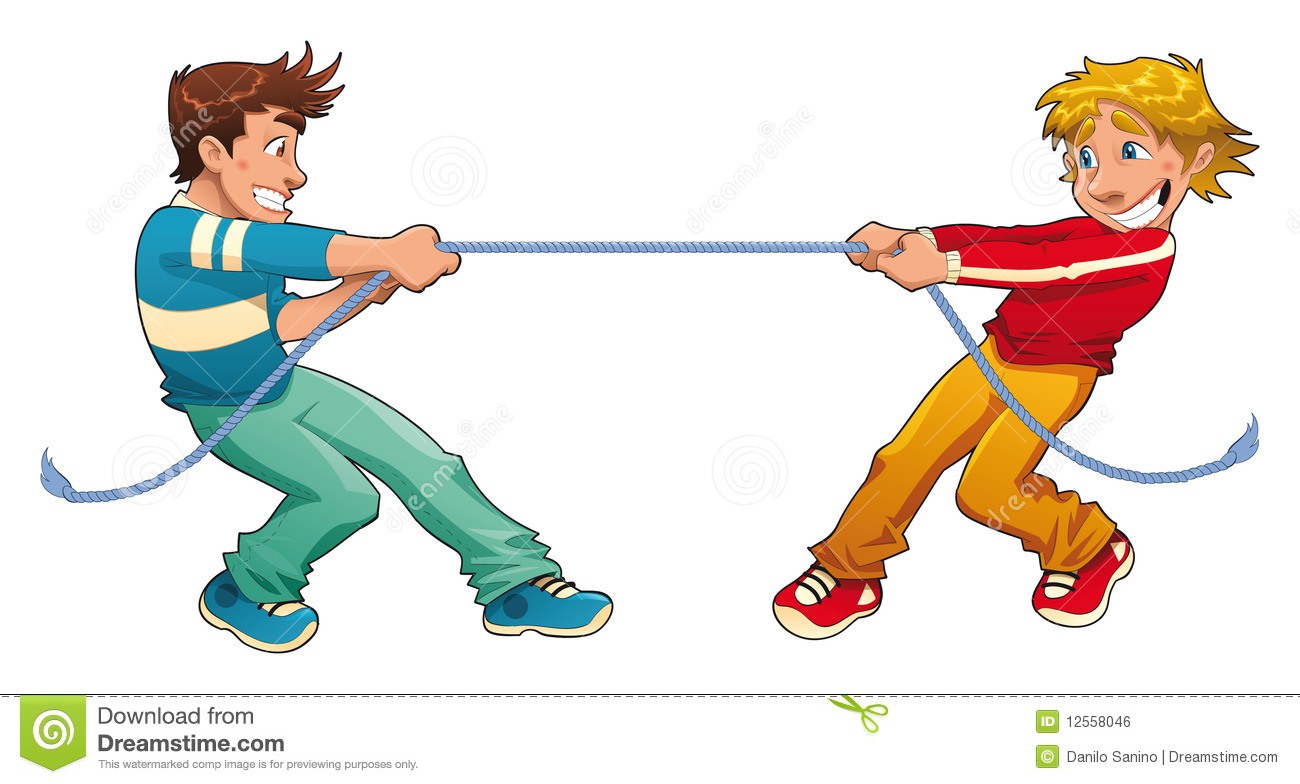
If these boys are pulling with the same amount of force.  What will happen?
a)
The boy in blue will win.
b)
They will not move at all.
c)
The boy in red will win.
d)
Both will fall down.
33.
When you tell the direction and speed of an object, you give its
a)
motion
b)
velocity
c)
acceleration
d)
mass
34.
Which of the following objects has the least acceleration?
a)
a. an empty shopping cart pushed with a hard force
b)
b. a full shopping cart pushed with a hard force
c)
c. an empty shopping cart pushed with a light force
d)
d. a full shopping cart pushed with a light force
35.
Speed is equal to 
a)
Distance/Time
b)
Time/Distance
c)
Time x Distance
d)
Acceleration
36.
Speed is different from velocity because
a)
Velocity has a direction
b)
Speed uses Distance /Time
c)
Velocity doesn't include time
d)
Velocity doesn't include distance
37.
An object at rest will remain at rest or in the same uniform motion unless acted upon by an unbalanced force: law of inertia.
a)
Newton's First Law of Motion
b)
Newton's Second Law of Motion
c)
Newton's Third Law of Motion
38.
as mass increases, the acceleration has to decrease: the law of acceleration
a)
Newton's First Law of Motion
b)
Newton's Second Law of Motion
c)
Newton's Third Law of Motion
39.
A object with a lot of mass needs more force or less force to be moved? 
a)
More
b)
Less
40.
What is the standard unit force is measured in?
a)
Newtons
b)
pounds
c)
grams
d)
meters
41.

What is the change in velocity divided by time?

a)

momentum

b)

force

c)

speed

d)

acceleration

42.

Newton's second law states that greater the mass the more _________ will be needed to move the object.

a)

power

b)

force

c)

distance

d)

speed

43.

force equals mass times .......

a)

speed

b)

acceleration

c)

velocity

d)

momentum

44.

If you multiple velocity by mass you will get the object's .....

a)

acceleration

b)

force

c)

speed

d)

momentum

45.
What is the unit to MEASURE force?
a)
Kilogram
b)
Meter
c)
Pascal
d)
Newton
46.
The equation to calculate momentum is
a)
p=mv
b)
p=1/2mv2
c)
p=mgh
d)
p=mg
47.
Which has more momentum: a car stopped at a red light or a bike moving at 15 mph?
a)
car
b)
bike
c)
they are equal
d)
cannot determine using the info provided
48.
65mi/hr South is an example of...
a)
Speed
b)
Velocity
c)
Acceleration
d)
Direction
49.
If you increase the mass on an object, its acceleration
a)
decreases
b)
stays the same
c)
also increases
d)
stops
50.
Acceleration: is the rate of change in ___________.
a)
speed
b)
distance
c)
velocity 
d)
displacement 
51.
Newton's third law states that any action will have a(n) _______ and ______ reaction
a)
Equal and similar
b)
Equal and opposite
c)
Equal and different
d)
Greater and opposite
52.
the tendency of an object to resist a change in its motion
a)
acceleration
b)
inertia
c)
mass
d)
frame of reference
53.
A force that acts on an object to slow or stop its motion
a)
speed
b)
friction
c)
gravity
d)
unbalanced forces
54.
A push, pull, friction or gravity are all examples of..
a)
velocity
b)
Newton's First Law of Motion
c)
momentum
d)
force
55.
the amount of matter an object has is its
a)
velocity
b)
mass
c)
inertia
d)
momentum
56.
An increase in speed or a change in velocity is
a)
force
b)
momentum
c)
acceleration
d)
balanced forces
57.
Equal forces acting in opposition to each other where no movement is created is a
a)
balanced force
b)
unbalanced force
c)
position time graph
d)
direction
58.
The location of an object is its
a)
velocity
b)
position
c)
motion
d)
momentum
59.
The tendency of an object that is at rest to stay at rest or if in motion to stay in motion is 
a)
momentum
b)
inertia
c)
speed
d)
velocity
60.
The force that pulls objects to earth or toward each other
a)
force
b)
gravity
c)
friction
d)
work
61.
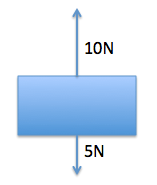
What is the net force on the block? (click on the words to view the picture)
a)
5 Newtons up
b)
5 Newtons down
c)
15 Newtons up
d)
15 Newtons down
62.
If a 10 kilogram object accelerates suddenly at 15 m/s2, how much force was applied to the object?
a)
150 Newtons
b)
15 Newtons
c)
150 kilograms
d)
100 kilograms
63.
A baseball is thrown a distance of 50 meters. What is the speed if it takes 2 seconds to cover that distance?
a)
100 m/s2
b)
25 m/s2
c)
52 m/s2
d)
100 seconds
64.
What is this graph showing?
a)
Constant Speed
b)
Acceleration (speeding up)
c)
Deceleration (slowing down)
d)
No motion
65.
The sum of all forces acting on an object.
a)
Contact Force
b)
Balanced Force
c)
Unbalanced Force
d)
Net Force
66.
Calculate the Net Force. 
a)
60N, Left 
b)
40N, Right 
c)
0N
d)
60N, Right
67.
A measure of how fast something moves over a certain distance is ________________.
a)
motion
b)
speed
c)
work
d)
force
68.

According to Newton, what kinds of objects are affected by gravity?

a)

Only objects inside the earth's atmosphere, like apples.

b)

Only objects that orbit the sun, like planets.

c)

Only objects with a lot of mass, like human beings.

d)

All objects in the universe.

69.

If the net force on an object is zero, what can you conclude?

a)

The object is not accelerating

b)

The object is not touching anything

c)

The object is not moving

d)

The object is slowing down

70.

What can you infer about an object moving at a constant velocity?

a)

No forces are acting on it

b)

Gravity is exerting the strongest force on it

c)

The forces acting on it are in balance

d)

It is stationary

71.

Which of the following statements is always true?

a)

An object at rest has no forces acting on it

b)

Unbalanced forces lead to a change in speed or direction

c)

Gravity always leads to an unbalanced force

d)

The net force on a moving object can never be zero

72.

What causes a ball rolling across a rug to slow to a stop?

a)

The rug doesn't have enough force to hold the ball.

b)

Friction resists the ball's forward motion.

c)

The rug doesn't have enough momentum to keep the ball moving.

d)

The ball isn't moving fast enough.

73.

Which of the following is NOT true about friction?

a)

It occurs any time two objects are in contact

b)

It always acts in the opposite direction as motion

c)

It always acts in the same direction as motion

d)

It prevents objects on earth from staying in motion forever

74.

If an unbalanced force acts on an object, what will happen?

a)

It will not move at all.

b)

It will accelerate in the same direction as the force.

c)

It will accelerate in the opposite direction to the force.

d)

It will accelerate at an angle of 90 degrees to the force.

75.

What is net force?

a)

A force associated with the Internet

b)

The combined forces acting on a particular object

c)

The same thing as inertia

d)

The same thing as gravity

76.

According to Newton's third law, what happens when you push against a wall?

a)

The wall pushes back at you half as hard as you push against it.

b)

The wall doesn't resist at all.

c)

The wall pushes back at you with the same amount of force.

d)

The wall pushes back at you twice as hard as you push against it.

77.
What can a force do?
a)
all of the above
b)
start a motion
c)
stop a motion
d)
change the direction of the motion
78.
A train traveling 60 mph slows down as it comes to a stop. This is an example of _____________
a)
Acceleration
b)
Distance
c)
Speed
d)
Velocity
79.
When a car suddenly stops at a red light, a pizza lying in the passengers seat flies in to the windshield. Why does the pizza fly forward?
a)
The pizza loses its backward force
b)
The pizza's inertia causes it to continue moving. 
c)
The friction of braking transfers energy to the pizza. 
80.
How much force is needed to accelerate a 5 kg marble at a rate of 2.5 m/s?
a)
12.5
b)
10
c)
2
d)
12
81.
On a distance-time graph, what shows an object going back to where it started?
a)
If the distance goes back to 0
b)
If line goes straight up
c)
If the line is at rest
82.
What is the average speed of a cheetah that ran 55 meters in 5 minutes?
a)
11 m/mi
b)
605 m/mi
c)
10 m/mi
83.
Friction is a force that acts in an ___________ direction of movement.
a)
similar
b)
opposite
c)
parallel
d)
west
84.
This is the measured value (always positive) from one point to another.
a)
Distance
b)
Displacement
c)
Acceleration
d)
Disorientation
85.
These are equal and opposite forces that do not cause a change in position or motion.
a)
Unbalanced Force
b)
Balanced Force
c)
Net Force
d)
Neutral Force
86.
This is a force which resists all motion.
a)
Air Resistance
b)
Gravity
c)
Friction
d)
Drag
87.
This is an attractive force between any two objects due to mass. More mass, more pull (in a downward direction).
a)
Friction
b)
Gravity
c)
Inertia
d)
Attraction
88.
This is a measure of resistance to motion, by an object.
a)
Air Resistance
b)
Centrifugal Force
c)
Friction
d)
Inertia
89.

This is the sum of all the forces applied to an object.

a)

Net Force

b)

Balanced Force

c)

Unbalanced Force

d)

Neutral Force

90.
This is the SI (metric) unit of force.
a)
km/h
b)
d/t
c)
N
d)
F
91.
A law of motion that states that an object at rest stays at rest and one in motion stays in motion.
a)
Newton's First Law
b)
Newton's Second Law
c)
Newton's Third Law
d)
Newton's Fourth Law
92.
This is a number, as of years, days, minutes, or seconds representing such an interval. The SI standard unit of this is the second.
a)
Time
b)
Period
c)
Revolution
d)
Value
93.

If two forces are acting against each other, this will cause acceleration to happen.

a)

Balanced Force

b)

Unbalanced Force

c)

Net Force

d)

Resulting Force

94.

What unit would be used to measure speed or velocity?

a)

m/s

b)

m/s2

c)

m

d)

s

95.

What unit would be used to measure acceleration?

a)

m/s

b)

m/s2

c)

m

d)

s

96.

What unit would be used to measure distance or displacement?

a)

m

b)

s

c)

m/s

d)

N

97.

If an object is in motion and you apply a force to the object in the same direction, it will...

a)

speed up

b)

slow down

c)

change direction

d)

None of the above

98.

To reduce the amount of inertia an object has, you should

a)

reduce its mass

b)

change its shape

c)

increase the force applied

d)

give a motivational speech

99.

A 260lb fullback has a momentum of 1440 kgm/s and runs into a 130lb safety with a momentum of -600 kgm/s. If he carries the safety into the endzone, how much momentum do they have together?

a)

840 kgm/s

b)

-840 kgm/s

c)

2040 kgm/s

d)

-2040 kgm/s

100.

Car A has a momentum of 500 kgm/s and runs into Car B which is parked. If Car B rolls forward with a momentum of 100 kgm/s, how much momentum does Car A have?

a)

It still has 500 kgm/s

b)

It only has 400 kgm/s

c)

It has no momentum because it stops

d)

It is impossible to tell without knowing its mass and velocity.

101.

Which of the following has the greatest momentum?

a)

a scurrying cockroach

b)

a parked semi-truck

c)

more information is needed

102.

Which of the following is NOT a unit of momentum?

a)

kg*m/s

b)

N*s

c)

kg*mph

d)

kg*m/s2

103.
If a net force is acting on an object, 
a)
its velocity must be constant
b)
its velocity must be changing
c)
its mass must be changing
d)
its acceleration = 0 
104.
Which has more momentum: a car stopped at a red light or a bike moving at 15 mph?
a)
car
b)
bike
c)
they are equal
d)
cannot determine using the info provided
105.
When two objects collide, the Pbefore is ____________ the Pafter.
a)
more than 
b)
less than 
c)
equal to
d)
unrelated to
106.
When the speed of an object is doubled, its momentum
a)
remains unchanged in accord with the conservation of momentum.
b)
doubles
c)
quadruples
d)
decreases
107.

If an object has a mass of 20 kg and a velocity of 4 m/s, what is the momentum of the object?

a)

80 kgm/s

b)

4 kgm/s

c)

5 kgm/s

d)

.2 kgm/s

108.

Why is momentum considered to be a vector quantity?

a)

Momentum has to indicate both magnitude and direction.

b)

Momentum has to have a positive value.

c)

Momentum has to be calculated using speed.

d)

Momentum has a quantity but not a unit.

109.

Which of the following is the unit for momentum?

a)

kg·m/s

b)

kg·m

c)

kg·m/s2

d)

Momentum has no unit.

110.

Calculate the momentum of a 55-kg running back moving westward at 10 m/s.

a)

550 kg·m/s, west

b)

550 kg·m/s

c)

550 m/s, west

d)

550 kg, west

111.

Calculate the momentum of a 1200-kg truck moving northward at 30 m/s.

a)

36000 kg·m/s, north

b)

400 kg·m/s, north

c)

36000 kg·m/s

d)

400 kg·m/s

112.

A baseball bat hits a baseball with a force of 100 Newtons. What is the force and its direction exerted by the ball on the bat?

a)

100 Newtons, same direction

b)

100 Newtons, opposite direction

c)

200 Newtons, opposite direction

d)

200 Newtons, same direction

113.

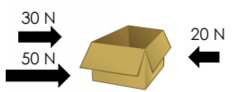
The illustration shows the forces in Newtons (N) acting on three different blocks. Which blocks will change their velocity under these conditions?

a)

Blocks 1 and 2

b)

Blocks 2 and 3

c)

Blocks 1, 2, and 3

d)

Blocks 1 and 3

114.

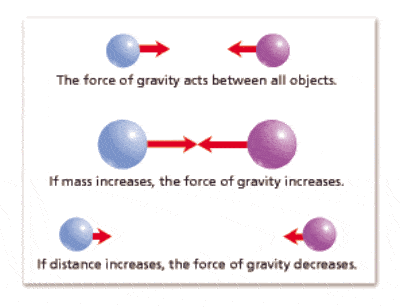
Which of the following does not affect the gravitational force between the earth and the sun?

a)

The mass of the earth

b)

The mass of the sun

c)

The distance between the earth and the sun

d)

The net electrical charge of the earth

115.

What is a force?

a)

something that always causes motion

b)

a type of acceleration

c)

a current

d)

a push or a pull

116.

Newton’s 3rd Law of motion states that any action will have a(n) ________and ______reaction

a)

Equal and similar

b)

Equal and different

c)

Equal and opposite

d)

Greater and opposite

117.

If the person is pushing backwards with the paddle, why do they move forward?

a)

The person will actually move backwards, they need to paddle the other way

b)

The water pushes back with an equal and opposite force

c)

The person is pushing harder than the water

d)

The water pushes back with a greater force than the person

118.

How is this an example of Newton's 3rd Law?

a)

Only his head is pushing on the ball

b)

Only the ball is pushing on his head

c)

Both the ball and the head are exerting equal force on each other

119.

When a small car pushes a big truck, the truck applies an equal and opposite force on the car.

a)

False

b)

True

120.

A book rests on a table. The force of gravity pulls down on the book with a force of 20N. What prevents the book from falling down into the ground?

a)

The table and the book are pushing back with an acceleration of 9.8m/s2.

b)

The table pushes back up on the book with a force greater than 20N

c)

The inertia of the book is equal to the inertia of gravity

d)

The table pushes back up on the book with an equal and opposite force of 20N

121.
A bus hits a bug and the bug splatters on the windshield, which force is greater?
a)
The Bus
b)
The Bug
c)
They're the same
d)
Gravity acting on the bus
122.
What is the best definition for mass?
a)
how much space an object takes up
b)
how much matter an object contains
123.
The mass of a piece of stone on the Earth's surface is smaller than its mass on the moon's surface.
a)
Right
b)
Wrong
124.

Weight is _________.

a)

the quantity of matter in an object.

b)

the measure of an object's inertia.

c)

the force exerted by gravity on an object's mass.

d)

equal to the mass of an object.

125.

Weight is constant.

a)

True

b)

False

126.
The force of gravity acting on an object is the object's ______.
a)
mass
b)
matter
c)
weight 
d)
friction 
127.
The amount of matter in an object is 
a)
pressure
b)
weight
c)
mass
d)
force
128.
The scientific unit of weight is
a)
Kg
b)
N
c)
pounds
d)
Kgm/s
129.
The scientific unit for mass is
a)
Kg
b)
N
c)
pounds
d)
ounces
130.

You have a ball with a weight of 76N. What is the mass of the ball?

a)

76N

b)

76kg

c)

7.6kg

d)

7.6N

131.

What would be the weight of a 10 kg object on earth?

a)

1 N

b)

10 N

c)

0.1 N

d)

100 N

132.

What is Newton's First Law

a)

F=ma

b)

Every action has an equal and opposite reaction

c)

Friction

d)

An object at rest stays at rest, an object in motion stays in motion.

133.

True or False. Acceleration of an object is directly proportional to the net force acting on it?

a)

True

b)

False

134.

An evil ewok threw a rock with a force of 24.6N and an acceleration of 6m/s2 at an innocent stormtrooper. What was the rocks mass?

a)

4Kg

b)

41kg

c)

4.1kg

d)

46kg

135.

Your car has a mass of 2500 kg and a force of 5000 N. How fast will it accelerate?

a)

20 m/s2

b)

2 m/s2

c)

0.5 m/s2

d)

120 N

136.

What is the net force?

a)

40 N left

b)

400 N right

c)

0 N Balanced

d)

40 N right

137.

What Unit do we Measure Force in?

a)

Newtons

b)

Joules

c)

Kilogram

d)

Work

138.

Jenny applies a 60 N force to a 20 Kg cart, what is the acceleration of the cart if friction can be neglected?

a)

1200 m/s/s

b)

0.33 m/s/s

c)

20 m/s/s

d)

3 m/s/s

139.

The mass of a wagon is 40 kg. The wagon accelerates at 8 m/s2 . What is the force?

a)

38.25 Kg

b)

320N

c)

5N

d)

3.825Kg

140.

You push on a tree with 20 N of force. If the tree doesn't move, the tree is pushing back on you with _____of force.

a)

20N

b)

10N

c)

40N

d)

70N

141.

What is Newton's 2nd Law?

a)

F=ma

b)

Every action has an equal and opposite reaction

c)

An object at rest stays at rest, an object in motion stays in motion.

d)

Friction

142.
Any object with mass has gravity.
a)
True
b)
Sometimes
c)
False
d)
Never
143.
As distance between two objects increase the pull of gravity 
a)
Increases
b)
Decreases
c)
Stays the same
144.
As mass increases, what happens to gravitational force?
a)
increases
b)
decreases
c)
stays the same
d)
i don't know
145.
As mass increases, what happens to gravitational force?
a)
increases
b)
decreases
c)
stays the same
d)
i don't know
146.
Two factors effecting the magnitude of the force of gravity between 2 objects are...
a)
mass and distance 
b)
mass and matter
c)
distance and weight 
d)
weight and mass
147.
If Earth's mass was cut in half, what would happen to your mass?
a)
increase because gravitational force increases
b)
decrease because gravitational force decreases
c)
decrease because gravitational force increases
d)
nothing, mass is not affected by gravitational force
148.
The force of gravity acting on an object is the object's ______.
a)
mass
b)
matter
c)
weight 
d)
friction 
149.
Which of the following never changes no matter where in the universe?
a)
weight
b)
force
c)
mass
d)
pounds
150.
What is the SI unit used to measure force? 
a)
pounds 
b)
grams 
c)
newtons 
d)
friction
151.
The amount of matter in an object is 
a)
pressure
b)
weight
c)
mass
d)
force
152.

If all objects with mass have gravity, which statement is true about the attraction between you and the earth?

a)

The force of the earth pulling on you is stronger

b)

The force of you pulling on the earth is stronger.

c)

The force of your pull on the earth is the same as the earth pulling on you.

d)

The force of gravity only comes from the earth, not you.