
Font size
 Worksheets
Populations & Human Impact
Total questions: 35
Worksheet time: 24mins
What type of factor has an increasing impact as the population size increases?
density-independent
density-dependent
cohort effect
survivorship factor
Which of the following are density dependent factors?
competition for resources
predation
disease
natural disasters
Which of the following are examples of a density independent factors?
forest fire
seasonal cycles
storms
disease
Factors like predation can have a positive benefit to the population of prey organisms because predators tend to keep prey populations below their ___________.
carrying capacity
sustainibility number
exponential growth point
competition level
As a population of a species increases within a territory, which of the following most likely also increases?
Immigration
Food supply
Carrying capacity
Competition
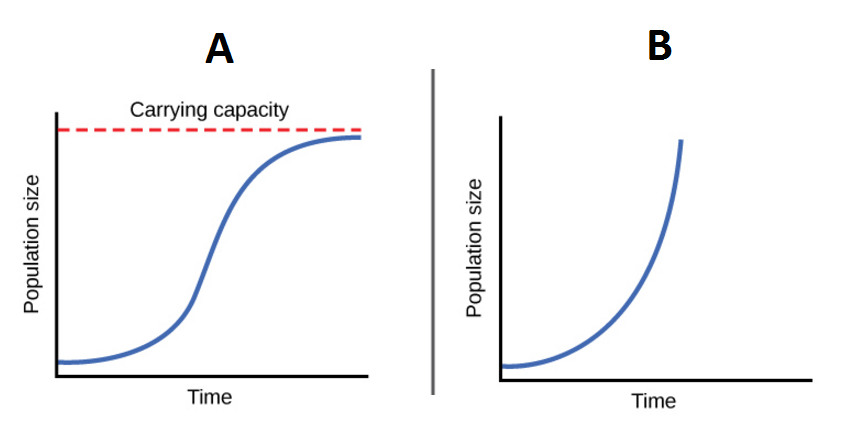
What type of growth model is shown in image A?
Exponential
Logistic
What type of growth model is shown in image B?
Exponential
Logistic
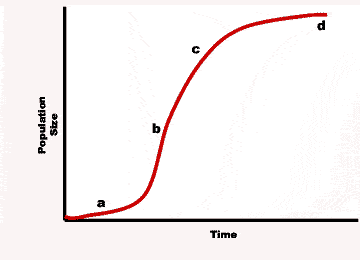
What point on the graph represents carrying capacity?
a
b
c
d
At carrying capacity, a population __________.
increases rapidly
increases slowly
decreases slowly
remains relatively constant
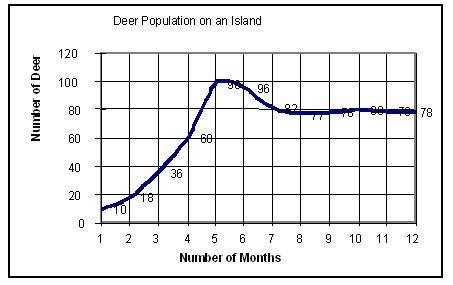
Which choice most closely approximates the deer population's carrying capacity based on the graph?
100
80
60
10
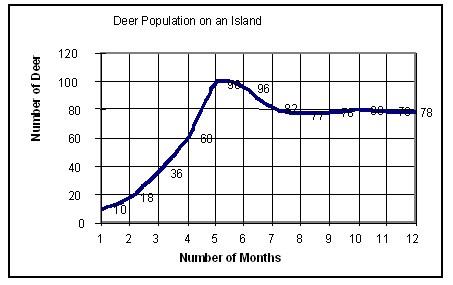
Which mathematical model most closely describes the population growth curve shown in deer population graph from the previous question?
logistic growth
exponential growth
What is the the closest approximation of the size of the human population today?
850 million
8 billion
20.8 billion
1.7 trillion

Which population growth model most closely describes the human population in the modern age?
logistic growth
exponential growth
upward growth
tumor growth
Which of the following issues is the cause of the other environmental impacts?
pollution
human population growth
climate change
habitat destruction
1. What are renewable resources?
. Resources that are used faster than they form
resources that can replenish themselves over time
resources that formed over millions of years
resources that exist only in rural areas
1. Which level of the food chain is most affected by biomagnifications?
Producers
primary consumers
secondary consumers
tertiary consumers
1. Why is firewood considered to be a renewable resource?
It can be replenished over time.
It is used up faster than it can form.
It is made from coal.
It can be made synthetically.
1. Why has Earth's human carrying capacity increased greatly?
Other organisms have been displaced by agriculture, so there is more space for humans.
Humans have modified their environment due to technological advances.
Humans can live closer together than other animals
Humans are now eating fewer plants than they used to.
1. Which of the following is not a renewable resource?
coal
wind energy
solar energy
water
Which member of the following food chain is most likely to be affected by mercury, a pollutant? Algae - zooplankton - salmon – bear
algae
salmon
zooplankton
bear
Which term describes the practice of managing resources so that current needs are met without harming future generations?
species introduction
sustainable development
habitat fragmentation
biomagnification
Which of the following is NOT a threat to biodiversity?
Pollution
Deforestation
Invasive Species
Ecological Succession
When human-made chemicals and garbage find their way into nature and harm the air, soil, and water it is called
pollution
habitat destruction
overexploitation
climate change
The largest threat to biodiversity is
bacteria
fungi
humans
plants



