
 Worksheets
Unit 1 Review: Quadratics
Total questions: 110
Worksheet time: 3hrs 42mins
The imaginary number i is equal to...
i
1
-i
-1
The imaginary number i2 is equal to...
i
1
-i
-1
The imaginary number i3 is equal to...
i
1
-i
-1
The imaginary number i4 is equal to...
i
1
-i
-1
The discriminant is which choice?
b2−4ac
a2+b2=c2
y=mx+b
y=ax2+bx2+c
Factor completely: 8x2+12x
4x(2x+3)
4x(2x−3)
4(2x+3)
4(2x2+3x)
Factor completely: x2+5x−6
(x−1)(x−6)
(x+1)(x+6)
(x+6)(x−1)
(x−1)(x+6)
Which term is associated with the AC Method?
factor by grouping
the quadratic formula
the pythagorean theorem
the squeeze theorem
The factors (x+2) and (x−2) are _______?
conjugate pairs
circles
squares
invisible
The roots of the given equation, (x+2)(2x−9)=0 , are...?
x=−2, x=29
x=−2, x=92
x=2, x=29
x=2, x=92
State the maximum number of unique zeros any given quadratic equation can have.
zero
one
two
three
The form, y=ax2+bx+c , is the ______ form of a quadratic equation.
standard
pythagorean theorem
linear
slope
TRUE OR FALSE: The signs of the coefficients in a quadratic equation / expression helps us determine the signs of its factors.
TRUE
FALSE
The expression x2−10x+24 is equivalent to...?
(x+12)(x−2)
(x−12)(x+2)
(x+6)(x+4)
(x−6)(x−4)
Daniel correctly factored the expression m2−12m−64 . Which expression did he write?
(m−8)(m−8)
(m−8)(m+8)
(m−16)(m+4)
(m+16)(m−4)
When the discriminant is greater than 0, it has ____ x-intercepts.
0
1
2
3
When the discriminant is equal to 0, it has ____ x-intercepts.
0
1
2
3
When the discriminant is less than 0, it has ____ x-intercepts.
0
1
2
3
If b2−4ac<0 , then its roots are...?
imaginary
real, rational, equal
real, rational, unequal
real, irrational, unequal
If b2−4ac=0 , then its roots are...?
imaginary
real, rational, equal
real, rational, unequal
real, irrational, unequal
If b2−4ac>0 and is a nonperfect square, then its roots are...?
imaginary
real, rational, equal
real, rational, unequal
real, irrational, unequal
If b2−4ac>0 and is a perfect square, then its roots are...?
imaginary
real, rational, equal
real, rational, unequal
real, irrational, unequal
The roots of the equation 9x2+3x−4=0 are...?
imaginary
real, rational, and equal
real, rational, and unequal
real, irrational, and unequal
The roots of the equation x2−10x+25=0 are...?
imaginary
real, rational, and equal
real, rational, and unequal
real, irrational, and unequal
Which graph represents a quadratic function with a negative discriminant?


Which if the following is an equation for a quadratic function that opens downward (concave down) and has the vertex of (-4, 7)?
f(x)=−(x−4)2+7
f(x)=(x+4)2+7
f(x)=−(x+4)2+7
f(x)=(x−4)2+7
How does the graph of g(x)=3x2 compare to the quadratic parent function f(x)=x2 ?
The graph of g(x) is wider than the graph of f(x).
The graph of g(x) is narrower than the graph of f(x).
The graph of g(x) is translated up 3 units above f(x).
The graph of g(x) is translated down 3 units below f(x).
How would you describe the translation from f(x) = x2 to g(x) = (x - 3)2 ?
Horizontal translation: three units to the left
Horizontal translation: three units to the right
Vertical translation: three units up
Vertical translation: three units down
Which describes the transformation of the graph of f(x) = x2 to the graph of g(x) = -4x2
Reflected, narrower
reflected, wider
shifted down 4 units
shifted up 4 units

f(x) = x2
then the red must be...


Determine the values of a, b, and c for the quadratic equation:
4x2 – 8x = 3
a = 4, b = -8, c = 3
a = 4, b =-8, c =-3
a = 4, b = 8, c = 3
a = 4, b = 8, c = -3
What does the discriminant tell us?
The maximum or minimum
The y-intercept
The number and type of solutions
The axis of symmetry
What are the solutions to x2 - 3x = 5?


For the function above, is the discriminant positive, negative, or zero?
Simplify the given expression: (2x−3)(x+4)
2x2+8x−3x−12
2x2−12
2x2+5x−12
2x2−5x−12
Simplify the given expression: (y−6)(y−4)
y2−10y+24
y2−4y−6y+24
y2+24
y2−24
Find the GCF of 3r and 18
(a)
The GCF of 7r2 and 49r is.....
7
7r
49r
49
Identify the a, b, and c values for this quadratic:
6x+3x2−7a= 3 b=6 c=7
a=6 b=3 c=7
a=3 b=6 c=-7
a=6 b=3 c=-7
Simplify the given expression: (2+ 5i) + (3 - 8i)
1 - 3i
1 - 13i
5 - 3i
5 + 13i
Simplify the given expression: ( 5 + i ) - ( 2i - 3 )
3i - 2
8 - i
8 + i
3i + 2
Simplify the given expression: ( 3 + 2i ) - ( 7 + 7i )
-4 + 5i
4 + 5i
4 - 5i
-4 - 5i
Write the equation in vertex form. y = x2+ 2x + 5
y=(x+1)2 − 4
y=(x+1)2 +4
y=(x−4)2−1
y=(x+4)2+1
What is the vertex of the given equation? y=(x+1)2+4
(1,4)
(-1,-4)
(-1,4)
(1,-4)
Does this equation have a maximum or a minimum?
Max is -1
Min is -1
Max is 4
Min is 4
Does this equation have a maximum or a minimum? y=(x−5)2
Max is -5
Min is -5
Max is 0
Min is 0
Solve the following quadratic linear system
(1,5) and (2,6)
(-1,5) and (2,6)
(-1,5) and (-2,6)
(-1,5) and (2,6)
50x3y Simplify
52xy
5x2xy
5ix2xy
5x22xy
−48x10y5 Simplify
4ix10y23y
16ix5y43y
4ix5y23y
16x5y23y
Which of the following symbols read as greater than?
>
<
≥
≤
Which of the following symbolizes less than?
>
<
≤
≥

Which inequality is shown?
y < -x2
y ≤ -x2
y > -x2
y ≥ -x2
Solve the given inequality: 2x2 + 5x ≥ 12
−4≤x≤1.5
x<−4 or x>1.5
x≤−4 or x≥1.5
no solution

Which inequality is represented by the graph?
y > (x - 3)² - 3
y ≥ (x + 3)² - 3
y > (x + 3)² - 3
y ≥ (x - 3)² - 3


Which inequality is represented by the graph?
y > -(x - 4)² + 1
y > -(x - 1)² + 4
y < (x - 4)² + 1
y > (x + 4)² + 1

Solutions are in the ___________ area.
non-shaded
shaded
vertex
axis of symmetry

Simplify the given expression.
10
-10
10i
-10i

Simplify the given expression.
5i
-5i
5+i
-5
What is the complex conjugate of 4 - 3i?
4−3i1
4+3i1
-4 + 3i
4 + 3i
Simplify the given expression:
(7 + 2i)(9 - 6i)
75-24i
63 - 24i - 12i2
51 - 24i
58 + 60i
Simplify the given expression: −25
-5i
5
5i
-5
Factor completely: x2−1
(x+1)(x +1)
(x - 1)(x - 1)
prime
(x + 1)(x - 1)
Factor completely: x2 - 25
( x + 5 ) ( x - 5 )
( x - 5 ) ( x - 5 )
( x + 5 ) ( x + 5 )
Prime
Factor completely: 4x2 - 25
(2x + 5) (2x - 5)
(2x - 5)2
(2x + 5)2
2x + 5(2x - 5)
Factor completely: x2 - 16
(x + 4) (x - 4)
(x + 8) (x - 2)
(x + 4)2
x + 4(x - 4)

Determine the number of solutions to the given linear-quadratic system.
0 solutions
1 solution
2 solutions
3 solutions

What are the solutions to the graphed system?
(0,-2) and (3,1)
(-2,0) and (2,0)
(0,-2) and (3,1)
(2,2) and (1,0)
Solve the system of linear and quadratic equations:
y = 5
y = 2x2 - 16x + 29
(6, 5) and (2, 5)
(2, 6)
(6, 2)
(5, 6) and (5, 2)

What is the solution to the linear-quadratic system graphed in the picture.
(0, 0)
(3, 0)
(2, -3)
(-3, 2)


You must be at least 18 years old to vote
You must be at least 48 inches tall to ride the bumper cars.
5 ≥ x

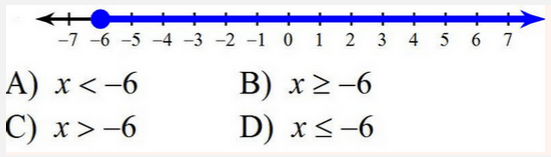
5 ≥ x


r ≥ -6?

REMEMBER MAXIMUM IS THE HIGHEST AND MINIMUM IS THE LOWEST.
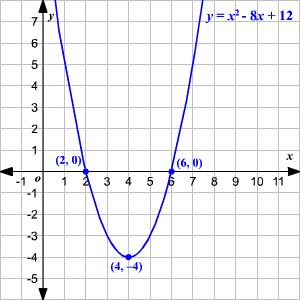
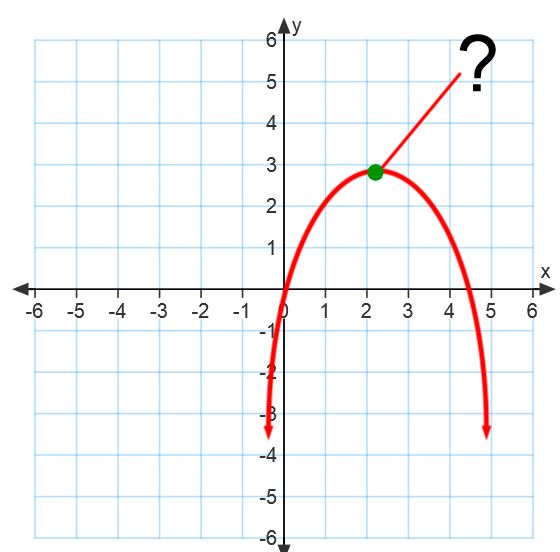


What is the green dashed line called?
roots or x-intercepts
parabola
axis of symmetry
y intercept
f(x) = x2 to the graph of g(x) = (x + 4)2?
h = -5(t - 2)2.
Maria throws a ball with a path of
h = -5(t - 2)2 + 10.
Which description is reasonable for the difference in the two equations?
What steps transform the graph y = x2 to y = 2(x+2)2 - 5?
Compress by 2, shifted 2 units left and 5 down
Stretch by 5, shifted 5 units left and 2 down
Stretch by 2, shifted 2 units left and 5 down
Compress by 5, shifted 2 units left and 2 down
What steps transform the graph y = x2 to y = x2 + 8
shifted up 8 units
shifted down 8 units
shifted left 8 units
shifted right 8 units

