Wayground logo

Free Printable Worksheets

Font size

S
M
L
XL
Worksheets

Mods 9-11

Total questions: 55

Worksheet time: 1hrs 29mins

Name
Class
Date
1.
Describes the fact that a neuron fires at the same intensity despite the intensity of the stimulus.
a)
Threshold
b)
Repolarization
c)
All or None Principle
d)
Action Potential
2.
When a neuron is not engaged in an impulse.
a)
Resting potential
b)
Action potential
c)
Neural potential
d)
Synaptic potential
3.
Excess neurotransmitters in the synapse that goes back into the presynaptic neuron.
a)
Resting potential
b)
Reuptake
c)
Retroactivity
d)
Repolarization
4.
Inhibits or blocks the effects of neurotransmitters.
a)
Aganost
b)
Antagonist
5.
What number(s) on the graph represents the Resting Potential?
a)
1 and 2
b)
1 and 5
c)
2 and 3
d)
3 and 4
6.
Multiple sclerosis is an autoimmune disease in which the body's own immune system destroys the _____________ of the nerve axons. 
a)
Myelin
b)
Dendrites
c)
Axon Terminal
d)
Nodes of Ranvier
7.
The brain's supporting cells are called: 
a)
glial cells
b)
mitochondria
c)
neurons
d)
nuclei
8.
______ send signals away from neurons whereas ______ receive signals from other neurons.  
a)
Axons; Dendrites
b)
Synapses; dendrites
c)
Dendrites; axons
d)
Axons; synapses
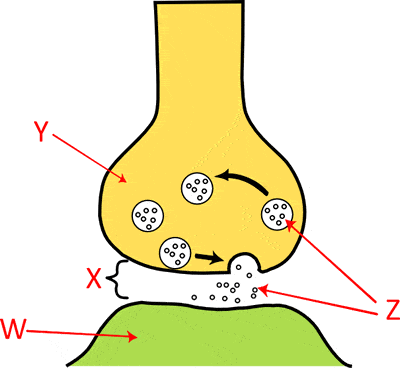
9.
W
a)
Axon Terminal Button
b)
Neurotransmitters
c)
Dendrite
d)
Synapse
10.
X
a)
Axon Terminal Button
b)
Neurotransmitters
c)
Dendrite
d)
Synapse
11.
Y
a)
Axon 
b)
Neurotransmitters
c)
Dendrite
d)
Synapse
12.
Which neurotransmitter is released in response to stress and trauma?
a)
Acetylcholine
b)
Endorphins
c)
Serotonin
d)
GABA
13.
Which neurotransmitter is involved in the "Fight or Flight" response?
a)
Acetylcholine
b)
Endorphins
c)
Norepinephrine
d)
Serotonin
14.
Which neurotransmitter inhibits brain activity?
a)
Acetylcholine
b)
GABA
c)
Endorphins
d)
Dopamine
15.
Serotonin is a neurotransmitter that helps regulate:
a)
learning and memory
b)
pain and pleasure
c)
muscle movements
d)
sleep, moods/emotions
16.
This neurotransmitter is most often associated with pleasure/reward sensations:
a)
Acetylcholine
b)
GABA
c)
Dopamine
d)
Serotonin
17.
All of the following mimic the neurotransmitter GABA except
a)
Alcohol
b)
Valium
c)
Xanax
d)
Heroin
18.
The release of this neurotransmitter is 100x more potent than any opiate (painkilling drug):
a)
Norepinephrine
b)
Serotonin
c)
GABA
d)
Endorphin
19.
Prozac works to combat depression by keeping this neurotransmitter in the synapse longer:
a)
Serotonin
b)
Acetylcholine
c)
GABA
d)
Endorphins
20.
Too much dopamine is linked with
a)
Alzheimers
b)
Schizophrenia
c)
Parkinsons
d)
Depression
21.
Low levels of serotonin is linked to
a)
Depression
b)
Alzheimer's
c)
Parkinson's
d)
Schizophrenia
22.
Synapses that are ____________ cause a neuron to fire whereas ____________ synapses reduce the likelihood that a neuron will fire.
a)
excitatory; inhibitory
b)
synaptic; terminal
c)
postsynaptic; presynaptic
d)
dendritic; axon
23.
What is the insulating membrane that surrounds parts of the axon that helps the impulses travel faster called?
a)
Axon
b)
Dendrites
c)
Node of Ranvier
d)
Myelin Sheath
24.

Endocrine glands secrete _

a)

Hormones

b)

Neurotransmitters

c)

A wide range of chemical substances

25.

What is the main function of the endocrine system?

a)

It creates chemicals, or hormones, that are sent around the body to maintain homeostasis.

b)

It creates electrical messages that are sent around the body to maintain homeostasis.

c)

It maintains the correct level of oxygen in the body to maintain homeostasis.

d)

It releases waste from the body to maintain homeostasis.

26.

The "master gland" is known as the __________________.

a)

thyroid gland.

b)

adrenal gland.

c)

pancreas.

d)

pituitary gland.

27.

After suffering an accidental brain injury, Kira has difficulty walking in a smooth and coordinated manner. It is most probable that she has suffered damage to her:

a)

A. amygdala

b)

B. angular gyrus

c)

C. cerebellum

d)

D. corpus callosum

28.
Controls behaviors (hunger, thirst, sleep, body temperature) through the release of hormones.
a)
hypothalamus
b)
thalamus
c)
adrenal glands
d)
pineal gland
29.
Controls heartbeat and breathing
a)
Pons
b)
Medulla
c)
Cerebellum
d)
Thalamus
30.
Known as the "Little Brain" and is in charge of balance and coordinating movements
a)
Thalamus
b)
Reticular Formation
c)
Hypothalamus
d)
Cerebellum
31.
This brain part, which was named for because it looks like a sea horse, is part of the limbic system which helps with memories.
a)
Amygdala
b)
Hippocampus
c)
Hypothalamus
d)
Pituitary Gland
32.

This scan provides a visual of brain activity that detects where radioactive form of glucose goes while the brain performs a given task.

a)

MRI

b)

fMRI

c)

PET

d)

EEG

33.

These are computer-aided x-rays of the brain that show a great deal of brain structure.

a)

CT scan

b)

MRI scan

c)

PET scan

d)

EEG

34.

This scan is best suited for looking at soft tissues such as ligaments and tendons, the brain, and many of the internal organs.

a)

MRI

b)

PET

c)

X-Ray

d)

EEG

35.

This is a technique for measuring and mapping brain activity that is noninvasive and safe.

a)

EEG

b)

X-Ray

c)

fMRI

d)

CAT scan

36.

The patient will be given a radioactive substance and asked to complete a task to see which part of the brain is being utilized.

a)

MRI

b)

PET

c)

CT Scan

d)

EEG

37.

the largest region of the brain, it is divided into a left and right hemisphere

a)

cerebrum

b)

frontal lobe

c)

parietal lobe

d)

cerebellum

38.

Helps you to store long term memories and controls movement in your body

a)

Frontal Lobes

b)

Parietal Lobes

c)

Temporal Lobes

d)

Occipital Lobes

39.
forming new neurons
a)
plasticity 
b)
neurogenesis
40.
Adults do not make good patients for brain surgery because    
a)
Adult brains are not able to repair themselves as quickly
b)
Children's brains are not able to repair themselves as quickly
c)
Adult brains repair themselves more quickly than children's brains.
d)
All of the above.
41.
Which lobe of the cerebral cortex governs perceiving objects in space, understanding symbols and numbers, and integrating sensory information?
a)
Temporal Lobe
b)
Frontal Lobe
c)
Occipital Lobe
d)
Parietal Lobe
42.
A neurosurgeon electrically stimulated parts of a patient's primary somatosensory cortex.  If the patient was conscious during the procedure, which of the following was probably experienced?
a)
'hearing' faint sounds
b)
'seeing' random visual patterns
c)
a sense of having skin touched
d)
movement of one or more of the larger body parts 
43.
The corpus callosum
a)
Manages our understanding of speech and language
b)
cannot process messages sent from the left hand
c)
is a deep fissure in the cerebral cortex
d)
is a thick band of nerve fibres linking the two hemispheres of the brain
44.

This lobe helps receive and process information from the eyes.

a)

Frontal lobe

b)

Parietal lobe

c)

Occipital Lobe

d)

Temporal Lobe

45.
Split brain operations are done to
a)
shrink tumors
b)
increase memory
c)
help speech disorders
d)
help stop seizures
46.
You are aware that a dog is viciously  barking at you, but you are not aware of the type of dog.  Later, you are able to describe the type and color of the dog.  This ability to process information without conscious awareness best exemplifies which of the following?
a)
Dual processing
b)
Split Brain
c)
Blindsight
d)
Consciousness
47.
Hemisphere that is associated with Verbal and Mathematical abilities
a)
Left Hemisphere
b)
Right Hemisphere
48.
Brain hemisphere associated with spatial abilities and recognizing others faces
a)
Left Hemisphere
b)
Right Hemisphere
49.
If a blind person uses one finger to read Braille, the brain area dedicated to that finger expands as the sense of touch invades the visual cortex. This is an example of
a)
integrated association areas.
b)
brain plasticity.
c)
hemispheric specialization.
d)
neural transformation.
50.

Wernicke's area is said to be responsible for speech _______________, whereas Broca's area is involved in speech _______________.

a)

production; comprehension

b)

syntax; production

c)

comprehension; syntax

d)

comprehension; production

51.
Which of the following is the most accurate description of the association areas of the cortex?
a)
They are located in the left hemishere and associate input from the right hemisphere
b)
They integrate information from different parts of the brain
c)
They include the motor and sensory areas in each lobe
d)
They are crucial for providing basic survival needs 
52.

Your brain has the ability to change in response to

experience. This ability is known as

a)

flexibility

b)

plasticity

c)

responsiveness

d)

reactivity

53.
Adolescents show the following
a)
Poor planning/ initiation/lack of insight into consequences
b)
Risk taking behaviors/ Susceptible to peer pressure
c)
Difficulty monitoring and inhibiting emotions
d)
All of the above
54.
The reason that adolescents may have difficulty with executive functions, planning, inhibition, risk taking, emotionality, and peer relationships is due to 
a)
Underdeveloped Pre Frontal cortex
b)
Underdeveloped Frontal lobe
c)
Environment and Peer pressure
d)
Parental demands and expectations
55.

When people consume large amounts of alcohol, they are often unable to recall what they did and said while they were drinking. This occurs because alcohol interferes with the brain’s ability to form new memories in the

a)

reticular formation

b)

occipital lobe

c)

thalamus

d)

hippocampus