

wayground logo

Free Printable Worksheets

NEW

Font size

S
M
L
XL
Worksheets

Solar System review

Total questions: 51

Worksheet time: 1hrs 3mins
Name
Class
Date
1.
Earth and the other planets closest to the Sun are made mostly of _______
a)
gas
b)
metal
c)
water
d)
rock
2.
The moon is a natural  ______ of Earth.
a)
comet
b)
axis
c)
satellite
d)
space probe
3.
Earth's ________ on its axis causes day and night.
a)
rotation
b)
revolution
c)
phase
d)
comet
4.
One kind of  _______ is the crescent Moon.  
a)
axis
b)
asteroid
c)
phase
d)
space probe
5.
One full orbit of an object around another object is called a ________.
a)
axis
b)
rotation
c)
revolution
d)
satellite
6.
The __________ has planets, moons, comets, and asteroids.
a)
solar system
b)
earth
c)
rotation
d)
United States
7.
Where is the asteroid belt found?
a)
between earth and mars
b)
Between Uranus and Neptune
c)
Between Mercury and Venus
d)
Between Mars and Jupiter
8.
Why does Earth have different seasons? 
a)
because of the distance between Earth and the sun 
b)
because of the speed of Earth as it rotates on its axis 
c)
because of the amount of light blocked by the moon on its axis 
d)
because of the tilt of Earth on its axis as it moves around the sun 
9.
Which factor makes Earth different from all the other planets in the solar system in its ability to support life? 
a)
The Earth is exposed to rays from the sun. 
b)
The Earth has only one moon that orbits around it. 
c)
The Earth rotates in an elliptical orbit around the sun. 
d)
The Earth has a breathable atmosphere. 
10.
Which best explains why the moon has phases?
a)
The moon’s position changes in relation to the sun and Earth. 
b)
The sun’s position changes in relation to the moon and Earth. 
c)
The Earth casts a shadow on the moon as it rotates. 
d)
The moon rotates along its axis
11.
Day and night is caused by the _____________ of earth on its axis.
a)
revolution
b)
orbit
c)
rotation
12.
As the Earth travels around the sun, this tilt causes different areas of the Earth’s surface to get different amounts of daylight at different times of the year. The angle of the Sun’s rays to the surface also causes areas to have more or less of the Sun’s energy. This causes the ________.
a)
months
b)
day and night
c)
seasons
d)
years
13.
Which outer planets have rings?
a)
Just Saturn
b)
Saturn and Jupiter
c)
Jupiter, Neptune, and Saturn
d)
all 4 of them
14.
The pattern of stars in a constellation stays the same, but a planet can be seen in different locations at different times because _______________.
a)
Stars don't move; planets revolve and rotate
b)
Stars and planets revolve and rotate.
c)
Stars not planets move
d)
Planets don't move; Stars revolve and rotate.
15.
Which of the following causes seasons?
a)
the earths tilt
b)
the earths rotation
c)
the earths revolution around the sun
d)
the earths size 
16.
Which planet is the hottest?
a)
Earth
b)
Neptune
c)
Mercury
d)
Venus
17.
Which planet is closest to the sun?
a)
Uranus
b)
Mercury
c)
Neptune
d)
Earth
18.
What holds the planets in their orbits around the sun?
a)
gravity
b)
speed
c)
string
d)
air currents
19.
A ball of ice and dust with a tail of gas and dust pointing away from the sun.
a)
Asteroid
b)
Comet
c)
Moon
d)
Meteor
20.
The inner planets are called terrestrial planets because they are composed of
a)
water
b)
gas
c)
frozen surfaces
d)
rocks
21.
Which planet is tipped on its side nearly 90 degrees?
a)
Jupiter
b)
Saturn
c)
Uranus
d)
Neptune
22.
Which planet has a giant red spot?
a)
Jupiter
b)
Saturn
c)
Uranus
d)
Neptune
23.

Which of these has the strongest gravitational field?

a)

sun

b)

earth

c)

saturn

d)

jupiter

24.

How long does Earth's orbit around the sun take?

a)

365 and 1/4 days

b)

360 days

c)

24 hours

d)

2 years

25.

Our sun is a medium-sized star compared to other stars.

a)

True

b)

False

26.

What causes day and night here on our Earth?

a)

The different moon phases

b)

Asteroids

c)

The rotation of Earth

d)

Stars

27.

The fourth planet from the Sun; also known as the "red planet."

a)

Neptune

b)

Mercury

c)

Earth

d)

Mars

28.

The sixth planet from the Sun; known for its large rings.

a)

Saturn

b)

Mercury

c)

Earth

d)

Mars

29.

This is the eighth (last) planet from the Sun; it is deep dark blue in color.

a)

Earth

b)

Neptune

c)

Mercury

d)

Jupiter

30.

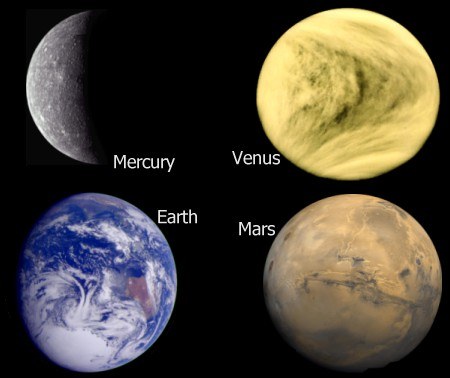
These are the 4 planets closest to the sun (Mercury, Venus, Earth, Mars).

a)

inner planets

b)

outer planets

c)

dwarf planets

d)

solar planets

31.

This is the nearest star to Earth.

a)

the moon

b)

the planet of Mars

c)

the asteroid belt

d)

the sun

32.

These are the four planets FARTHEST from the Sun; Jupiter, Saturn, Uranus, and Neptune.

a)

inner planets

b)

outer planets

c)

solar planets

d)

the best planets

33.

This is the phase of the moon when the moon looks like a thin sliver (less than half of the moon's nearside is sunlit).

a)

crescent

b)

gibbous

c)

full

d)

new

34.

This is the phase of the moon where NONE of the moon's nearside is sunlit.

a)

crescent

b)

gibbous

c)

full moon

d)

new moon

35.

This is the phase of the moon that looks ALMOST full.

a)

crescent

b)

gibbous

c)

full moon

d)

new moon

36.

Stars DO NOT twinkle in the sky; only planets twinkle in the sky.

a)

True

b)

False

37.
Our Sun is one of many stars in the Milky Way Galaxy. Which term BEST describes our Sun?
a)
large
b)
average sized
c)
small
38.
1.  When all of the moon is lit up it is called a _____________.
a)
New Moon
b)
Gibbous Moon
c)
Full Moon
39.
1.  If it is summer in the Northern Hemisphere, then it will be _____________ in the Southern Hemisphere.
a)
Fall
b)
Summer
c)
Winter
40.
Which letter or letters represent daytime on Earth? 
a)
B
b)
C
c)
B and C
d)
A and B
41.
The Earth is constantly spinning on its axis, like you might spin a basketball on your finger.

It is this spinning of the Earth that causes
 
a)
the seasons
b)
night and day
c)
moon phases
42.
Which of these causes the phases of the moon?
a)
earths orbit around the sun
b)
the moons orbit around earth
c)
the orbit of the sun as it orbits earth
d)
the orbit of the moon as it orbits the sun
43.
Which statement describing the relationship between stars and planets is true?
a)
planets orbit the sun and stars do not
b)
planets create light, and stars reflect light energy
c)
stars orbit some planets
d)
the sizes of the planets are directly related to the sizes of nearby stars
44.

What moon phase is this image?

a)

Full

b)

New

45.

The different shapes that the moon seems to have.

a)

revolutions

b)

phases

c)

rotations

46.

As the moon's shape appears to get smaller, we say that the moon is _.

a)

waning

b)

waxing

47.

When the moon appears to be getting larger

a)

wax

b)

wane

c)

new

48.

The cycle of the moon lasts about a _.

a)

month

b)

year

c)

week

49.

True or False: The moon produces its own light.

a)

True

b)

False

50.

What is the moon mostly made of?

a)

Green Cheese

b)

Hot gases

c)

Lava

d)

Rock

51.

Tides (marea) are caused by ___________

a)

wind

b)

gravitational pull of moon

c)

rain
