
 Worksheets
AP Biology Unit 1 Review
Total questions: 40
Worksheet time: 1hrs 15mins

The Oxygen atoms in the molecule shown have this charge:
Positive
Partial Positive
Negative
Partial Negative

Capillary action is in part the result of adhesion. Which aspect of water is responsible for this?
Nonpolar covalent bonds that enable water to dissolve other substances
Polar covalent bonds that join molecules of water to other substances
Hydrogen bonds between water and another substance
Ionic bonds that enable electrons to flow through water and into another substance

The ability of water molecules to stick to each other, creating surface tension is called:
Cohesion
Adhesion
Insulation
Ph

The fact that water can stick to other substances is called:
Ph
Adhesion
Cohesion
Insulation


Storage of fat by the body is advantageous primarily because fats
are insoluble and chemically stable
can be digested with less energy and fewer enzymes than carbohydrates and proteins
yield, gram for gram, more than twice as much energy as complex carbohydrates and proteins
store almost all potential energy in chemical bonds
monosaccharides, fatty acid and glycerol, amino acids, and nucleotides are examples of _____________.
Elements
Compounds
Macromolecules
Monomers
What are the monomers that make up lipids?
monosaccharides
glycerols and fatty acids
amino acids
nucleotides
A polymer of glucose that serves as a storage macromolecule in animals is
chitin
cellulose
glycogen
amylase
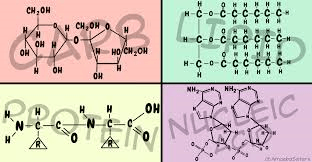
Carbohydrates are made of which elements?
Carbon (C)
Hydrogen (H)
Oxygen (O)
Nitrogen (N)
Phosphorus (P)
Lipids are made of which elements?
Carbon (C)
Hydrogen (H)
Oxygen (O)
Nitrogen (N)
Phosphorus (P)
Proteins are made of which elements?
Carbon (C)
Hydrogen (H)
Oxygen (O)
Nitrogen (N)
Phosphorus (P)
Nucleic Acids are made of which elements?
Carbon (C)
Hydrogen (H)
Oxygen (O)
Nitrogen (N)
Phosphorus (P)

What macromolecule is shown above?
Carbohydrate
Lipid
Protein
Nucleic Acid

Which biomolecule is this a picture of?
Protein
Nucleic Acid
Lipid
Carbohydrate

Which biomolecule is this a picture of?
Protein
Nucleic Acid
Lipid
Carbohydrate

Which of the following statements is/are true regarding the chemical reaction illustrated in Figure 5.5?
It is a hydrolysis reaction.
It is a hydrolysis reaction and it results in a peptide bond.
It results in a dehydration reaction that is breaking the two amino acids apart.
It is a dehydration reaction that is joining two amino acids together.
Polysaccharides are best described as:
a complex molecules such as starches that are composed of many chains of sugar monomers
chains of amino acids joined by peptide bonds
molecules made of glycerol and three fatty acid chains
a five- or six-carbon sugar molecule bonded to an aldehyde or ketone group.
Which macromolecule(s) have sulfur?
Carbohydrates
Proteins
Nucleic Acids
Fats
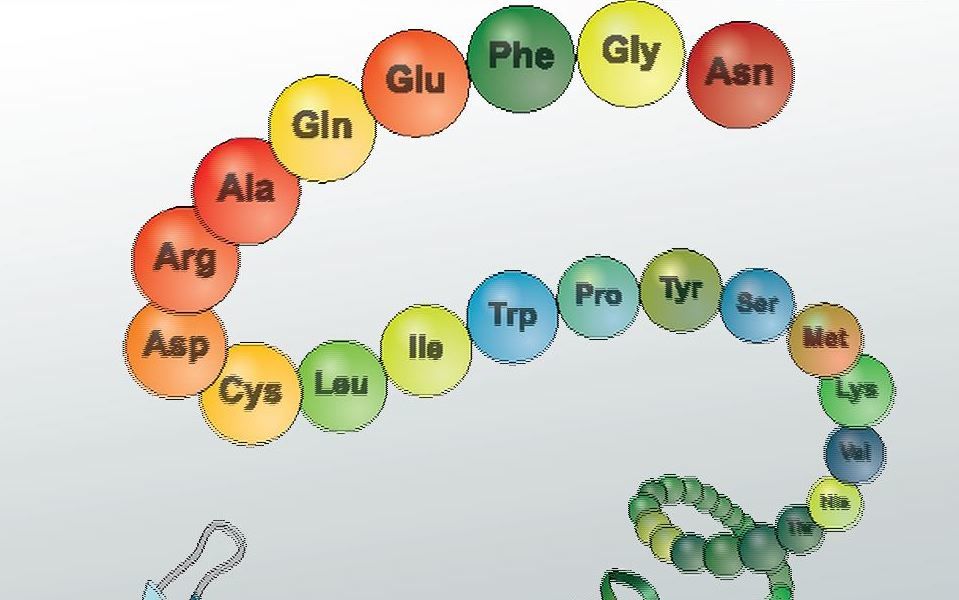
Which protein structure involves the peptide bonds between amino acids?
primary
secondary
tertiary
quaternary
Genetic information stored in DNA is coded in...
the directionality of the molecule
the complementary base pairs
the sugar phosphate backbone
the sequence of bases in a single strand
DNA and RNA nucleotides are added via dehydration synthesis forming ...
helical structure
ionic bonds
covalent bonds
hydrogen bonds
Substitution of amino acids in primary struture does not affect subsequent levels of protein folding.
True
False
DNA and RNA have the same 5-carbon sugar and the same nucleotides.
True
False
n the 1950s, the scientist Alfred Hershey and Marth Chase carried out an experiment using bacteriophages, which are viruese that infect bacteria. During the experiment, the scientists allowed bacteriophages that had been labeled with a radioactive element to infect the cells.
After carrying out their experiment, the scientists concluded that bacteriophages inject DAN, but not protein, into the host bacterial cell during infection.
To be able to reach this conclusion the scientists found which element inside the bacteria cells?
radioactive carbon
radioactive phosphorus
radioactive hydrogen
radioactive sulfur

A scientist grew Chlorella, a single-celled photosynthetic algae, for three weeks in a laboratory culture. The culture medium contained dissolved carbon and other nutrients.
Scientists measured the beginning and the end of the three week period. Based on the results of the graph which nutriets were absent from the culture medium?
phosphorus
nitrogen
oxygen
sulfur

A scientist grew Chlorella, a single-celled photosynthetic algae, for three weeks in a laboratory culture. The culture medium contained dissolved carbon and other nutrients.
Scientists measured the beginning and the end of the three week period. Based on the results of the graph which nutriets were absent from the culture medium?
phosphorus
nitrogen
oxygen
sulfur

