
 Worksheets
Yr10 LC1 Assessment 2021
Total questions: 60
Worksheet time: 33mins

Temperature is measured directly using an instrument called (a) ?
The shrinking of (a) proves the temperature is increasing as it melts the ice.
During wet, cool years, most trees grow more than during hot, dry years and the rings are (a)
Drought or a severe winter can cause (a) rings.
The (a) is the trapping of the sun’s warmth in the planet’s atmosphere.
The (a) greenhouse effect is the addition of greenhouse gasses by human activity
Which of the following are evidence for climate change?
Artwork
Rising Sea Levels
Pollen Grain Evidence
Ice Cores
Which of the following is a natural cause of climate change?
Agriculture
Volcanism
Burning fossil fuels
Deforestation
In the Milankovitch Cycles, the shape of Earth’s orbit is referred to as (a) ?
Which greenhouse gas is more potent?
Methane
Carbon Dioxide
This involves reducing greenhouse gas emissions and increasing the sinks for these gases.
Mitigation
Adaptation
Responding to changes and adjusting accordingly in order to survive.
Adaptation
Mitigation
Which of the following are examples of mitigation strategies to tackling climate change?
Alternative energy
Agricultural changes
Changing house design
Afforestation
Which of the following are examples of adaptation strategies for climate change?
Carbon capture and storage
Sea wall
Managing water supplies
International agreements
Solar Insolation is concentrated where?
Along the equator
At the poles
At the tropics
Cold environments are usually found...
Above the Arctic Circle
Below the Arctic Circle
Above the Antarctic Circle
Below the Antarctic Circle
Which one is a landmass?
Antarctic
Arctic
Which map shows the tundra biome?


Which biome is permanently covered by ice?
Polar
Tundra
Taiga
Alpine
Which biome is found further north?
Tundra
Polar
What is permafrost?
When the ground freezes for most of the year
When the ground is frozen all year
When the ground has a frost
When the ground thaws and then refreezes
The brief summers can be quite warm......
Polar
Tundra
Soils are frozen (permafrost) but in summer it will melt closer to the surface............
Tundra
Polar
Soil in (a) environments is thin and acidic and not very fertile.
Temperatures in (a) environments are never normally above 0 degrees Celcius.

In what months are temperatures above 0oC?
All months
June, July August, September
July, August, September, October, November
April, May, June, July
What is the average rainfall in mm for the month os July?
80
15
40
-10

Which cold environment location would this creature be found in?
Arctic
Antarctic
Glacial highland
Glacial lowland

Give THREE adaptations of this animal
Eats seals
Has thick fur
Can run fast
Its fur is white
Has layer of fat beneath its skin
Arctic wolves have more-rounded ears to reduce (a) ?

Name this plant
Burberry Plant
Bareberry Plant
Bearberry Plant
Barberry Plant

Give TWO adaptations of this plant
Has red berries
Covered in fine hairs
Has a woody stalk
Grows close to the ground
Is eaten by birds
Eats other living things is the definition for?
Producer
Decomposer
Consumer
Herbivore
Makes its own energy by the process of photosynthesis describes what?
Consumer
Producer
Carnivore
Decomposer
What is the name of the top layer of tropical rainforests?
(a)
What is the name of the bottom layer of tropical rainforests?
(a)
If the rainforests were to disappear, the amount of carbon dioxide in the atmosphere would ____.
Increase
Decrease
Increase briefly, then decrease
Stay the same
The main rainforests are found in the following areas:
South America, Africa, South East Asia
South America, North America, Africa
South America, Africa, North East Asia
Europe, North America, Australia
The Emergent trees have __________ roots to help stop them _________________.
Buttress, Falling down
Big, Growing taller
Butted, Hurting other trees
Buttress, Growing too close together
Which map best shows the location of tropical rainforests?
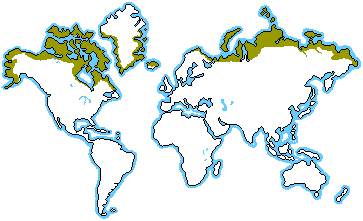
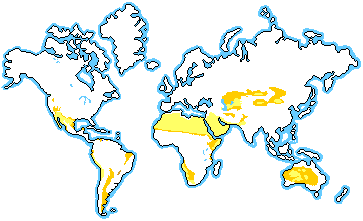
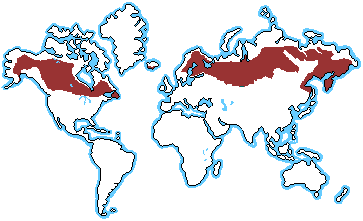
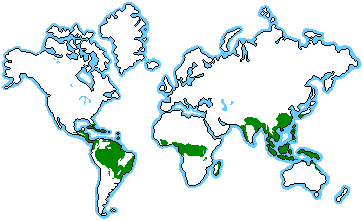
Rainforests typically have more than, how much rainfall?
250 mm
1500 mm
2500 mm
500 mm
The term biotic refers to what?
The non-living parts of an ecosystem.
The living parts of an ecosystem.
Decomposers
Which two continents are projected to experience the greatest urban growth in the future?
Europe
Africa
Asia
North America
Most of the world's megacities are in
Australia
Europe
Asia
Africa
Which of the following needs to be higher for a population to naturally increase?
Death rate
Life expectancy
Birth rate
Which of the following is the correct definition for natural increase?
When the death rate is higher than the birth rate
When people are expected to live longer
When the birth rate is higher than the death rate
When the birth rate is higher than life expectancy
Which of the following is the name of the programme used to improve Rio's favelas?
Deploying the military
Pacification
Improving surveillance
Removal of military

What type of plate boundary is shown in the picture?
Conservative
Divergent
Convergent
Collision
Which three indicators are used to measure the HDI?
Literacy rate, life expectancy and GNI per capita
Life expectancy, mean years of schooling and GNI per capita
Literacy rate, GDP per capita, mean years of schooling
Give the correct spelling for the most southern continent
(a)
The planting of many trees is known as...
(a)
Solar, wind, geothermal, nuclear and biomass are all forms of (a) energy.
Moving from countryside to cities is known as...
Rural Urban Migration
Urbanisation
Urban Sprawl
Suburban Growth
Give the adaptation for when animals copy things in their environment.
(a)
The Arctic Circle and Antarctic Circle are line of (a)
An example of a water-borne disease is (a) ?

