Wayground logo

Free Printable Worksheets

Font size

S
M
L
XL
Worksheets

Cell Parts and Processes Review

Total questions: 50

Worksheet time: 17mins

Name
Class
Date
1.
Which type of cell contains a nucleus?
a)
Prokaryotic
b)
Eukaryotic
2.
Which type of cell is bigger?
a)
Prokaryotic
b)
Eukaryotic 
3.
Prokaryotes have contains membrane-bound organelles. True or False?
a)
True
b)
False
4.
Are prokaryotes multicellular or unicellular? 
a)
Multicellular
b)
Unicellular
5.
Which type of cell?
a)
Prokaryote
b)
Eukaryote
6.
Plants and animal cells are examples of ___ cells 
a)
prokaryotic cells 
b)
eukaryotic cells 
7.
Eukarytoes have Many membrane-bound organelles? True or False
a)
True 
b)
False
8.
Eukaryotes contain DNA and ribosomes?
a)
True
b)
False
9.
Which of the following are prokaryotic cells?
a)
plants
b)
animals
c)

bacteria

10.
Which type of cell?
a)
Prokaryote
b)
Eukaryote
11.

What organelle is called the "powerhouse" of a cell?

a)

mitochondria

b)

nucleus

c)

cell wall

d)

cell membrane

12.

A large central vacuole is found in a _____ cell.

a)

animal

b)

plant

13.

What is the function of a chloroplast?

a)

makes proteins for animal cells

b)

allows materials in and out of the cell

c)

provides structure and support

d)

absorbs sunlight for photosynthesis

14.

Looking in a microscope, you see cells that have rectangular shapes and a green color. What type of cells are you probably viewing?

a)

plant cells

b)

animals cells

c)

muscle cells

d)

blood cells

15.

Identify the structure that is indicated by the arrow in the image.

a)

cell wall

b)

central vacuole

c)

chloroplast

d)

nucleus

16.

Identify the structure that is indicated by the arrow in the image.

a)

cell wall

b)

central vacuole

c)

chloroplast

d)

cell membrane

17.

The arrow is showing the fluid inside the cell that surrounds the cell organelles. What is the arrow pointing to in the cell?

a)

cytoplasm

b)

mitochondria

c)

ribosomes

d)

nucleus

18.

What type of cell is being shown in the image?

a)

plant

b)

animal

19.

Identify the structure that is labeled "C" in the image.

a)

central vacuole

b)

nucleus

c)

chloroplast

d)

mitochondria

e)

cell membrane

20.

Identify the structure that is labeled "H" in the image.

a)

cell wall

b)

chloroplast

c)

mitochondria

d)

nucleus

e)

cell membrane

21.

I make proteins for the cell. What am I?

a)

ribosome

b)

cell membrane

c)

nucleus

d)

chloroplast

22.

In what organelle is the genetic material found inside?

a)

cell membrane

b)

chloroplast

c)

nucleus

d)

ribosome

23.

Spraying Axe body spray in a corner of the room and someone on the opposite corner smells it is an example of what?

a)

Osmosis

b)

Facilitated diffusion

c)

Active transport

d)

Diffusion

24.
Active transport requires ______, moves materials from __________________, and goes _______ the concentration gradient.
a)
No energy, low to high, against
b)
ATP, high to low, with
c)
ATP, low to high, with
d)
ATP, low to high, against
25.
Moving "Big stuff" out
a)
Endocytosis 
b)
Exocytosis
c)
Diffusion
d)
Osmosis
26.
A cell will __________________ in a hypotonic solution.
a)
swell and perhaps burst (lyse)
b)
shrink
c)
the size of the cell will not change
d)
the size of the cell will change from large to small and from small to large
27.
A cell will _____________________ in a hypertonic solution.
a)
swell
b)
shrink
c)
will not change
d)
will explode
28.
How does a cell maintain homeostasis?
a)
Regulates what enters and leaves the cell
b)
Flexibility
c)
Protective barrier
d)
Structure and support
29.
Another term for equilibrium is...
a)
Not enough
b)
Too little
c)
Homeostasis
d)
Too much
30.
The cell membrane is selectively permeable, which means...
a)
All materials can enter and leave the cell
b)
Certain things can enter while others cannot
c)
The cell manually sorts through all materials
d)
Only certain cells can interact with the cell.
31.
A can of air freshener is sprayed in the opposite side of the room.  Ten minutes later you start to smell the scent.  This is an example of 
a)
diffusion
b)
active transport
c)
endocytosis
d)
osmosis
32.
Controlling what goes into or out of the cell without energy is called
a)
active transport
b)
endocytosis
c)
passive transport
d)
exocytosis
33.
What is it called when molecules move across the cell membrane from an area of high concentration to an area of low concentration through a carrier protein?
a)
Diffusion
b)
Osmosis
c)
Active Transport
d)
Facilitated Diffusion
34.
What is the name of the process in which molecules move from an area of high concentration to an area of low concentration across a selectively permeable membrane?
a)
Diffusion
b)
Osmosis
c)
Active Transport
d)
Facilitated Diffusion 
35.
What is homeostasis?
a)
How the body releases oxygen
b)
Passive transportation 
c)
How the body regulates itself for survival
d)
Active transport
36.
What is the difference between active and passive transport?
a)
Active does not need energy and passive uses ATP (energy)
b)
Active uses ATP (energy) and passive does not need energy
c)
Active stores transport proteins and passive releases 
d)
Active uses hormones and passive does not 
37.
Where is there a low concentration of dye?
a)
at the bottom of cup
b)
in the color
c)
at the top of cup 
d)
no concenteraion gradient
38.
Two examples of passive transport are
a)
Earth and Sun
b)
Diffusion and Osmosis
c)
Energy and Wind
d)
None of the above
39.
Permeable means
a)
things can pass through
b)
the concentration levels are different
c)
it is permanent
d)
things are stuck
40.
Against the concentration gradient
low to high
uses energy/ATP
a)
facilitated diffusion
b)
osmosis
c)
active transport
d)
simple diffusion
41.
Most active transport proteins use energy from the breakdown of:
a)
nucleus
b)
cell membrane
c)
ATP
d)
mitochondria
42.
The movement of molecules against a concentration gradient
a)
simple diffusion
b)
facilitated diffusion
c)
active transport
d)
osmosis
43.
A molecule that diffuses down a concentration gradient goes from an area of ______ concentration into an area of ______ concentration.
a)
high, low
b)
low, high
c)
passive, active
d)
active, passive
44.
The difference in the concentration of a substance from one location to another is called 
a)
diffusion
b)
osmosis
c)
concentration gradient
d)
passive transport
45.
This picture represents what type of cell transport?
a)
endocytosis
b)
exocytosis
c)
osmosis
d)
passive transport
46.
ALL living cells have this in common
a)
Nucleus
b)
Cell Membrane
c)
Cell Wall
d)
Mitochondria
47.
What is it called when molecules move across the cell membrane from an area of high concentration to an area of low concentration through a carrier protein?
a)
Diffusion
b)
Osmosis
c)
Active Transport
d)
Facilitated Diffusion
48.
Solutes move with the concentration gradient, therefore no energy is used. 
a)
Passive Transport
b)
Active Transport
49.
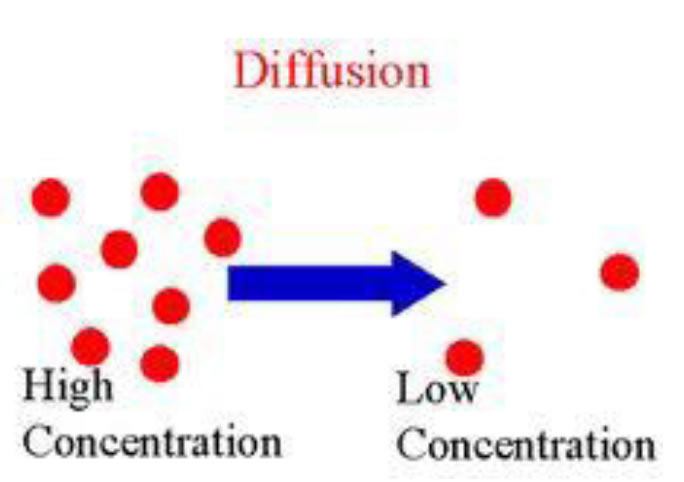
Movement of particles from high to low concentration. 
a)
Passive Transport
b)
Active Transport
50.
This is a picture of
a)
Cell wall
b)
Cell membrane
c)
chloroplast
d)
mitochondria