
 Worksheets
Evolution
Total questions: 25
Worksheet time: 13mins
Name
Class
Date
1.
Inherited trait that helps an organism survive is a(n) __________.
a)
Fossil
b)
Adaptation
c)
Ancestor
d)
Natural selection
2.

The diagram shows fossils in different rock layers. Which of these statements about the age of these fossils is most likely correct?
a)
Fossil A and C are the same age
b)
Fossil B is older than fossil C
c)
Fossils A is older than fossil B
d)
Fossil D is older than fossil C
3.
What do we call a change in a species over time?
a)
Adaptation
b)
Evolution
c)
Extinction
d)
Environmental influences
4.
When an organism completely dies out, it is called.....
a)
Adaption
b)
Extinction
c)
Fossilization
d)
Mutation
5.
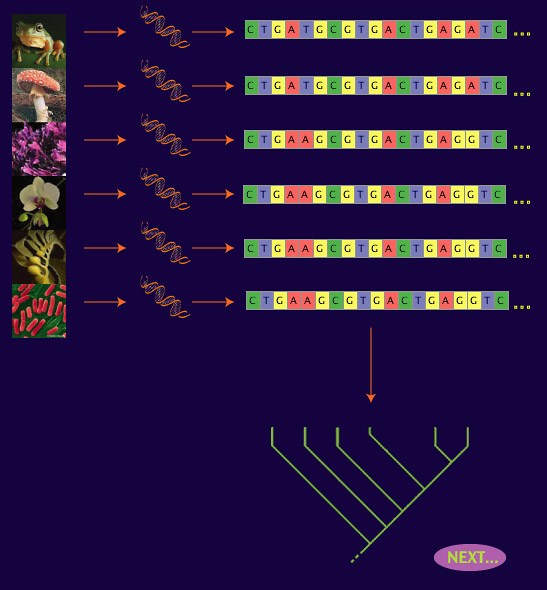
Two organisms that are closely related would have
a)
very similar DNA sequence
b)
exactly the same DNA sequences
c)
no proteins in common
d)
completely different DNA sequence
6.

All the individuals of a species that live in a particular area are called a
a)
variation
b)
population
c)
fossil
d)
group
7.

Which layer is oldest?
a)
A
b)
W
c)
G
d)
Z
8.
Who was the first naturalist to study evolution?
a)
Charles Darwin
b)
Gregor Mendal
c)
Carolus Linneaus
d)
Thomas Edison
9.
This is a process by which organisms inherited advantageous traits that tend to reproduce more successfully than the other organisms do.
a)
Artificial selection
b)
Natural selection
c)
Populations
d)
Environment
10.
The surroundings and conditions in which an organism lives and operates.
a)
Evolution
b)
Population
c)
Environment
d)
Biological diversity
11.
These are natural differences within a species.
a)
Evolution
b)
Genetic variation
c)
Biological diversity
d)
Populations
12.
This is an ecological relationship in which two or more organisms depend on the same limited resource.
a)
Adaptation
b)
Competition
c)
Evolution
d)
Natural selection
13.
This is the trace or remains of an organism that lived long ago, most commonly preserved in sedimentary rock.
a)
Competiton
b)
Extinction
c)
Evidence
d)
Fossil
14.
What is the process in which humans breed organisms for certain traits?
a)
natural selection
b)
inheritance
c)
artificial selection
d)
descent withOUT modification
15.

Darwin wrote that organisms with traits that are best suited to the environment will ________________
a)
increase in number
b)
become extinct
16.
What characteristic did Darwin observe about the finches on the Galapagos Islands?
a)
Their feathers
b)
Genotypes
c)
Their beaks
d)
Their body sizes
17.

Scientists have collected millions of fossils of different organisms, and have developed a timeline of life on Earth. What do we call this?
a)
Mutation
b)
Natural Selection
c)
The theory of evolution
d)
Fossil Record
18.

How do we measure the age of a fossil in years?
a)
variation
b)
absolute dating
c)
selection
d)
mutation
19.
What is the correct order of eras, from oldest to youngest?
a)
Cenozoic, Mesozoic, Paleozoic
b)
Mesozoic, Cenozoic, Paleozoic
c)
Paleozoic, Cenozoic, Mesozoic
d)
Paleozoic, Mesozoic, Cenozoic
20.
What is the geological era in which the dinosaurs reigned?
a)
The Paleozoic
b)
The Mesozoic
c)
The Proterozoic
d)
The Cenozoic
21.
In which era do we currently live?
a)
Jurassic
b)
Mesozoic
c)
Paleozoic
d)
Cenozoic
22.
Place the following in order starting with the OLDEST
1 Paleozoic
2 Cenozoic
3 Precambrian
4 Mesozoic
1 Paleozoic
2 Cenozoic
3 Precambrian
4 Mesozoic
a)
1 3 2 4
b)
3 1 4 2
c)
4 3 2 1
d)
2 3 1 4
23.
Cavemen lived at the same time as the dinosaurs.
a)
TRUE
b)
FALSE
24.
Which type of life dominates the Precambrian Time?
a)
Dinosaurs
b)
Mammals
c)
Bacteria
d)
Humans
25.
During which geologic era did trilobites, mosses and ferns first appear in the fossil record?
a)
Paleozoic
b)
Mesozoic
c)
Cenozoic
d)
Precambrian
100 %

