wayground logo

Free Printable Worksheets

Font size

S
M
L
XL
Worksheets

Ch3 - Measurement in Chemistry

Total questions: 50

Worksheet time: 54mins

Name
Class
Date
1.

If the exponent is a positive number the original number was...

a)

a really big number.

b)

a really small number.

2.

If the exponent is a negative number the original number was...

a)

a really large number.

b)

a really small number.

3.

How would you write 0.0005 in scientific notation?

a)

50 x 10-5

b)

5 x 10⁻⁴

c)

5 x 10³

d)

.5 x 103

4.
How would you write 4.3756 x 10in standard form?
a)
437,560,000
b)
0.00043756
c)
43,756
d)
4,3756
5.
Which of the following is correct scientific notation?
a)
20.35 x 10⁴
b)
.2035 x 104
c)
2035 4
d)
2.035 x10⁴
6.
It is a measure of how close measurements come to each other when they are made in the same way
a)
Accuracy
b)
Precision
c)
Error
d)
Extrapolation
7.

How close a measurement is to the accepted value is called..

a)

Accuracy

b)

Precision

c)

Significant

d)

Estimate

8.
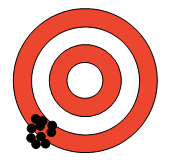
This bullseye demonstrates...
a)
High Accuracy & High Precision
b)
High Accuracy & Low Precision
c)
Low Accuracy & High Precision
d)
Low Accuracy & Low Precision
9.
Jessie estimates the weight of her cat to be 8 pounds.  The actual weight of the cat was 10 pounds.  Find the percent error.  
a)
15%
b)
20%
c)
25%
d)
30%
10.
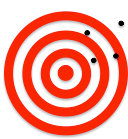
Describe the accuracy and precision of the image
a)
Accurate and Precise
b)
Accurate and not precise
c)
Not Accurate and Precise
d)
not accurate and not precise
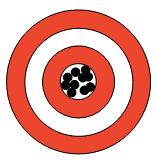
11.
?
a)
High Accuracy & High Precision
b)
High Accuracy & Low Precision
c)
Low Accuracy & High Precision
d)
Low Accuracy & Low Precision
12.
A set of data are all close to each other, but they are not close to the actual value.  This set of data can be described as...
a)
accurate
b)
precise
c)
both precise and accurate
13.

Which is the more precise measurement?

a)

4 mL

b)

4.3 mL

c)

4.30 mL

d)

4.300 mL

14.
How many significant figures: 216 m
a)
1
b)
2
c)
3
d)
0
15.
How many significant figures: 2016 m
a)
1
b)
2
c)
3
d)
4
16.
How many significant figures: 153.0 mL
a)
1
b)
2
c)
3
d)
4
17.
How many significant figures: 0.012 km
a)
1
b)
2
c)
3
d)
4
18.
How many significant figures: 1000 mL
a)
1
b)
2
c)
3
d)
4
19.
How many significant figures: 100.000 cL
a)
1
b)
3
c)
5
d)
6
20.
How many significant figures: 4.20 cm
a)
1
b)
2
c)
3
d)
4
21.
How many significant figures will be in the answer to the following question:
7.62 x 6.98 x 3.2645
a)
1
b)
2
c)
3
d)
4
22.
Calculate 12.34 + 1.234 + 0.1234
a)
13.6974
b)
13.697
c)
13.70
d)
13.7
23.
Calculate 1.23 m x 0.89 m and give your answer with the appropriate number of significant figures.
a)
1.0 m2
b)
1.1 m2
c)
1.0947 m2
d)
1.09 m2
24.

What is the product of 2.67 meters and 1.3 meters?

a)

3.4 meters

b)

3.5 meters

c)

3.47 meters

d)

3.471 meters

25.

What is the quotient of 15.3 meters and 7.4 meters?

a)

2.1 meters

b)

2.07 meters

c)

2.068 meters

d)

2.0676 meters

26.

What is the difference of 12.58 meters and 5.7 meters?

a)

7 meters

b)

6.9 meters

c)

6.8 meters

d)

6.88 meters

27.

What is the sum of 12.58 meters and 5.7 meters?

a)

18.28 meters

b)

18.2 meters

c)

18.3 meters

d)

18 meters

28.
What is the correct SI unit for mass?
a)
Kilograms
b)
newtons
c)
pounds
d)
grams
29.

What prefix is represented by the following symbol: m

a)

hecto

b)

kilo

c)

milli

d)

mega

30.

Which of the following is the correct prefix for 10-6?

a)

milli-

b)

nano-

c)

mega-

d)

micro-

31.

Which of the following is the correct prefix for 10-2?

a)

milli-

b)

centi-

c)

deca-

d)

hecto-

32.

2.53 L is equal to

a)

0.253 kl

b)

25 300 ml

c)

253 ml

d)

2530 ml

33.

How would you write micrometers with symbols

a)

mm

b)

μm\mu m

c)

microm

d)

none of the above

34.
What two types of measurements make up DENSITY
a)
Mass and Volume
b)
Temperature and Mass
c)
Grams and Centimeters
d)
Volume and Weight
35.
Jack has a rock. The rock has a mass of 14g and a volume of 2cm3. What is the density of the rock?
a)
7 mL
b)
7 g/cm3
c)
28 g/cm3
d)
1/7 g/cm3
36.
Why do the liquids form different layers?
a)
They have different densities.  
b)
They have different masses.  
c)
They have different volumes.  
d)
They are different temperatures.  
37.
What units can be used to express density?
a)
g/mL
b)
grams
c)
millimeters
d)
milliliters
38.
If an object has a density of .6 g/mL and you put it into water, will it sink or float?  
a)
sink
b)
float
39.
Archimedes used density to discover if the crown of gold was real because
a)
Substances have their own unique densities
b)
Substances can change densities depending on their size
c)
Substances can change densities depending on their mass
d)
Substances can change densities depending on their volume
40.

What is the formula for Mass?

a)

Mass/Volume

b)

Density x Volume

c)

Mass/Density

41.

What is the formula for Volume?

a)

Mass/Volume

b)

Density x Volume

c)

Mass/Density

42.

What is 4000g in kg?

a)

400

b)

40

c)

0.4

d)

4

43.

What is 3 litres in ml?

a)

30

b)

300

c)

3000

d)

0.3

44.

What is 3.75 litres in ml

a)

3750

b)

375

c)

3705

d)

37.5

45.

What is 435mm in cm?

a)

4.35

b)

43.5

c)

0.435

d)

435

46.

What is 0.9km in meters?

a)

0.9

b)

9

c)

90

d)

900

47.

A _____ is a little more than two laps around the track. (2.5 laps exactly)

a)

kilometer

b)

furlong

c)

Mile

d)

meter

48.

A volume of 1 cubic centimeter is equivalent to

a)

1 gram.

b)

1 liter.

c)

0.10 cubic decimeters.

d)

1 milliliter.

49.

The average weight of a newborn baby is 3 – 4 ___________.

a)

kilograms

b)

grams

c)

pounds

d)

ounces

50.

what is 5m in cm?

a)

50

b)

5

c)

500

d)

0.5