
NEW
Font size
 Worksheets
Year 10 revision quiz
Total questions: 50
Worksheet time: 25mins
Thread like structures made of DNA wrapped around proteins
nucleotides
chromosomes
genes
genotypes
the building block of DNA, composed of deoxyribose sugar, nitrogen base and a phosphate group
nucleotide
chromosome
gene
genotype
a pair of chromosomes of the same length, with the same genes in the same locations
gametes
homologous chromosomes
diploid
genotype
a cell with two full sets of chromosomes
gametes
phenotype
diploid
haploid
when an organism carries two different versions of the gene on the homologous chromosomes
homozygous
heterozygous
diploid
haploid
a characteristic that is seen in a heterozygous organism
dominant trait
recessive trait
diploid
allele
In budgerigars, green feather colour (G) is dominant to blue feather colour (g). A blue budgerigar is mated with a heterozygous budgerigar. Identify the most probably genotypes of the offspring. (Do a Punnett square)
all the offspring will be blue
all the offspring will be green
1/2 Gg; 1/2 gg
1/2 GG; 1/2 gg

In this pedigree, the individuals shaded blue have thalassaemia, a disease inherited in a dominant-recessive pattern. Identify the option in which both statements are true.
3 and 7 are both carriers of the disease. 8 or 9 must be a carrier
6 and 7 are both heterozygous for thalassaemia. 3 and 5 are carriers of thalassaemia
5 and 6 are heterozygous for the condition. 10 and 12 must be carriers of the disease
2 is homozygous for thalassaemia. 3 and 4 must be carriers of the disease
fossil that can be used to compare the relative age of rock strata in different locations
index fossil
isotope
trace fossil
replacement fossil
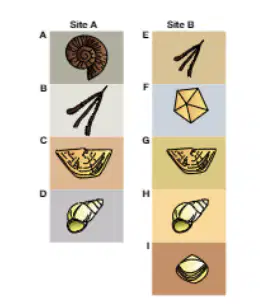
A palaeontologist visited two different sites in a quarry and saw several layers containing different fossils (as shown)
which is the oldest stratum?
A
C
E
I
A palaeontologist visited two different sites in a quarry and saw several layers containing different fossils (as shown)
Which is the youngest stratum?
A
C
E
I
change in characteristics of a species over many generations resulting in the formation of new species.
artificial selection
evolution
natural selection
selective pressure
naturally inherited differences in a population
variation
resistance
isolation
selective pressure
similar structures in related individuals (with a common ancestor)
homologous structures
embryos
centromeres
analogous structures
characteristics shared by two species that look similar, but do not share a common ancestry
homologous structures
embryos
centromeres
analogous structures
Bacteria divide asexually approximately once every 20 minutes in ideal conditions. Fruit flies reproduce sexually in a life cycle of about 11 days. Why might an experimenter choose bacteria rather than fruit flies in an experiment on natural selection?
Asexual reproduction cannot produce any genetic change, so bacteria are useful as a control in experiments
Variation, isolation and selection cannot occur in bacteria, so there will be no speciation.
There will not be any variation in the bacteria for natural selection to act on.
A short generation time means any evolution in the species should occur faster.
the number of protons in an atom's nucleus
atomic number
mass number
elements
isotopes
the number of particles in an atom's nucleus
atomic number
mass number
elements
isotopes
vertical columns in the periodic table
groups
rows
periods
transition elements
horizontal rows in the periodic table
groups
alkali metals
periods
transition elements
energy levels of the atom, regions in which electrons spin around the nucleus
electron shells
electron configuration
ground state
excited state
when electrons jump to a higher energy level
flame test
electron configuration
ground state
excited state
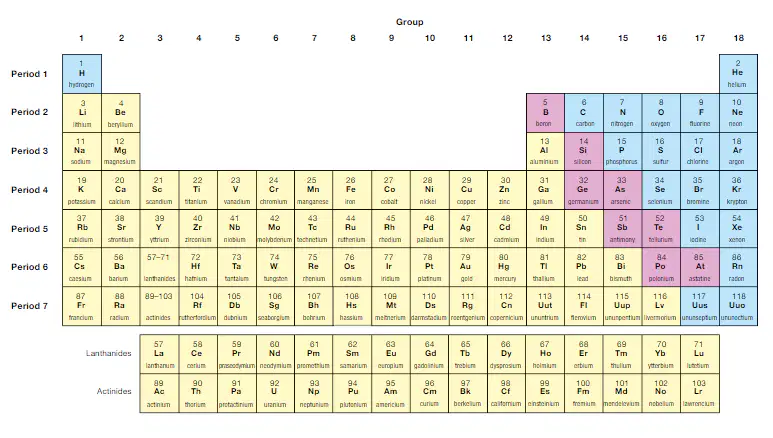
Which statement is correct?
chlorine is in period 3
chlorine is in group 17
chlorine has the atomic number 17
chlorine would react in a similar way to Al, Si, P and S
The atoms get bigger as you move down any group. Use this information to identify the statement below that is definitely true.
Helium is the biggest of all the group 18 elements
A sulfur atom is bigger than an oxygen atom
A sulfur atom is bigger than a phosphorus atom
A sulfur atom is bigger than a potassium atom
Atoms in the same group of the periodic table tend to react in a very similar way to each other. The reaction between lithium and chlorine is:
2Li + Cl2 --> 2LiCl
Use this information and the periodic table to identify which of the following reactions could not occur.
2Mg + Cl2 -> 2MgCl
2Na + Cl2 -> 2NaCl
2Na +Br2 -> 2NaBr
2K + I2 -> 2KI
The chemicals that are used up in a chemical reaction
reactants
products
elements
compounds
reactions with oxygen that produce light and heat
combustion
respiration
corrosion
acid base reactions
an atom or group of atoms that has lost or gained electrons
ion
molecule
metallic bonding
insoluble compound
an insoluble substance formed when two solutions are mixed
ion
product
precipitate
reactant
the amount of a solute in a certain volume of solution
concentration
catalyst
dilution
solvent
What type of reaction is this?
2N2 + 3 H2 -> 2NH3
combustion
decompostition
combination
double displacement
What type of reaction is this?
CuCO3 -> CuO + CO2
combustion
decompostition
combination
double displacement
What type of reaction is this?
Ba(NO3)2 + MgSO4 -> BaSO4 + Mg(NO3)2
combustion
decompostition
combination
double displacement
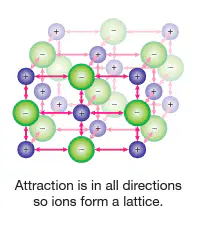
What type of bonding does this image show?
ionic bonding
metallic bonding
covalent bonding
non metallic bonding

What type of bonding does this image show?
ionic bonding
metallic bonding
covalent bonding
non metallic bonding
Which one of these changes would not increase the rate of reaction?
increasing the temperature
increasing the size of the pieces
stirring
increasing the concentration of reactants
the straight line distance between your starting and finishing points
displacement
instantaneous speed
time
average speed
speed at a particular moment in time
displacement
instantaneous speed
gradient
average speed
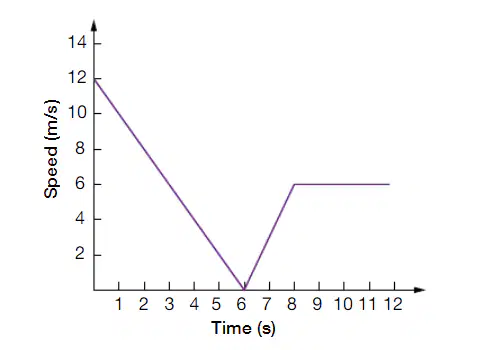
In this speed vs time graph, at what time is the object stationary?
between 6 and 8 seconds
between 0 and 6 seconds
6 seconds
between 8 and 12 seconds
In this speed vs time graph, at what time is the object accelerating?
0 seconds
between 0 and 6 seconds
between 6 and 8 seconds
between 8 and 12 seconds
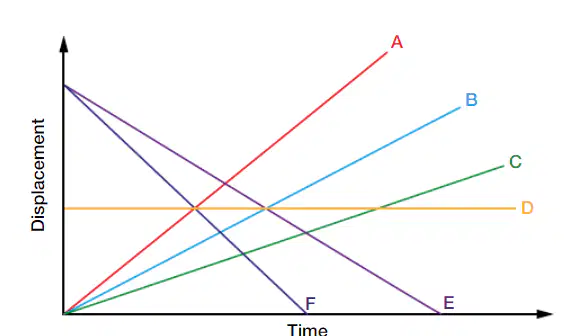
In this displacement vs time graph, which graph represents a stationary object?
graph A
graph C
graph D
graph E
graph F
In this displacement vs time graph, which graph represents the fastest forward moving object?
graph A
graph C
graph D
graph E
graph F
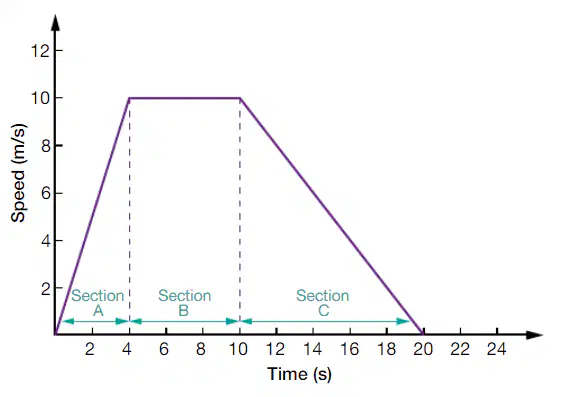
Acceleration is the gradient of a speed vs time graph.
What is the acceleration in section A of the graph?
2.5 m/s2
10m/s2
4m/s2
1m/s2
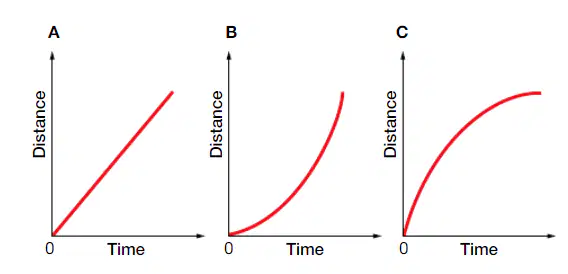
Which distance-time graph shows an object speeding up?
graph B
graph A
graph C
none of these graphs
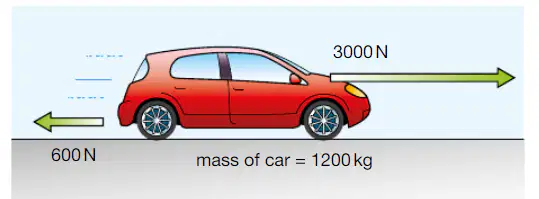
Calculate the acceleration of the car shown
net force is 2400 N
a=F/m
therefore a = 2400/1200
= 2m/s2
net force is 3000N
a = F/m
therefore a = 3000/1200
= 2.5 m/s2
net force is 2400N
F=ma
therefore a= 1200/2400
= 0.5 m/s2
net force is 3000N
F=ma
therefore a = 1200/3000
= 0.4m/s2
Calculate the kinetic energy of a 1300kg car travelling at 18km/h (5m/s)
Ek = 1/2 mv2
Ek = 1/2 x 1300 x 5 x 5
Ek = 16250J
Ek = 1/2 mv2
Ek = 1/2 x 1300 x 18 x 18
Ek = 210600J
Ek = 1/2 mv2
Ek = 1/2 x 1300 x 5
Ek = 3250J
Ek = 1/2 mv2
Ek = 1/2 x 1300 x 5 x 5
Ek = 6500
A 3 kg ball is dropped onto concrete from a height of 2m. Calculate its gravitational potential energy.
Ek = 1/2 mv2
Ek = 1/2 x 3 x 2 x 2
Ek = 6J
Ep = mgh
Ep = 3 x 9.8 x 2
Ep = 58.8J
Ep = Ek
Ep = 0
Ep = mgh
Ep = 19.6 J
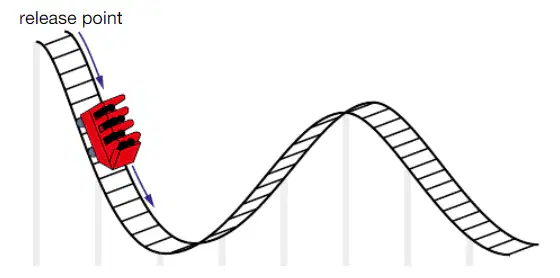
This figure shows the position of a roller coaster soon after it is released on a track. how does its energy change at this moment in time?
increasing kinetic energy, constant gravitational potential energy
increasing kinetic energy, decreasing gravitational potential energy
decreasing kinetic energy, increasing gravitational potential energy
decreasing kinetic energy, constant gravitational potential energy
What is represented by the gradient of a distance time graph?
time
force
speed
acceleration
What is represented by the gradient of a velocity time graph?
speed
acceleration
time
force

