wayground logo

Free Printable Worksheets

NEW

Font size

S
M
L
XL
Worksheets

Radioactivity

Total questions: 50

Worksheet time: 28mins

Name
Class
Date
1.
This particle determines what element you have - the elements identity.
a)
electron
b)
proton
c)
neutron
d)
valence shell
2.
Which particles make up the nucleus of an atom?
a)
protons and neutrons
b)
electrons and protons
c)
electrons, protons, and neutrons
d)
electrons and neutrons
3.
What is the number of protons that the element in this image contain?
a)
14
b)
7
c)
15
d)
18
4.
An element with a mass number of 11 and an atomic number of 5 has how many neutrons?
a)
11
b)
5
c)
6
d)
16
5.

An isotope of an element has the same number of _________, but a different number of _________.

a)

Protons, electrons

b)

Protons, neutrons

c)

Electrons, neutrons

d)

Neutrons, protons

6.

A radioactive nuclide has a ____ stable nucleus than a non-radioactive nucleus of the same element.

a)

more

b)

less

c)

identical

d)

small

7.
What makes something radioactive?
a)
elements with an atomic number above 81
b)
an unstable nucleus
c)
contaminated sewage
d)
It decays over time
8.
_______________ is the process by which unstable atoms emit radiation until they become stable.
a)
Radiation
b)
Chemical Reaction
c)
Radioactive Decay
d)
Isotopes
9.
In order of most to least penetrating radiation we have
a)
Alpha , Beta,  Gamma
b)
Beta , Gamma , Alpha
c)
Gamma, Beta, Alpha
d)
Gamma, Alpha, Beta
10.
Negatively charged particles emitted from a nucleus at a high speed are ____ .
a)
protons
b)
neutrons
c)
electrons
d)
protons and neutrons
11.

Which type of radiation releases an electron?

a)

Alpha radiation

b)

Beta radiation

c)

Gamma radiation

d)

Theta radiation

12.

What particle is released when an unstable isotope undergoes alpha radiation?

a)

a helium nucleus

b)

an electron

c)

a photon of light

d)

a neutron

13.
Name the instrument used to detect radioactivity.
a)
voltmeter
b)
ohmeter
c)
seismograph
d)
geiger counter
14.
Which type(s) of radiation would be affected by a magnet?
a)
alpha only
b)
beta only
c)
alpha and beta
d)
gamma only
15.
Which type of radioactive decay is occurring in this equation? 
a)
Alpha decay
b)
beta decay
c)
gamma decay
d)
positron emission
16.
Where does radioactivity have application in our lives?
a)
Medicine
b)
Energy (electricity)
c)
Agriculture
d)
All of the above
17.
The rate at which a radioactive element decays is its ____.
a)
quarter life
b)
whole life
c)
wonderful life 
d)
half life
18.
Energy in the sun is produced as a result of nuclear ____ reactions.
a)
fusion
b)
fission
c)
waste
d)
sub
19.
In a nuclear reactor, electricity is produced from what element?
a)
Plutonium
b)
Uranium 235
c)
Radon 220
d)
Lead 232
20.
Neutrons released in a fission reaction can strike other nuclei and cause a 
a)
meltdown
b)
take down
c)
break down
d)
chain reaction
21.
The process by which nuclei having small masses are united to form a single larger nucleus is called nuclear ____.
a)
fusion
b)
fission
c)
reactivity
d)
waste
22.
If the half life of a radioactive element is 100yrs, how long would it take for the radioactivity to reduce by one half?
a)
200yrs
b)
100yrs
c)
50yrs
d)
300yrs
23.
What is nuclear fission?
a)
Big nucleus splits to small nuclei
b)
Small nuclei fuse into a bigger nucleus
c)
Stars
d)
Making compounds
24.
How do nuclear power-plants work?
a)
Fusion
b)
Half-life
c)
Fission
d)
Fusion or fission
25.

A certain radioactive sample has a half life of 2 years. After 6 years, how much of the sample is left?

a)

1/2

b)

1/3

c)

1/16

d)

1/8

26.
_______________ is the process by which unstable atoms emit radiation until they become stable.
a)
Radiation
b)
Chemical Reaction
c)
Radioactive Decay
d)
Isotopes
27.
Marie Curie was the first woman to win a...
a)
Golden Globe
b)
Nobel Prize
c)
Oscar
d)
 Emmy Award
28.

What is the mass number of this isotope?

a)

131

b)

53

c)

184

d)

78

29.

What is the atomic number of this isotope?

a)

131

b)

53

c)

184

d)

78

30.

How many neutrons does this isotope have?

a)

131

b)

53

c)

184

d)

78

31.

What is the name of this isotope?

a)

Iodine-131

b)

Iodine-53

c)

Iodine-184

d)

Iodine-78

32.

An alpha particle is made up of

a)

2 protons and 4 neutrons

b)

1 proton and 1 neutron

c)

2 protons and 2 neutrons

d)

4 protons and 2 neutrons

33.

Which type of nuclear radiation can be stopped by a sheet of paper?

a)

Alpha

b)

Beta

c)

Gamma

34.

When a substance undergoes beta decay

a)

The atomic number increases by 1

b)

The atomic number decreases by 2

c)

The atomic number does not change

35.

A sample of Radium-228 decays from 100g to 12.5g. How many half lives did it experience?

a)

1

b)

2

c)

3

d)

4

36.

How much of a 250g sample would be left after 5 half lives?

a)

125g

b)

62.5g

c)

31.25g

d)

7.81g

37.

If the half life of Uranium-240 was 10 years, how long would it take for it to decay from 310g to 80g?

a)

10 years

b)

240 years

c)

20 years

d)

30 years

38.

When nuclei decay, massive amounts of __________ is released.

a)

energy

b)

electrons

c)

protons

d)

neutrons

39.
After 4 half-lives, 1g of a sample of Krypton-85 remains unchanged.  What was the original mass of the sample?
a)
16g
b)
32g
c)
0.0625g
d)
4g
40.

Finish this equation

20983Bi--> _______ + 20581Tl

a)

42He

b)

0-1e

c)

y

41.
Solve this equation for alpha decay.
85209At = ___ + 24He
a)
83205Bi
b)
86209Rn
c)
81207Tl
d)
85208At
42.

Identify the missing substance in each of the following nuclear reaction.

_____→13756 Ba + 0−1 e

a)

13755Ba

b)

13757La

c)

13856Ba

d)

13755Cs

43.

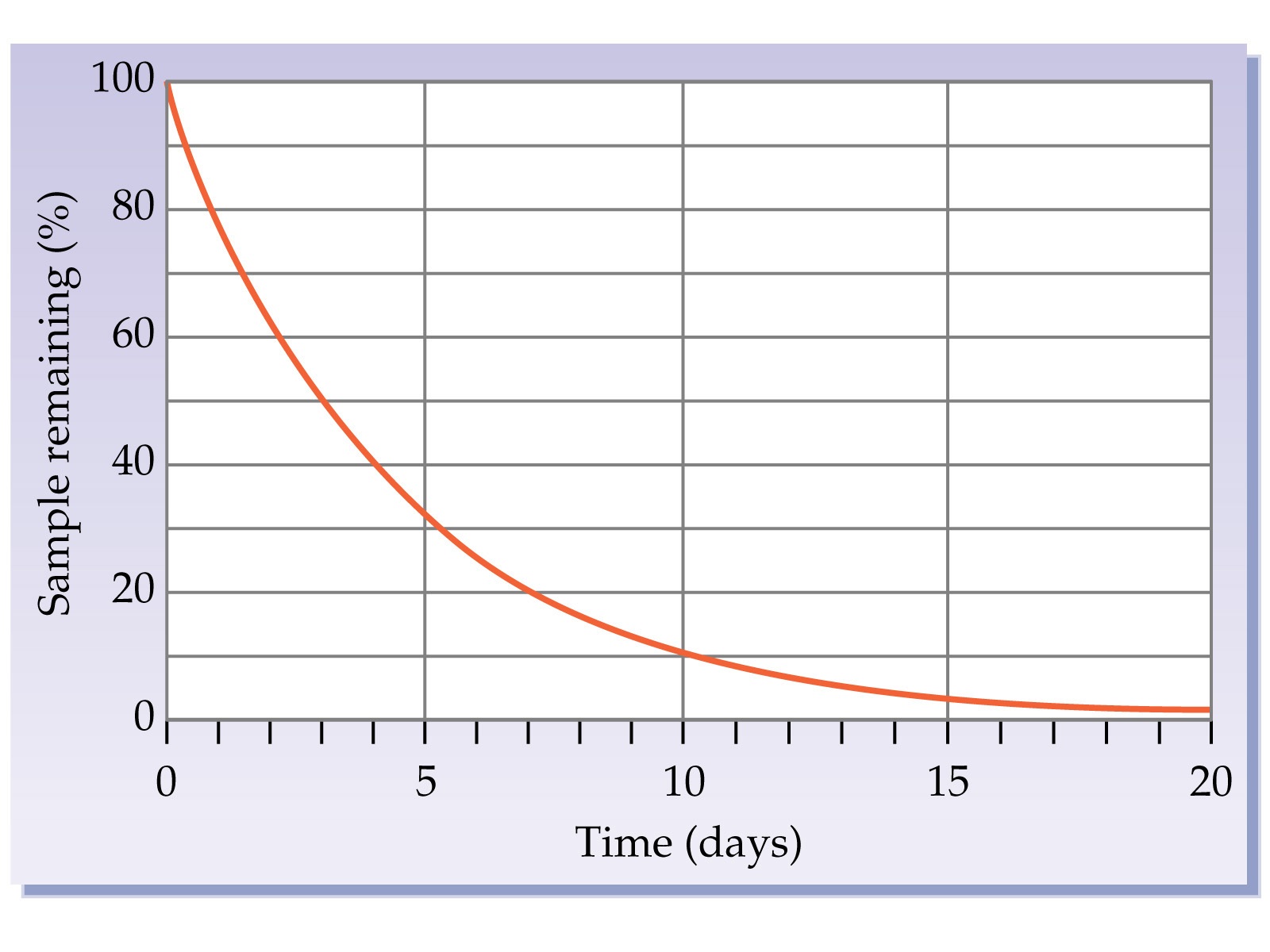
What is the Half Life of this isotope?

a)

3 days

b)

5 days

c)

8 days

d)

10 days

44.

This type of electromagnetic wave can be used to see inside luggage at an airport or in hospitals to see your bones.

a)

Gamma Rays

b)

Visible Light

c)

X Rays

d)

Infrared Rays

45.

This type of electromagnetic wave has the most energy and therefore can be very dangerous.

a)

Microwaves

b)

Radio Waves

c)

X Rays

d)

Gamma Rays

46.
Which part of the electromagnetic spectrum has high enough energy to cause damage to eyes and skin, and sometimes even cancer? 
a)
infrared light
b)
visible light
c)
ultraviolet light
d)
microwaves
47.
Which type of radiation is the most ionising?
a)
alpha
b)
beta
c)
gamma
48.

This is the name for the type of radiation that naturally occurs in the environment and is generally safe.

a)

background radiation

b)

environmental radiation

c)

ionizing radiation

d)

acceptable radiation

49.

Ionizing radiation has the ability to cause biological damage to our tissues. True or False

a)

True

b)

False

50.

Which is an example of man made radiation?

a)

Cosmic

b)

Radioactive decay

c)

Radon

d)

Nuclear power plant