
NEW
Font size
 Worksheets
2025 LT 23 Remediation: Rate Law Data & Orders of Rxns
Total questions: 30
Worksheet time: 42mins
What is the unit of k for the rate law: rate = k[A][B]
s-1
M-2 s-1
M-1 s-1
M-3 s-1
What is the unit of k for the rate law: rate = k[A]
s-1
M-2 s-1
M-1 s-1
M-3 s-1
What is the rate unit in the rate law: rate = k[A][B]
M s-1
M2 s-1
M-1 s-1
s-1
For the reaction 2X + 3Y → Z + 3Q, the initial rate of decrease in [X] was 2.8 x 10⁻³ M s-1. What was the initial rate of decrease in [Y]?
5.6 x 10⁻³ M s-1
2.8 x 10⁻³ M s-1
1.4 x 10⁻³ M s-1
4.2 x 10⁻³ M s-1
For the reaction 2X + 3Y → Z + 2Q, the initial rate of decrease in [X] was 2.8 x 10⁻³ M s-1. What was the initial rate of increase in [Q]?
5.6 x 10⁻³ M s-1
2.8 x 10⁻³ M s-1
1.4 x 10⁻³ M s-1
4.2 x 10⁻³ M s-1
Consider the reaction 2H2 + O2 → 2H2O. What is the ratio of the initial rate of appearance of water to the initial rate of disappearance of oxygen?
1:1
2:1
1:2
2:2
Consider the reaction: 4NH3 + 7O2 → 4NO2 + 6H2O At a certain instant the initial rate of disappearance of the oxygen gas is X. What is the value of the appearance of water at the same instant?
1.2 X
1.1 X
0.86 X
0.58 X
Consider the reaction X → Y + Z
Which of the following is a possible rate law?
rate = k[X]
rate = k[Y]
rate = k[Y][Z]
rate = k[X][Y]
Consider the following rate law: rate = k[A]m[B]n
How are the exponents m and n determined?
by using the balanced chemical equation
by using the subscripts for the chemical formulas
by using the coefficients of the chemical formulas
by experiment
What is the order of reaction with respect to A?
What is the overall order of reaction?
Write the rate law for the reaction aA → bB if the reaction is third order in A.
Rate =k[A]
Rate =3[A]
Rate =k[3A]
Rate =k[A]3
What will happen to the rate of reaction if the concentration of A is doubled and the concentration of B is tripled?

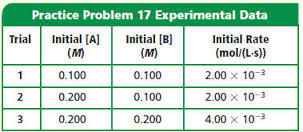
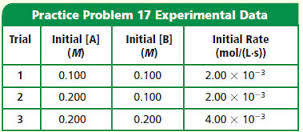


The reaction
2ClO2(aq) + 2OH-(aq) —> ClO3(aq) + ClO2-(aq) + H2O(l) was studied with the following results:
Calculate the rate constant with proper units.
230 M/s
230 M-1s-1
230 M2-s-1
rate =K[ClO2][OH-]

The following data were measured for the reaction BF3(g) + NH3(g) —> F3BNH3(g)
What is the rate law for the reaction?
rate = k[NH3]
rate = k[BF3]2[NH3]
rate = k[BF3][NH3]
rate = k[BF3][NH3]2
The decomposition of dimethylether at 504 °C is first order with a half-life of 750 seconds. What fraction of an initial amount of dimethylether remains after 3000 seconds?
1/16
1/8
1/32
1/4
Please consider the following hypothetical reaction and its experimentally determined specific rate constant, k. What overall order is this reaction?
X + Y → Z
k = 0.255 M-1 s-1
1st
2nd
3rd
can't be determined
A rate law for a reaction A + B + C → D + E is rate = k[A]2[C]. What is the rate constant if the reaction proceeds at an initial rate of 0.0082 M/s when all of the reactants have initial concentrations of 0.075M?
1.46
0.109
9.15
Please consider the following hypothetical reaction and its experimentally determined specific rate constant, k. What overall order is this reaction? X + Y → Z k = 0.255 M/s
0 order
1st order
2nd order
cannot be determined
What can be said about the stoichiometric coefficients of a balanced chemical equation for a reaction and the powers to which the concentrations are raised in the rate law expression?
There is an exact relationship between the two.
Not much can be said except that there is no necessary relationship.
The powers can be equal to the number of molecules that are formed.
The powers equal the coefficients of the equation.
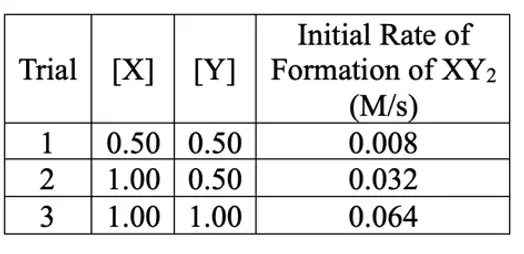
In order to determine the order of the reaction represented, the initial rate of formation of XY2 is measured using different initial values of [X] and [Y]. The results of the experiment are shown in the table. In trial 2, which of the reactants would be consumed more rapidly, and why?
X(g) + 2Y(g) → XY2(g)
X, because it has a higher molar concentration
X, because the reaction is second order with respect to Y
Y, because the reaction is second order with respect to Y
Y, because the rate of disappearance will be double that of X

