
 Worksheets
1st quarter test - 5th grade
Total questions: 50
Worksheet time: 2hrs 38mins
Science can tell you how to do something, but not whether you should?
True
False
Engineers observe things, and then attempt to explain them by conducting, or performing, experiments?
True
False
Scientists conduct experiments to test hypotheses they've made?
True
False
Scientists design and build prototypes in order to prove a hypothesis?
True
False
Which of the following are not recommended guidelines when working in a science lab or classroom (choose all that apply)?
Wear protective clothing and/or safety glasses when working with chemicals or conducting investigations.
If glassware is broken, pick it up as soon as possible.
Read and follow the directions to an investigation before performing the investigation.
Keep your workspace tidy and neat to avoid accidents.
Smell or taste unknown substances in order to find out what they are.
Which of the following is the best definition of science?
The knowledge gained from observations and experiments.
The way in which we design and build things.
The moral opinion of educated people who have studied things.
Religious beliefs that have been studied in the Bible.
1. A tire company is creating a new tire for a motorcycle to drive off-road in sandy and rocky conditions as well as on roads. Engineers developed three different tread patterns. Based on the engineering design process, the next step the company should take is to:
Send out a questionnaire about tires to the public
Select which tread design will be best
Research the properties of rubber
See which tire is the most expensive
1. Rob and his team have been chosen to build a wind turbine at a local ski resort that needs to generate electrical energy and withstand the harsh environment of the mountains. Rob and his team have done their research on the problem. What would be the next step for the team?
Create a prototype of the wind turbine
Develop possible solutions(s) for the turbine and how it will fit the criteria needed
Test the wind turbine on the mountains during the harsh winter months
Redesign a new solution for this turbine
What is a good reason for having an engineering
design process?
To be able to develop the most successful engineering product
To complete a scientific experiment
It’s the law of engineering
The products will sell for more money
Which step in the engineering design process is the final one?
Defining a problem
Developing possible solutions
Communicating results with a wider audience
Research existing solutions


Which of the following is the correct sequence (order) of the steps in the engineering and design process?
ask, imagine, plan, improve, create
ask, imagine, plan, create, improve
research, ask, imitate, build, experiment
imagine, plan, create, improve, ask
Which of the following best explains why water molecules stick together?
They have a property called traditional bonding
The clear substance in molecules acts like a glue
They have a property called cohesion
They contain tiny microbes that are "sticky"
You are going to design an indestructible kite. After doing research, you design several solutions and select the one you want to use. What are the next two steps you should do in the design process?
build a prototype and test it
build and finish full-sized kites
patent the design and sell it
evaluate your solutions and communicate results
build a prototype and so more research
The base unit of metric length.
Meter
Liter
Gram
The base unit of metric volume.
Meter
Liter
Gram
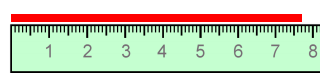
What is the length in centimeters (cm)?
7.2 cm
8.0 cm
7.4 cm
7.7 cm
The lights are off in the house; no one is home.
Inference
Opinion
Qualitative Observation
Quantitative Observation
Red and white days are better than pink days.
Inference
Opinion
Qualitative Observation
Quantitative Observation

What type of graph is this?
line graph
bar graph
circle graph

What type of graph is this?
line graph
bar graph
circle graph
Which type of graph is usually just a comparison of numbers?
line graph
bar graph
circle graph

What would most likely be the temperature at 2 1/2 minutes?
58
62
78
88
The mass of the beaker was 122 g.
Qualitative Data
Quantitative Data

The vertical axis of a line graph is called the __________.
slope
line of best fit
x-axis
y-axis

The horizontal axis of a line graph is called the __________.
slope
line of best fit
x-axis
y-axis
Which type of graph best represents data that shows a change over a period of time?
line
bar
table
circle
conclusion
Using any of your 5 senses to describe the world around you.
Observation
Inference
Quantitative Observation
Logical Theory

Observation or Inference: I think the weather is cold.
Observation
Inference

Qualitative or Quantitative: There is 300 mL of liquid in this beaker.
Qualitative Observation
Quantitative Observation

Qualitative or Quantitative: We bought 3.4 pounds of fruit.
Qualitative Observation
Quantitative Observation

Qualitative or Quantitative: I hear a rush of wind, loud yells, and metal banging together.
Qualitative Observation
Quantitative Observation

Which two of these can be observations about a gorilla?
The gorilla wants a bigger banana.
The gorilla has 5 fingers on his right hand.
The gorilla is hungry.
The gorilla has dark brown hair.

What observation could be made about the picture.
The child is feeling cold.
The child will play outside.
The child is dressed with many clothes
The child will stay warm while he is outside.

It must be summer.
Qualitative Observation
Quantitative Observation
Opinion
Inference

These kind of observations are made using instruments such as rulers, balances and thermometers.
Qualitative Observations
Quantitative Observations
Scientific Observations
Measured Observations

